

NATO leaders ramp up pressure on Turkey over S-400 missile system

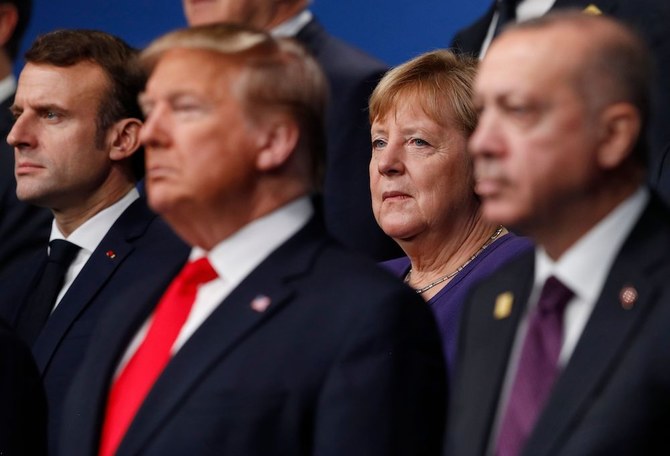
France's President Emmanuel Macron and German Chancellor Angela Merkel pose with NATO leaders including US President Donald Trump and Recep Tayyip Erdogan for the family photo at the NATO summit in London. (AFP)
Updated 05 December 2019
Follow

NATO leaders ramp up pressure on Turkey over S-400 missile system

  • Secretary General Jens Stoltenberg says Turkey's S-400 system incompatible with NATO
  • Trump said imposing sanctions on Turkey over the Russian supplied missile system

LONDON: A missile defense system bought by Turkey from Russia is “in no way compatible” with NATO’s defense, the alliance said after a fractious meeting near London came to an end on Wednesday.

Ankara’s purchase of the S-400 system and recent testing on US-made jets has strained relations with Washington and other NATO members.

The 70th anniversary meeting was also overshadowed by Turkey’s military offensive into northern Syria and an agreement with one of Libya’s warring administrations over maritime borders in the Mediterranean.

Turkey has in the past been seen as an important regional NATO member, offering a base for US military planes and nuclear payloads. But some experts say Turkey’s actions are making it increasingly incompatible with other NATO countries.

Speaking after the meeting, NATO Secretary General Jens Stoltenberg, made clear that the purchase of the missile defense system from Russia was in no way compatible with the alliance.

“That’s a national Turkish decision. Many allies have expressed concerns, I have also expressed my concerns about the consequences of that decision,” Stoltenberg said.

“A Russian air defense system, S-400, will never be integrated into NATO. It will never be part of the NATO integrated air and missile defense system.”

The US has repeatedly expressed its displeasure at the purchase, especially after Turkey started to test them against American supplied F-16 jets last month. The US has already punished Turkey by kicking it out of the F-35 joint strike fighter program. Trump said on Tuesday he was looking at imposing sanctions on Turkey over the missile system.

“The acquisition of these weapons is inconsistent with Turkey's obligations to NATO and President Trump was clear when he met with Erdogan last month and told him that this was unacceptable and inconsistent with Turkey's obligations,” Christiaan James, director of the Media Hub at the US Embassy in London said.

Turkey’s operation, launched in October against Kurdish militants in northern Syria, was also under scrutiny during the meeting at a hotel in Watford, just outside of London. Turkish President Recep Tayyip Erdogan had wanted NATO to recognize the Syrian Kurdish People's Protection Units (YPG) as terrorists, saying he would block an update to defense plans for the Baltic states and Poland if the alliance did not back him.

But after meetings between Erdogan, Trump and others, Turkey backed down and dropped its objections.

French President Emmanuel Macron has been particularly vocal in his criticism of Turkish policy in Syria. 

On Wednesday, those differences appeared unresolved by the meeting, with Macron saying they would have to "agree to disagree" over Turkey’s branding of Kurdish militias in Syria as “terrorist groups.”

“I don't see any possible consensus,” Macron said.

James said the US also expressed its concern about the incursion into northern Syria.

“We are cooperating and talking with the Turks about it, but there are differences in vision between Turkey and the United States, and this is a natural matter,” he added.

German Chancellor Angela Merkel, painted a more positive picture of the summit, which, despite some awkward exchanges in the build-up between Macron and Trump and the US president’s anger at a conversation between some leader’s mocking him, appeared to have been more successful than the disastrous event in 2018.

“The issue of defense planning for the Baltic states and Poland was also accepted by Turkey,” she said. “That was an important step. Before the meeting began, there was still disagreement.”

She said she had discussed with Macron, Erdogan and British Prime Minister Boris Johnson a proposal put forward for a UN Security Zone in northern Syria that could allow refugees to return to the area from Turkey.

“We talked about the need for the United Nations, in particular the United Nations High Commissioner for Refugees, to play a role in this process. After all, we can not accept that refugees go to an area that does not conform to the standards that the UN accepts,” she said.

Merkel added that Turkey was in discussions with the UNHCR, but said she “believes there can be no return at present to areas controlled by Syrian forces.”


Afghan barbers under pressure as morality police take on short beards

Updated 4 sec ago
Follow

Afghan barbers under pressure as morality police take on short beards

KABUL: Barbers in Afghanistan risk detention for trimming men’s beards too short, they told AFP, as the Taliban authorities enforce their strict interpretation of Islamic law with increasing zeal.
Last month, the Ministry for the Propagation of Virtue and Prevention of Vice said it was now “obligatory” to grow beards longer than a fist, doubling down on an earlier order.
Minister Khalid Hanafi said it was the government’s “responsibility to guide the nation to have an appearance according to sharia,” or Islamic law.
Officials tasked with promoting virtue “are obliged to implement the Islamic system,” he said.
With ministry officials patrolling city streets to ensure the rule is followed, the men interviewed by AFP all spoke on condition of anonymity due to security concerns.
In the southeastern province of Ghazni, a 30-year-old barber said he was detained for three nights after officials found out that one of his employees had given a client a Western-style haircut.
“First, I was held in a cold hall. Later, after I insisted on being released, they transferred me to a cold (shipping) container,” he said.
He was eventually released without charge and continues to work, but usually hides with his clients when the patrols pass by.
“The thing is that no one can argue or question” the ministry officials, the barber said.
“Everyone fears them.”
He added that in some cases where both a barber and clients were detained, “the clients have been let out, but they kept the barber” in custody.
Last year, three barbers in Kunar province were jailed for three to five months for breaching the ministry’s rules, according to a UN report.

‘Personal space’

Alongside the uptick in enforcement, the religious affairs ministry has also issued stricter orders.
In an eight-page guide to imams issued in November, prayer leaders were told to describe shaving beards as a “major sin” in their sermons.
The religious affairs ministry’s arguments against trimming state that by shaving their beards, men were “trying to look like women.”
The orders have also reached universities — where only men study because women have been banned.
A 22-year-old Kabul University student said lecturers “have warned us... that if we don’t have a proper Islamic appearance, which includes beards and head covering, they will deduct our marks.”
In the capital Kabul, a 25-year-old barber lamented that “there are a lot of restrictions” which go against his young clients’ preference for closer shaves.
“Barbers are private businesses, beards and heads are something personal, they should be able to cut the way they want,” he said.
Hanafi, the virtue propagation minister, has dismissed such arguments, saying last month that telling men “to grow a beard according to sharia” cannot be considered “invading the personal space.”

Business slump

In Afghanistan, the majority are practicing Muslims, but before the Taliban authorities returned to power in 2021, residents of major cities could choose their own appearance.
In areas where Taliban fighters were battling US-backed forces, men would grow beards either out of fear or by choice.
As fewer and fewer men opt for a close shave, the 25-year-old Kabul barber said he was already losing business.
Many civil servants, for example, “used to sort their hair a couple of times a week, but now, most of them have grown beards, they don’t show up even in a month,” he said.
A 50-year-old barber in Kabul said morality patrols “visit and check every day.”
In one incident this month, the barber said that an officer came into the shop and asked: “Why did you cut the hair like this?“
“After trying to explain that he is a child, he told us: ‘No, do Islamic hair, not English hair’.”