

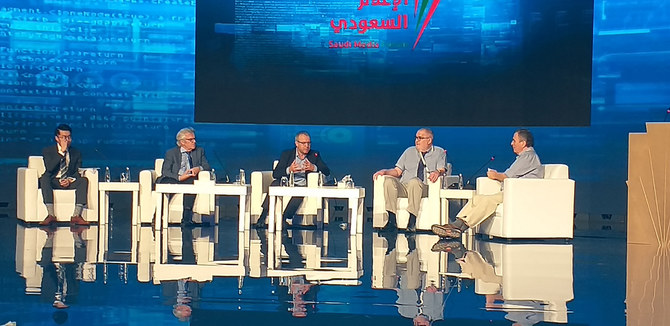
Saudi Media Forum session highlights threat posed by fake news

1 / 2
Saudi Media Forum session on War Against Fake News in progress. (AN Photo)
2 / 2
Session on War Against Fake News in progress at Saudi Media Forum in Riyadh. (AN Photo)
Updated 04 December 2019
Follow

Saudi Media Forum session highlights threat posed by fake news

  • Arab News’ Ross Anderson said disinformation is spread using online platforms and social media sites, and the greatest concern is that young people often are not able to identify it
  • Staurt Lau, Europe correspondent for the SCMP, pointed out that the flood of disinformation and rumors spread on social media by political campaigners is causing damage

RIYADH: Fake news poses a serious threat to the media industry’s values of honesty, truth and accountability, senior journalists agreed at the Saudi Media Forum in Riyadh on Tuesday.

During a panel discussion titled “The War Against Fake News,” the participants said that news organizations have a responsibility to challenge and expose false stories. There is also a need, they noted, to better teach the public, young people in particular, the media skills they need to counter the spread of disinformation.

“It is a lie and a deliberate attempt to mislead people,” Arab News Associate Editor Ross Anderson said of fake news during the session.

Disinformation is spread using online platforms and social media sites, he added, and the greatest concern about fake news is that young people often are not able to identify it. As a result, he continued, the lies are shared across social media, with everyone quoting each other without checking facts or knowing the truth.

Rainer Hermann, the Middle East editor of Deutsche Welle, echoed these sentiments and noted that fake news comes with a heavy cost to newsrooms. There is a need, he said, to debunk and delete fake news and to halt the proliferation of deliberate disinformation being spread through online news platforms and social media sites. One way to help achieve this is by emphasizing the importance of dialogue in society, he added, and another is education.

“We need to talk to each other to discuss things and find the truth instead of spreading disinformation,” he said. “Schools need to teach media skills to counter the spread of fake news.”

Hermann added that part of the problem is that many people do not question what is fake and what is real news, or attempt to find out the truth behind what they read and share online. He also singled out right-wing politicians for the role they play in spreading fake news.

Staurt Lau, Europe correspondent for the South China Morning Post, pointed out that the flood of disinformation and rumors spread on social media by political campaigners is causing damage. There are many who suggest that fake news is a matter of degree or how big the lies are, he said, but he believes it is a matter of concern. Traditional news media, print and broadcast, are not doing enough to support quality journalism and rid the profession of unethical practices, he added.

The session was moderated by author and journalist Roger Harrison, who has worked with Arab News for almost 20 years.


OpenAI’s Altman says world ‘urgently’ needs AI regulation

Updated 19 February 2026
Follow

OpenAI’s Altman says world ‘urgently’ needs AI regulation

  • Sam Altman, head of ChatGPT maker OpenAI, told a global artificial intelligence conference on Thursday that the world “urgently” needs to regulate the fast-evolving technology

NEW DELHI: Sam Altman, head of ChatGPT maker OpenAI, told a global artificial intelligence conference on Thursday that the world “urgently” needs to regulate the fast-evolving technology.
An organization could be set up to coordinate these efforts, similar to the International Atomic Energy Agency (IAEA), he said.
Altman is one of a host of top tech CEOs in New Delhi for the AI Impact Summit, the fourth annual global meeting on how to handle advanced computing power.
“Democratization of AI is the best way to ensure humanity flourishes,” he said on stage, adding that “centralization of this technology in one company or country could lead to ruin.”
“This is not to suggest that we won’t need any regulation or safeguards,” Altman said.
“We obviously do, urgently, like we have for other powerful technologies.”
Many researchers and campaigners believe stronger action is needed to combat emerging issues, ranging from job disruption to sexualized deepfakes and AI-enabled online scams.
“We expect the world may need something like the IAEA for international coordination of AI,” with the ability to “rapidly respond to changing circumstances,” Altman said.
“The next few years will test global society as this technology continues to improve at a rapid pace. We can choose to either empower people or concentrate power,” he added.
“Technology always disrupts jobs; we always find new and better things to do.”
Generative AI chatbot ChatGPT has 100 million weekly users in India, more than a third of whom are students, he said.
Earlier on Thursday, OpenAI announced with Indian IT giant Tata Consultancy Services (TCS) a plan to build data center infrastructure in the South Asian country.