

Saudi technology city developing drones

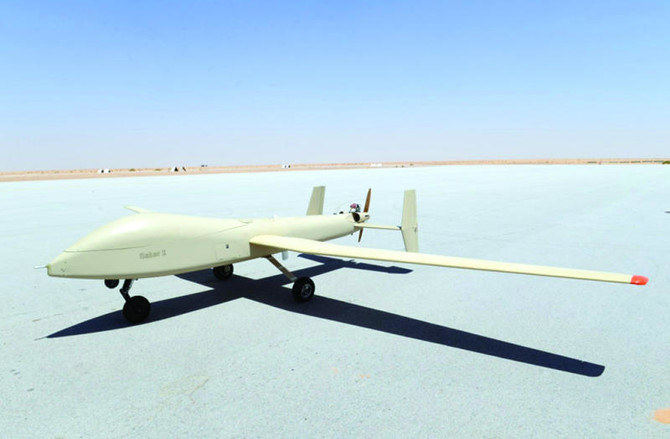
The King Abdulaziz City for Science and Technology (KACST) first unveiled the unmanned aerial vehicles that it produced in 2013. (AN file photo)
Updated 24 November 2019
Follow

Saudi technology city developing drones

  • Composite materials are used to create the UAVs
  • The company’s work is aligned with the aims of Vision 2030

DUBAI: King Abdulaziz City for Science and Technology (KACST) is enhancing its home-grown unmanned-aerial-vehicles (UAVs) — Saker-1 and Saker-4.

The medium-altitude and long-endurance drone Saker-1 has already achieved good results in preliminary tests.

It “managed to carry … up to 150 kg, managed to fly up to 15,000 ft (4.6 km) … fired a missile and a bomb with a range of 6 km,” Dr. Ali Al-Shihri, manager of the National Center for Aeronautical Technology at KACST, told Arab News.

The drone is also equipped with an Intelligence, Surveillance, Reconnaissance (ISR) system and can live stream videos during shot during the day and night, with the help of infrared radiation sensors.

Saker-4 is a smaller model of UAVs.

It is “capable of carrying about 3 kg of surveillance systems, and managed to fly up to 11,000 ft (3.6km) and reach a speed of about 120 km per hour,” Al-Shihri said.

Composite materials — such as glass fibers, carbon fibers, resin and fiber-reinforced composites — are used to create the UAVs. This decreases the weight of the devices, saves energy and prolongs flying time.

KACST is a research and development facility in Saudi Arabia that aims to employ scientific research in the development of new technologies and push them into industrial development.

Weaponized UAVs “are sensitive technologies, they need to go through different levels of certification, and pass the aviation and military standards — it’s a long process” until their industrialization, Al-Shihri said, adding that realizing the capability to build such technology is a big achievement in itself.

The company’s work is aligned with the aims of Vision 2030, including localizing technology, increasing local content, improving infrastructure and offering jobs for Saudis.

When it started its work in 2001-2003 it only had 10-20 employees; now there are about 120 Saudi engineers with different levels of certification working at the center.

“We are striving to recruit Saudi females,” Al-Shihri added.


UNESCO honors Al-Bisht Al-Hasawi as thousands flock to Al-Ahsa festival

Updated 6 sec ago
Follow

UNESCO honors Al-Bisht Al-Hasawi as thousands flock to Al-Ahsa festival

RIYADH: The third edition of Al-Bisht Al-Hasawi Festival is drawing thousands of local and international visitors to Ibrahim Palace in Al-Hofuf.

Running until Feb. 7 at the historic palace, the event features a bisht exhibition, a rare bisht gallery, a handicrafts zone and workshops led by skilled artisans.

The festival showcases a convergence of cultures, with international pavilions highlighting the global appeal of this authentic Saudi heritage. 

The bisht’s allure has drawn international visitors eager to explore Al-Ahsa’s rich history and traditional crafts.

Tourists enthusiastically don the traditional robe, admiring its royal designs. Many participate in workshops with master artisans, learning the intricate art of Zari embroidery.

Organized by the Heritage Commission, this year’s festival celebrates the inscription of the bisht on UNESCO’s Representative List of the Intangible Cultural Heritage of Humanity, the Saudi Press Agency reported.

The event showcases Al-Ahsa’s centuries-old tradition of hand-weaving and gold embroidery, a craft passed down through generations of local families.

Visitors can explore interactive displays, participate in live workshops, and witness the meticulous process of tailoring this iconic symbol of prestige.

With UNESCO’s participation and representatives from six countries, the festival has evolved into a global platform for cultural dialogue, cementing the bisht’s status as a world-class cultural treasure.

At the heart of the festival is the story of the “Golden Threads” (Al-Zari), intricate gold-plated silver threads that define the bisht’s character and prestige.

Visitors can discover them in the Golden Threads VIP Area, where they can watch master artisans demonstrate the full bisht-making process at the Host’s Majlis, offering insight into Al-Ahsa’s centuries-old craftsmanship.