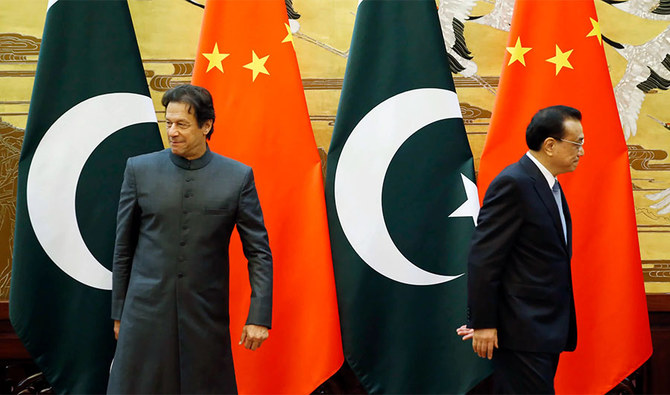
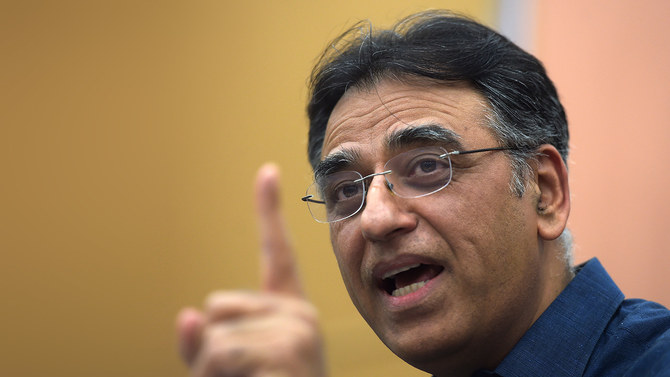
KARACHI: Pakistan’s newly appointed Minister for Planning Asad Umar on Saturday rejected US reservations on the nearly $70 billion China Pakistan Economic Corridor (CPEC) and said relations between ‘iron brothers’ Beijing and Islamabad would ‘never be frayed.’
Umar’s strong clarification came in response to remarks by US diplomat Alice Wells on Friday, who said the CPEC would further add to Pakistan’s debt burden. Wells is in charge of South Asia affairs at the US State Department.
“China is a close, time-tested friend, who stood with us during the most difficult situations. We are iron brothers and have to further strengthen the friendship and take CPEC forward to bring the relationship even closer,” Umar said at the Karachi Press Club.
“This does not mean that our friendship with China goes against anyone. All countries including the US are welcome to invest in Pakistan,” he said, and added: “We don’t want to create any situation where we become a part of the conflict between other countries.
Pakistan denied that the country was heavily in debt due to Chinese loans and said loans from China made up less than a quarter of total public debt.
“Our total public debt is $74 billion of which the Chinese debt amounts to $18 billion-- even less than one fourth of the total debt. And if I further break it down, the CPEC debt under this figure of public debt is $4.9 billion-- not even 10 percent of the total debt,” the minister said.
“As far as the money taken from China is concerned, it was taken at such a time when our trade deficit was dangerously high and our reserves were falling. We were unable to easily procure loans from other sources. This was the hallmark of China’s friendship with Pakistan that in such a time of crisis, it provided us loans from its commercial banks.”
Over the next three years, he said, debt servicing would witness about a third being spent on settling the commercial loans from China, and the commercial borrowing would be substituted by long-term, multi-lateral debt leading to a sharp decline in Chinese debt servicing.
Umar refuted Wells’ argument that the Chinese commercial loans were too expensive and had too short a payback period.
“The average maturity of public debts is 20 years. The interest on the loan is only 2.34 percent and that makes it a very cheap loan,” he said.
Umar did concede that China was making an investment in Pakistan and was not handing out aid.
“She (Alice Wells) is right-- it is basically an investment and Pakistan never said that this is aid. Pakistan’s stance is very clear that we want to move away from the dependence on aid.”
But following a systematic negation of Wells statements, Umar said it was untrue that China would be the sole benefactor of CPEC, while listing the many infrastructural and other advantages to Pakistan.


![]()
![]()

Pakistan rejects US warning on CPEC, reaffirms commitment to 'iron brother' China
Pakistan rejects US warning on CPEC, reaffirms commitment to 'iron brother' China
- Minister of planning was responding to a ‘warning’ against CPEC by US diplomat Alice Wells
- China’s share only $18 billion in Pakistan’s $74 billion total public debt, minister said
Latest updates





© 2026 SAUDI RESEARCH & PUBLISHING COMPANY, All Rights Reserved And subject to Terms of Use Agreement.