

Al-Jubeir calls for ‘deterrence not appeasement’ to halt Iranian aggression towards Saudi Arabia

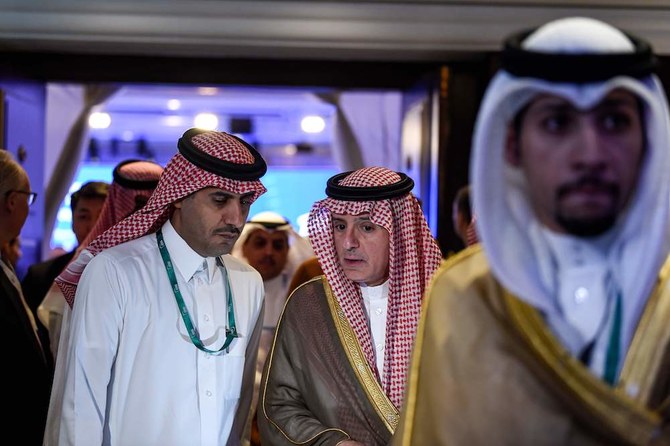
Adel Al-Jubeir told the Manama Dialogue Saturday that it was impossible to talk with Iran. (AFP)
Updated 23 November 2019
Follow

Al-Jubeir calls for ‘deterrence not appeasement’ to halt Iranian aggression towards Saudi Arabia

  • Minister of state for foreign affairs defended Riyadh’s measured response to attacks against the Kingdom's oil facilities
  • Adel Al-Jubeir said engagement with Iran had failed to work for 40 years

MANAMA: Deterrence is the only way to stop Iran from destabilizing the Middle East and attacking Saudi Arabia, the Kingdom’s minister of state for foreign affairs said Saturday.

An investigation into a drone and missile attack against Saudi oil facilities in September is still ongoing, Adel Al-Jubeir told a regional security conference in Bahrain. 

But he added that both the direction of the attack on the Abqaiq oil processing facility and Khurais oil field, and the types of weapons used meant Saudi Arabia held Iran responsible.

Al-Jubeir defended Riyadh’s measured response to the September strikes, saying the Kingdom was being “strategically very patient” in its investigation so there is “not a shadow of doubt” on where the drones and missiles came from.

“We have said all along we don't want war, so to jump into war very quickly is not a rational position,” he added.

The strikes on the oil facilities followed a series of incidents earlier this year blamed on Iran, including attacks on shipping in and near the Strait of Hormuz.

Faced with increasing US sanctions straining the Iranian economy, Tehran is accused of lashing out against its enemies in the region to prove it can disrupt global energy supplies.

The regime has also started breaking its commitments to an international deal to curb its nuclear program in response to an easing of sanctions. 

Donald Trump withdrew the US from the deal last year and immediately ramped up economic pressure on Iran. European states are scrambling to keep the deal intact.

But Al-Jubeir told the annual Manama Dialogue that deterrence, not appeasement was the only way to deal with Iran.

“The idea that perhaps engagement would cause the Iranians to change their behavior has not worked in 40 years, why would it work in the next four years,” he said. “The key to regional stability is deterrence. The key to regional stability is a steadfast position by the international community to make sure everyone has to abide by the rules of international law. 

“That’s how we can bring about a change in Iran’s behavior. If Iran wants to continue with its destructive past then sanctions should be increased, not reduced.”

Earlier, the French Defence Minister Florence Parly accused the US of failing to respond to Iran’s aggression in the region, including the shooting down of an American surveillance drone in June.

Al-Jubeir disagreed, saying the US had been a dependable ally for the past seven decades.


Saudi, Pakistan defense chiefs discuss ‘measures needed to halt’ Iranian attacks on Kingdom

Updated 07 March 2026
Follow

Saudi, Pakistan defense chiefs discuss ‘measures needed to halt’ Iranian attacks on Kingdom

RIYADH: Saudi Defense Minister Prince Khalid bin Salman and Pakistan’s  Chief of Defense Forces Asim Munir discussed Iran’s attacks on the Kingdom, amid the escalating military conflict in the Middle East. 

“We discussed Iranian attacks on the Kingdom and the measures needed to halt them within the framework of our Joint Strategic Defense Agreement,” Prince Khalid wrote on social media early on Saturday.

“We stressed that such actions undermine regional security and stability and expressed hope that the Iranian side will exercise wisdom and avoid miscalculation.”

The US and Israel began a large-scale military campaign against Iran on Feb. 28. Iran has since attacked a number of sites across the Gulf.

Tehran has also attacked US and Israeli military assets as the war as escalated, impacting lives in the peaceful Arabian Gulf peninsula and risked shaking the global economy as Iran continued restricting energy shipping along the Strait of Hormuz.

The Saudi Defense Ministry said a number of drones had been shot down that were targeting the Shayba oil field in the Empty Quarter on Saturday.

A drone attacked the US embassy in Riyadh on Tuesday causing a minor fire, but no one was hurt in the incident.

Saudi Arabia and Pakistan signed a “Strategic Mutual Defense Agreement”  in September, pledging that aggression against one country would be treated as an attack on both.

Separately, Prince Abdulaziz bin Saud bin Naif, the Saudi interior minister, received a call from his Pakistani counterpart Raza Naqvi, who condemned the blatant attacks targeting the Kingdom and affirmed his country’s solidarity in confronting any threats to the Kingdom’s security and stability, the Saudi Press Agency reported on Saturday.