
ISLAMABAD: China’s top diplomat to Pakistan on Friday lambasted the US’s warning that pursuing the China Pakistan Economic Corridor (CPEC) would economically trap and cripple the country, entangling it in a complex web of cumbersome loans.
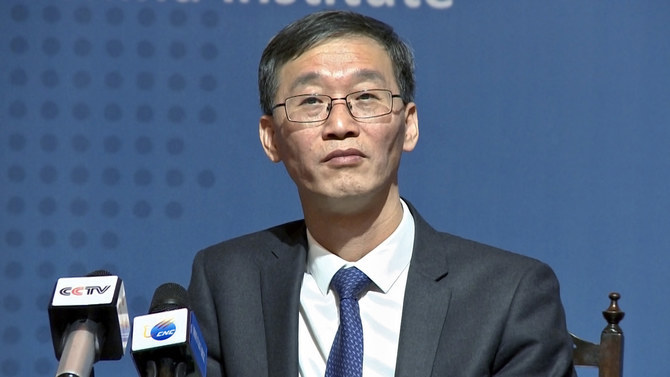
Addressing participants at the 5th CPEC Media Forum, at a talk organized by the Pakistan-China Institute (CPI), Chinese Ambassador Yao Jing criticized Alice Wells, the US principal deputy assistant secretary of the Bureau of South and Central Asian Affairs, calling her statements “propaganda and incitement.”
Speaking at the Woodrow Wilson International Center for Scholars, Wells had said the CPEC — heralded as a game-changer by both Asian countries — would only profit Beijing, and that the US offered a better model.
“It’s clear, or it needs to be clear, that CPEC is not about aid,” she said, noting that the multibillion-dollar initiative was driven by non-concessionary loans, with Chinese companies sending their own labor and material.“CPEC relies primarily on Chinese workers and supplies, even amid rising unemployment in Pakistan.”
The corridor “is going to take a growing toll on the Pakistani economy, especially when the bulk of payments start to become due in the next four to six years,” she added.
Jing, flanked by notable Pakistani panelists including Senator Mushahid Hussian, chairman of the CPI, said Pakistan’s “biggest creditor is the West, not China”.
He asked the audience: “Have you found any occasion that the Chinese government came asking you (Pakistan) to pay back our (China’s) money? China will never ask for this kind of repayment as long as you are in need.
“The US is the biggest loan taker in the world. Even China has given them credit of $3 trillion. They are extending aid to other countries, but I would like to ask them why they have suspended their assistance (to Pakistan) for political purposes.”
The US has gone on the offensive against China’s Belt and Road Initiative (BRI), a signature project of President Xi Jinping which aims to build ports, highways and railways around the world.
But Wells’ speech was unusually specific in warning of risks to Pakistan, a historical ally of the US but which has had a turbulent relationship with Washington in recent years over Islamabad’s ties with Islamist militants.
CPEC, which is valued at well over $60 billion, is a part of the BRI, with the two phases under discussion related to key infrastructure and development plans.
“In today’s forum I was supposed to talk about the media’s role in promoting state-to-state relations, and its role in consolidating China-Pakistan friendship,” Jing added. “Unfortunately a (US official) early this morning talked about CPEC in Washington … which shocked and surprised me.
“For a high-level government official of the US State Department, it is not appropriate for her to comment and communicate her official position (on CPEC) based on media reports.”
Jing questioned Wells’ statement and said: “Have the Americans approached us or approached the Pakistani government to check the real cost of this project? So far, I can say, I am not clear on the real cost. Why? Because it is under discussion.
“If you (the US) are citing these media reports as your policy basis or your policy foundation to say that China’s project is costly, I won’t accept it.
“Last month when Prime Minister Imran Khan visited China, he told our leadership that CPEC is the top priority of the Pakistani government. The Chinese President said that the Chinese government, as always, attaches great importance to the success of the CPEC.”