

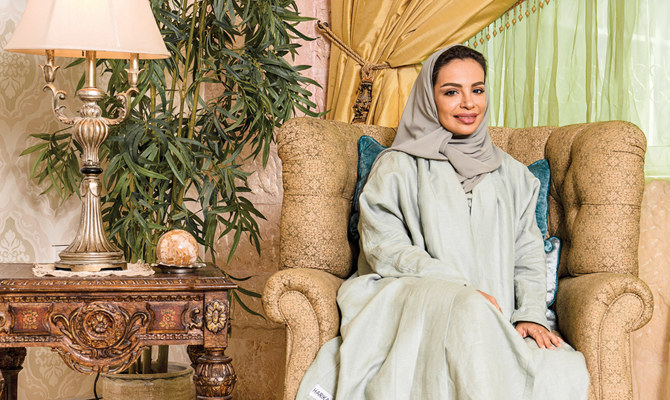

Najla Abdullah I am an executive member of the Young Businesswomen Council at the Asharqia Chamber. I am also a certified artist trainer and I am attending the Academy of Learning in Dammam, where I am studying public relations and media.
I have founded a number of art initiatives and projects. Art is in my blood. It is the field where I think I can inspire others and leave a good impression.
I am 32 years old, and I was born in Dhahran to a family interested in education and developing hobbies. My father studied business administration in the US while my mother specialized in geography. I am the middle child of nine — I have four sisters and four brothers. We are a family of with a wide range of interests; my parents gave us the freedom to choose what to study, encouraging us to choose academic and career paths that would suit our personalities.
I began my elementary schooling at the Fifth Primary School before joining the Third Middle School. After that, I attended the secondary-level section of King Abdul Aziz National Schools in Alkhobar.
Following my high school graduation, I took a number of engineering, art and fashion courses before continuing my academic journey.
I am always ready to try new things. I like to experience things that may not be in my field of work — I am always seeking new information and knowledge. Whenever I finish a certain project, I’m usually already thinking about the next one.
To me, work should also mean fun. It is important that I enjoy what I’m doing. Otherwise, I’ll try a more joyful thing.
Art is in my blood. It is the field where I think I can inspire others and leave a good impression.
As an art aficionado whose job mainly relies on visual feedback and the aesthetic aspects of life, I try to shift unpleasant situations around me into something beautiful and positive that can help me. Beautiful music in my workplace, for instance, makes me more productive and creative. It can also inspire me to be more innovative.
With the generous support of the deputy governor of the Eastern Province, Prince Ahmed bin Fahd Al-Saud, and the kind help of the King Abdul Aziz Center for World Culture (Ithra), I had the chance to provide an artwork for Sharqiah Season. The project was based around illuminated boats in the sea. The idea of my project was to show visitors to the region one of the city’s landmarks. I was delighted by the appreciation from both officials and visitors. That project was an achievement I will always remember with pride.
I believe the quotes of great people who have lived before us are worth heeding — they summarize years of experience. There is a particular wise saying that really resonates with me: “Life is made of experiences. So, the end of an experience is only the end of that experience, not the end of life.”


