WASHINGTON: The US House launched the first public hearing Wednesday of Donald Trump’s impeachment investigation, the extraordinary process to determine whether the 45th president of the United States should be removed from office.
Rep. Adam Schiff, the Democratic chairman of the House Intelligence Committee, immediately outlined the question at the core of the impeachment inquiry — whether the president used his office to pressure Ukraine officials for personal political gain.
“The matter is as simple and as terrible as that,” Schiff said. “Our answer to these questions will affect not only the future of this presidency but the future of the presidency itself, and what kind of conduct or misconduct the American people may come to expect from their commander in chief.”
It was a remarkable moment, even for a White House full of them. The hearing is the first chance for America, and the rest of the world, to see and hear for themselves about Trump’s actions toward Ukraine and consider whether they are, in fact, impeachable offenses.
The top Republican on the panel, Rep. Devin Nunes of California, accused the Democratic majority of conducting a “scorched earth” effort to take down the president after the special counsel’s Russia investigation into the 2016 election failed to spark impeachment proceedings.
“We’re supposed to take these people at face value when they trot out new allegations?” said Nunes, a top Trump ally. He derided what he called the “cult-like atmosphere in the basement of the Capitol” where investigators have been interviewing witnesses behind closed doors for weeks. Transcripts of those interviews have been released.
Nunes called the Ukraine matter a “low rent” sequel to the Russia probe. “Democrats are advancing their impeachment sham,” he said.
The proceedings were being broadcast live, and on social media, from a packed hearing room on Capitol Hill. The country has been here only three times before, and never against the 21st century backdrop of real-time commentary, including from the Republican president himself.
Testifying will be two seasoned diplomats, William Taylor, the graying former infantry officer now charge d’affaires in Ukraine, and George Kent, the deputy assistant secretary in Washington, telling the striking, if sometimes complicated story of a president allegedly using foreign policy for personal and political gain ahead of the 2020 election.
So far, the narrative is splitting Americans, mostly along the same lines as Trump’s unusual presidency. The Constitution sets a dramatic but vague bar for impeachment, and there’s no consensus yet that Trump’s actions at the heart of the inquiry meet the threshold of “high crimes and misdemeanors.”
Trump calls the whole thing a “witch hunt,” a retort that echoes Nixon’s own defense. “READ THE TRANSCRIPT,” he tweeted Wednesday.
At its core, the inquiry stems from Trump’s July 25 phone call with Ukraine’s newly elected president, Volodymyr Zelenskiy when he asked the Zelenskiy for “a favor.”
Trump wanted the Ukraine government to investigate Democrats in the 2016 election and his potential 2020 rival, Joe Biden, all while holding as leverage military aid the young democracy relies on as it confronts an aggressive Russia.
An anonymous whistleblower first alerted officials to concerns about the phone call. The White House released a rough transcript of the conversation, with portions deleted.
Democratic House Speaker Nancy Pelosi was initially reluctant to launch a formal impeachment inquiry. But she pressed ahead in September after the whistleblower’s complaint.
The White House has instructed administration officials not to testify in the inquiry. But over the past month, witness after witness has appeared behind closed doors to tell the investigators what they know.
Most received subpoenas to appear, and both Taylor and Kent had fresh subpoenas Wednesday.
Trump lashed out at the witnesses, tweeting they were “NEVER TRUMPERS,” but the two are career diplomats working for both Republican and Democratic administrations. There’s no evidence they engaged in partisan activity opposing Trump.
Whether Wednesday’s proceedings begin to end a presidency or help secure Trump’s position, it was certain his chaotic term had finally arrived at a place he could not control and a force, the constitutional system of checks and balances, that he could not ignore.
Unlike the Watergate hearings and Richard Nixon, there is not yet a “cancer-on-the-presidency” moment galvanizing public opinion. Nor is there the national shrug, as happened when Bill Clinton’s impeachment ultimately didn’t result in his removal from office. It’s perhaps most like the partisanship-infused impeachment of Andrew Johnson after the Civil War.

Democrats, Republicans assail each other as Donald Trump impeachment opens in Washington
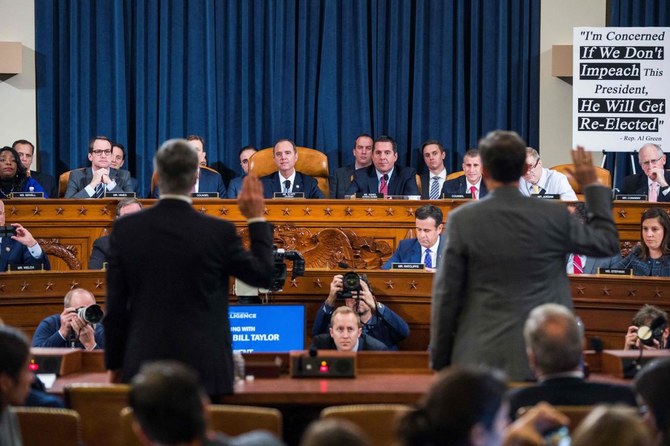
- The proceedings being broadcast live and on social media
- The White House has instructed administration officials not to testify in the inquiry
‘People will vote for us’: Bangladesh’s Tarique Rahman confident of win in landmark election
- In first 180 days, Tarique Rahman plans democratic reform, restoring law and order, focusing on job creation
- He says he admires Vision 2030, wants to visit Kingdom as one of the first countries and perform Umrah
DHAKA: After almost two decades in self-exile, Tarique Rahman, the leader of the Bangladesh Nationalist Party, is expecting victory in Thursday’s election following a change in regime that for years restricted his supporters’ voting rights.
Rahman left Bangladesh in 2008 and settled in London, facing various convictions brought against him by the administration of Sheikh Hasina, the BNP’s archenemy who led the country until mid-2024, when she was toppled in a student-led uprising.
He returned in late December, received by millions of people who lined his route from the airport to the center of Dhaka. He believes they will back his party at the polls.
“BNP is the most popular party in the country. We have been struggling for the people’s voting rights for more than 17 years. We represent the people’s expectations and aspirations,” he told Arab News in Dhaka on Tuesday.
“I believe the people will vote for us and, inshallah, we will achieve a landslide victory.”
Rahman, 60, is the son of BNP’s founder, Ziaur Rahman, a 1971 Liberation War hero, who became president in 1977. After his assassination in 1981, Rahman’s mother, Khaleda Zia, took over the party’s helm and in 1991 became the country’s first woman prime minister.
Rahman assumed the BNP’s chairmanship following her death from a prolonged illness, just days after his return to Bangladesh.
In Thursday’s election, the BNP will race against another 50 parties, including Bangladesh Jamaat-e-Islami, which is forecast to emerge as the main opposition party in the next government. The Awami League, led by the ousted premier Hasina, has been banned from contesting, following deadly unrest that led to the party’s removal from power in August 2024.
An interim administration led by Nobel laureate Muhammad Yunus, which has been tasked with preparing the general election, banned Awami League’s activities, citing national security and a war crimes investigation against the party’s top leadership.
The UN Human Rights Office has accused the former government and its security apparatus of systematic rights violations to suppress the student-led protests between July 15 and Aug. 5, 2024. An estimated 1,400 people were killed.
If Rahman wins the election, he wants his administration to pursue accountability for the former leadership and meet the political and economic expectations of the youth movement that brought about the change.
In the first six months, his party’s immediate priorities include restoring law and order, democratic reform and creating a business-friendly environment.
“Our 180-day program includes development plans across key sectors, including employment for 10 million people,” he said.
“We will also accelerate private sector growth, ensure employment-oriented economic recovery and develop the blue economy. We will focus heavily on the ICT sector and AI-driven technological innovation.”
In international cooperation, he will prioritize partnerships with Gulf Cooperation Council countries, especially Saudi Arabia — home to more than 3 million Bangladeshis — with whom strong commercial relations were established during his father’s rule, and which is likely to be one of the first countries he would visit if he becomes prime minister.
“The highest number of Bangladeshi migrant workers are employed in Saudi Arabia, and the remittances they send significantly contribute to our economy,” he said.
“I admire the Saudi Vision 2030, and I am sincerely looking forward to working with the leadership of the Kingdom of Saudi Arabia ... I would definitely like to visit Saudi Arabia early in my term. Personally, I also wish to visit the holy mosque, Al-Masjid Al-Haram, Makkah, to perform Umrah.”
In relations with other countries, especially the regional powers India and Pakistan, the BNP government’s policy would be guided by national interest, which “is not about any specific country,” Rahman said.
“We want good relations with all our foreign friends, particularly our neighbors. We are committed to building relations of equality, cooperation and friendship with our neighbors. The foundation of that relationship will be mutual respect and understanding, which will ensure our collective progress.”
Exchanges with Pakistan, from which Bangladesh gained independence in 1971, have improved following Hasina’s removal — after decades of unease. At the same time, ties with India, where the former premier fled after the 2024 unrest, have since deteriorated.
In November, a special tribunal in Dhaka convicted the former prime minister of crimes against humanity, and Bangladesh requested that the Indian government extradite her.
“We want to establish justice in the country,” Rahman said. “No one is above the law. Anyone who has committed crimes must face trial. This is not about any specific political party; it is about justice and rule of law.”
During Hasina’s time in office, Rahman faced multiple corruption cases — allegations he has denied, saying they were politically motivated.
“There were so many false charges filed against me, and the situation in the country was not stable in terms of law and order,” he said. “Despite all the odds — as I have committed and communicated to my countrymen and women — I have returned back to my beloved Bangladesh before the historic national election and (I am) looking forward to it eagerly.”


