
SANTIAGO, Chile: Protests against social inequality continued for a 26th day with huge demonstrations across Chile and a national strike that brought much of the country to a standstill Tuesday, while the value of the national currency fell to a record low.
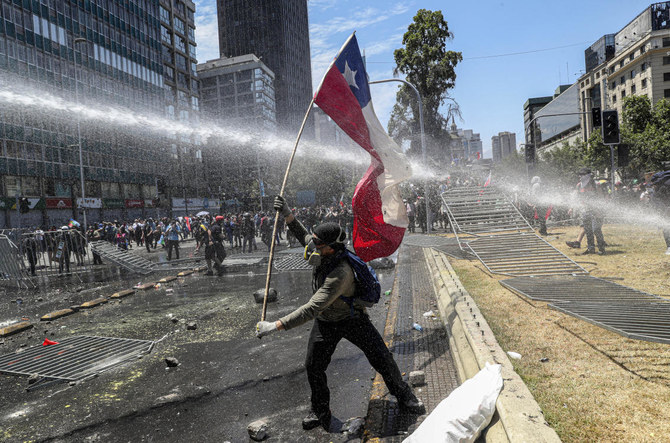
Thousands of people marched peacefully in Santiago, congregating in the central meeting place of Plaza Italia waving the flags of Chile and the Mapuche indigenous group, with whistles and music rising in the air. After nightfall, the demonstrators lighted up the gathering with cellphone screens and green laser light.
But groups of hooded protesters in the capital also fought with police, who responded with water cannons and tear gas. A church in the Lastarria tourist district was ransacked and set on fire Tuesday night, and there were reports of looting at restaurants and shops.
The strike drew widespread participation across the country, generating a holiday atmosphere in many cities. Classes were canceled and some government offices scaled back their services. Some shop and restaurants also were looted.
The coastal city of Valparaíso ground to a halt, with government offices and public and private transport shut down. Protesters threw rocks at some shops in the morning, prompting many to remain closed, while hooded agitators erected barricades and looted. People hurled rocks at the Hotel O’Higgins, an iconic building in Viña del Mar, and ransacked one of the main grocery stores.
Large demonstrations also occurred to the south, in Concepción, where a government building was evacuated after a fire broke out. In Antofagasta, in the north, barricades impeded traffic, while in Punta Arenas, in the Patagonia region, hundreds of people took to the streets to express their anger.
Silvia Silva, a demonstrator in Santiago, called the strike “historic” and one that “will mark a before and after in our country” as Chileans continue to push for a new constitution drawn up with the direct input of citizens.
“No more abuse. Today we are saying enough, in the most peaceful way possible, to politicians and to those who are in charge of drafting laws in our country,” said Luis Casas, who was at her side.
Karla Rubilar, the government spokeswoman, said, “A strike is not the road forward.”
Chile is one of the wealthiest countries in Latin America, but it is also one of the most unequal, with a swath of basic services privatized.
A student protest over rising subway fares Oct. 18 has grown into a broad movement demanding reforms to education, health care and pensions. It has been a mostly peaceful movement, though there have been violent clashes between demonstrators and police. Twenty people have been killed and the National Institute of Human Rights in Chile has documented more than 2,000 injuries.
The government of President Sebastián Piñera has responded with a package of social improvements, and on Sunday announced a plan to overhaul the constitution that was enacted during the dictatorship of Gen. Augusto Pinochet. But Piñera’s proposals have not appeased protesters, who demand a bigger role in reformulating the country’s legal principles.
The demonstrations have had an economic cost, too. The National Chamber of Commerce Services and Tourism of Chile estimates up to 100,000 jobs could be lost.
On Tuesday, the Chilean currency continued its downward slide, hitting a record 800 pesos per US dollar. Prior to the demonstrations, it had hovered around 700 to 720 pesos. It closed Tuesday at 781 pesos.
Treasury Minister Ignacio Briones said the depreciation “is a sign of the instability that we are experiencing.”