

Bangladesh train collision kills at least 16, toll could rise

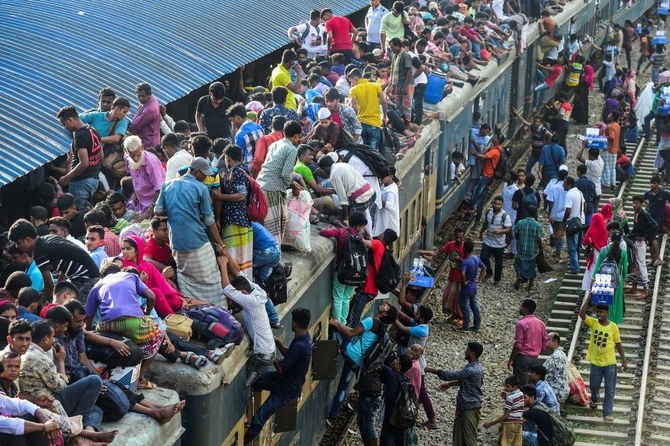
Railway accidents in Bangladesh happen relatively frequently, many at unsupervised crossings, and also because of the poor condition of tracks. (AFP file photo)
Updated 12 November 2019
Follow

Bangladesh train collision kills at least 16, toll could rise

  • Most passengers were asleep at the time of the crash
  • Railway accidents in Bangladesh happen relatively frequently, many at unsupervised crossings, and also because of the poor condition of tracks

DHAKA: Rescuers in Bangladesh were struggling on Tuesday to pull passengers from mangled wreckage after a head-on collision of two trains killed at least 16 people and injured more than 40, officials said.

A train heading for the southern port city of Chittagong and one bound for Dhaka collided at around 3 a.m. (2100 GMT) in Brahmanbaria, about 100 kilometers east of the capital, crumpling three compartments of the southbound train.

“When I came out of the train, I saw dead bodies without heads, without legs, without hands,” Mohammad Muslim, 50, who was among the passengers, many of them asleep at the time, told Reuters by telephone.

“We were so close to death, but Allah saved us,” added Muslim, who was riding on the train headed for the port.

“Suddenly there was a big bang. I saw people were screaming,” one of those on the train going to Dhaka said in television footage.

Television broadcast images of doctors treating people for broken limbs and head injuries at hospitals.

“So far, 16 bodies have been recovered,” district official Hayat Ud Dowlah Khan told Reuters by telephone, warning that the toll could rise during the rescue effort by fire, police, border guard and army officials.

“More than 40 injured people have been admitted in hospitals,” Khan said, with some in critical condition.

Prime Minister Sheikh Hasina expressed shock and sorrow at the injuries and loss of lives, urging officials and the public to provide support for the victims.

It was not immediately clear how the two trains came to be on the same track, and the government has ordered an investigation.

“One of the trains might have violated the signal, leading to the tragedy,” one police official, Shayamal Kanti Das, told reporters.

Railway accidents in Bangladesh happen relatively frequently, many at unsupervised crossings, and also because of the poor condition of tracks.


In rare overlap, Chinese Muslims observe Ramadan with Lunar New Year

Updated 6 sec ago
Follow

In rare overlap, Chinese Muslims observe Ramadan with Lunar New Year

  • Lunar New Year started on Feb. 17 and is celebrated for another two weeks
  • Chinese Indonesians make up about 3 percent of the Indonesian population

JAKARTA: Every year, on the first day of Lunar New Year, Febriani visits relatives and gathers for a feast with her Chinese Muslim family, part of a long-standing tradition honoring their ethnic heritage.

But this year, as Thursday marks the beginning of Ramadan, she is celebrating two important occasions within the same week, in a rare overlap that last took place in 1995.

“I’m very happy and grateful that Lunar New Year and Ramadan are celebrated so closely. I observe both every year, so it’s truly special,” she told Arab News.

Widely observed across Asia, the Lunar New Year or Chinese New Year festival is believed to date back to the 14th century B.C., to the times of the Shang Dynasty, China’s earliest ruling dynasty, when people celebrated good harvests.

In 2026, it started on Feb. 17 and is celebrated for another two weeks. For many, celebrations typically involve elaborate feasts, giving children pocket money in red envelopes, and watching dragon dance parades.

In Indonesia, Chinese-descent citizens make up an estimated 3 percent of the country’s Muslim-majority population of more than 280 million. While most are either Buddhists or Christians, a small minority professes Islam.

For 25-year-old Febriani, both Lunar New Year and Ramadan are equally meaningful.

“The two celebrations teach us to strengthen bonds, to share with one another, and to become closer to family,” she said.

“They are both important to me because they happen only once every year and they’re always an occasion to gather with the extended family. It is also a chance to self-reflect and strengthen relationships with your loved ones.”

For Naga Kunadi, whose family lives in Central Java’s Cepu district, Chinese New Year is all about embracing his ethnic identity.

Earlier in the week, his family was busy preparing for the new year’s feast, which was a fusion of Chinese and Indonesian dishes, such as claypot tofu, meatball soup and shumai, or steamed dumplings.

“To celebrate Chinese New Year, we prepared halal Chinese food at home. It’s also a way to introduce to my children the traditions from our Chinese side, but there’s a bit of a fusion because my wife is Javanese,” Kunadi told Arab News.

Kunadi, an Islamic teacher at the Lautze Mosque in Jakarta, sees both Chinese New Year and Ramadan as opportunities to teach important life values for his two children. 

Upholding Chinese New Year traditions with his family is for him a way of preserving his ethnic heritage.

“We want to preserve cultural values as long as it does not clash with our religion,” he said.

“If we leave our culture behind, we might lose our identity, so this is something I want to teach my children.”

The fasting month of Ramadan, on the other hand, gives him a chance to teach and practice honesty.

“I want to focus on the religious and moral aspects during the holy month of Ramadan, when we practice honesty on a personal level,” Kunadi said.

“There’s always an opportunity to eat or snack in secret without anybody knowing, but we train ourselves not to do that. For me, Ramadan is a time for everyone to put honesty into practice, including myself and my children.”