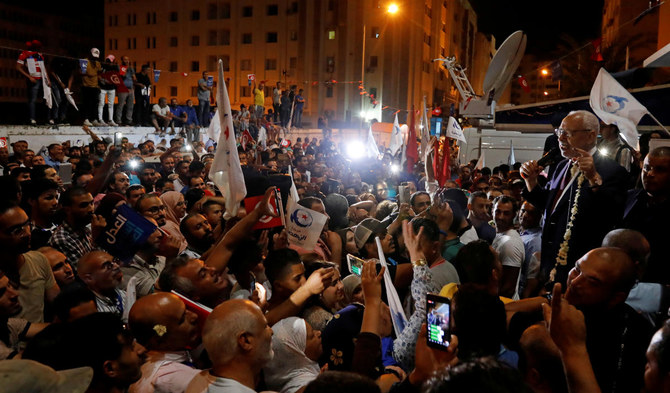
TUNIS: Tunisia’s Islamist-inspired Ennahdha party which last month came top in legislative polls put forward its leader Rached Ghannouchi on Sunday to head the next parliament.
Ennahdha, which won 52 out of 217 seats in October’s parliamentary election — well short of the 109 needed to govern — also insisted that the new prime minister of Tunisia should be selected from the party.
Ghannouchi, a divisive figure and veteran leader of Ennahdha, was proposed as candidate for speaker of parliament by the party’s Shoura Council, according to council chief Abdelkarim Harouni.
Ghannouchi has led Ennahdha since it was founded almost 40 years ago, carrying the movement to victory in a 2011 election, just months after the party reemerged from underground following the revolution that ousted autocrat Zine El Abidine Ben Ali.
He has never run for office but won a parliamentary seat in Tunis in the October 6 legislative polls.
Harouni on Sunday reiterated that Ennahdha wants one of its own figures to head the new government in the North African country.
The Islamist-inspired party has until Friday to announce its candidate for the premiership.
Ennahdha has been holding negotiations with other political groups to form a new government.
But Harouni said “certain parties want to deprive the winner of the legislative election” from heading the cabinet.
Tunisia’s new parliament is expected to hold its first full session on Wednesday.
The legislative polls were held between the first and second round of Tunisia’s presidential election which was won by political outsider Kais Saied, a conservative academic.

Tunisia’s Islamist-inspired party wants leader to be house speaker
Six dead as Gaza’s displaced struggle in torrential rain
- Five people, including two women and a girl, die when homes collapsed near Gaza City
- One-year-old boy died of extreme cold in a tent in Deir Al-Balah in central Gaza
CAIRO/GAZA: A rainstorm swept across the Gaza Strip on Tuesday, flooding hundreds of tents, collapsing homes sheltering families displaced by two years of war and killing at least six people, local health officials said.
Medics said five people, including two women and a girl, died when homes collapsed near Gaza City’s beach, while a one-year-old boy died of extreme cold in a tent in Deir Al-Balah in central Gaza.
Tents were torn from their stakes, some flying dozens of meters before crashing to the ground. Others lay crumpled in muddy pools as families scrambled to salvage what they could. Residents tried to re-secure remaining shelters, hammering in loosened pegs and stacking sandbags around the edges to keep floodwaters from pouring inside.
“We didn’t realize what was happening until the wall started collapsing — an eight-meter-high wall, a strong concrete wall. Because of the speed and force of the wind, the wall fell on top of us, onto three tents,” said Bassel Hamuda, a displaced man in Gaza.
“The elderly man, 73 years old, was martyred. His son’s wife was killed, and his son’s daughter was killed,” he told Reuters.
Three months since a ceasefire halted major combat, Israeli forces have ordered the near-total depopulation of nearly two thirds of Gaza, forcing its more than 2 million people into a narrow strip near the coast where most live either in makeshift tents or damaged buildings.
RELATIVES GATHER AT MORGUE
Dozens of relatives gathered at a hospital morgue on Tuesday for special prayers over bodies laid on medical stretchers before the funerals.
The Hamas-run Gaza government media office said at least 31 Palestinians had died since the start of the winter season from exposure to cold or the collapse of unsafe buildings damaged by previous Israeli strikes.
It said about 7,000 tents were damaged in the past 48 hours, most of whose occupants have no alternative shelter.
Municipal and civil defense officials said they were unable to cope with the storm because of fuel shortages and damaged equipment. During the war Israel had destroyed hundreds of vehicles needed to respond to the weather emergency, including bulldozers and water pumps.
In December, a UN report said 761 displacement sites hosting about 850,000 people were at high risk of flooding, and thousands had moved in anticipation of heavy rain.
UN and Palestinian officials said at least 300,000 new tents were urgently needed for the roughly 1.5 million people still displaced. Most existing shelters are worn out or made of thin plastic and cloth sheeting.
“In Gaza, winter weather is adding to the suffering of families already pushed to the brink by over two years of war,” UNRWA, the UN Palestinian refugee agency, said in a post on X on Tuesday.
“Flooding, cold temperatures, and damaged shelters are exposing displaced people to new risks, while humanitarian access remains severely constrained,” it added.
In a statement on Tuesday, Hamas urged mediators of the Gaza ceasefire deal that began in October to compel Israel to allow the unconditional flow of aid, shelter, and rebuilding materials.
Israel says hundreds of trucks enter Gaza daily carrying food, medical supplies and shelter equipment. International aid organizations say the supplies are still insufficient.
Medics said five people, including two women and a girl, died when homes collapsed near Gaza City’s beach, while a one-year-old boy died of extreme cold in a tent in Deir Al-Balah in central Gaza.
Tents were torn from their stakes, some flying dozens of meters before crashing to the ground. Others lay crumpled in muddy pools as families scrambled to salvage what they could. Residents tried to re-secure remaining shelters, hammering in loosened pegs and stacking sandbags around the edges to keep floodwaters from pouring inside.
“We didn’t realize what was happening until the wall started collapsing — an eight-meter-high wall, a strong concrete wall. Because of the speed and force of the wind, the wall fell on top of us, onto three tents,” said Bassel Hamuda, a displaced man in Gaza.
“The elderly man, 73 years old, was martyred. His son’s wife was killed, and his son’s daughter was killed,” he told Reuters.
Three months since a ceasefire halted major combat, Israeli forces have ordered the near-total depopulation of nearly two thirds of Gaza, forcing its more than 2 million people into a narrow strip near the coast where most live either in makeshift tents or damaged buildings.
RELATIVES GATHER AT MORGUE
Dozens of relatives gathered at a hospital morgue on Tuesday for special prayers over bodies laid on medical stretchers before the funerals.
The Hamas-run Gaza government media office said at least 31 Palestinians had died since the start of the winter season from exposure to cold or the collapse of unsafe buildings damaged by previous Israeli strikes.
It said about 7,000 tents were damaged in the past 48 hours, most of whose occupants have no alternative shelter.
Municipal and civil defense officials said they were unable to cope with the storm because of fuel shortages and damaged equipment. During the war Israel had destroyed hundreds of vehicles needed to respond to the weather emergency, including bulldozers and water pumps.
In December, a UN report said 761 displacement sites hosting about 850,000 people were at high risk of flooding, and thousands had moved in anticipation of heavy rain.
UN and Palestinian officials said at least 300,000 new tents were urgently needed for the roughly 1.5 million people still displaced. Most existing shelters are worn out or made of thin plastic and cloth sheeting.
“In Gaza, winter weather is adding to the suffering of families already pushed to the brink by over two years of war,” UNRWA, the UN Palestinian refugee agency, said in a post on X on Tuesday.
“Flooding, cold temperatures, and damaged shelters are exposing displaced people to new risks, while humanitarian access remains severely constrained,” it added.
In a statement on Tuesday, Hamas urged mediators of the Gaza ceasefire deal that began in October to compel Israel to allow the unconditional flow of aid, shelter, and rebuilding materials.
Israel says hundreds of trucks enter Gaza daily carrying food, medical supplies and shelter equipment. International aid organizations say the supplies are still insufficient.
© 2026 SAUDI RESEARCH & PUBLISHING COMPANY, All Rights Reserved And subject to Terms of Use Agreement.