China raises annual rare earth output quotas to record high

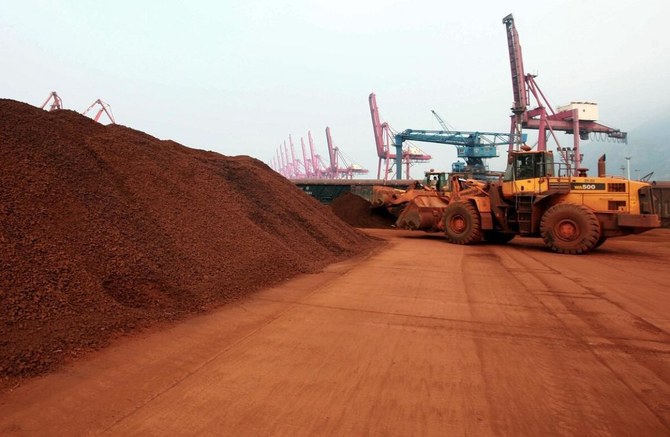
A front loader shifts soil containing rare earth minerals to be loaded at a port in Lianyungang, in east China's Jiangsu province, for export. (AFP)
Updated 08 November 2019
Follow

China raises annual rare earth output quotas to record high

  • Annual quotas for 2019 are highest volumes ever allocated
  • Beijing had raised prospect of limiting supply in US trade row

BEIJING: China lifted its annual rare earth output quotas on Friday by 10% to record-high levels for 2019, potentially easing fears the world’s dominant producer of the group of 17 prized minerals will restrict supply.
Beijing in late May raised the prospect of weaponizing its control of rare earths, used in everything from consumer electronics to sophisticated military equipment, in its trade war with the United States but has yet to announce any formal restrictions.
China is home to at least 85% of global rare earth processing capacity, according to Adamas Intelligence.
The full-year rare earth mining quota has been set at 132,000 tons for 2019 and the smelting and separation quota at 127,000 tons, the Ministry of Industry and Information Technology said in a statement.
The quotas, up from 120,000 tons and 115,000 tons, respectively, in 2018, are the “highest volume ever allocated” David Merriman, a London-based manager at commodity research firm Roskill, said in an email.
China has now increased the allowances for two years in a row and an official at the Association of China Rare Earth Industry confirmed the numbers were record highs.
They imply a quota of 72,000 tons for mining in the second half of 2019, up more than 54% from an unusually low level a year earlier.
For smelting and separation, or the processing of ore into material manufacturers can use, the second half quota is 69,500 tons.
The quota hikes could be seen as a message that China has “the capability to increase supply, making life difficult for (rare earths) under development in regions such as the Americas, EU and Australia,” Roskill’s Merriman said.
But it likely “has much more to do with the domestic Chinese supply-chain situation,” he added, noting that China had been increasingly looking overseas for feedstock amid an environmental crackdown at home.
The move will allow state-run miners and processors to “legally maintain market share,” Merriman said.
China typically issues the rare earth quotas twice a year for six-month periods. In March, the first-half quotas were set at 60,000 tons for mining and 57,500 tons for smelting and separation.
The late release of the full-year quotas comes as Beijing and Washington work to iron out the details on a so-called “phase one” deal to end trade hostilities.
China’s rare earth exports in October rose by 1.9% from the previous month to 3,639 tons, according to customs data released earlier on Friday.


How AI and financial literacy are redefining the Saudi workforce

Updated 26 December 2025
Follow

How AI and financial literacy are redefining the Saudi workforce

  • Preparing people capable of navigating money and machines with confidence

ALKHOBAR: Saudi Arabia’s workforce is entering a transformative phase where digital fluency meets financial empowerment. 

As Vision 2030 drives economic diversification, experts emphasize that the Kingdom’s most valuable asset is not just technology—but people capable of navigating both money and machines with confidence.

For Shereen Tawfiq, co-founder and CEO of Balinca, financial literacy is far from a soft skill. It is a cornerstone of national growth. Her company trains individuals and organizations through gamified simulations that teach financial logic, risk assessment, and strategic decision-making—skills she calls “the true language of empowerment.”

An AI-driven interface showing advanced data insights, highlighting the increasing demand for leaders who can navigate both technology and strategy. (creativecommons.org)

“Our projection builds on the untapped potential of Saudi women as entrepreneurs and investors,” she said. “If even 10–15 percent of women-led SMEs evolve into growth ventures over the next five years, this could inject $50–$70 billion into GDP through new job creation, capital flows, and innovation.”

Tawfiq, one of the first Saudi women to work in banking and later an adviser to the Ministry of Economy and Planning on private sector development, helped design early frameworks for the Kingdom’s venture-capital ecosystem—a transformation she describes as “a national case study in ambition.”

“Back in 2015, I proposed a 15-year roadmap to build the PE and VC market,” she recalled. “The minister told me, ‘you’re not ambitious enough, make it happen in five.’” Within years, Saudi Arabia had a thriving investment ecosystem supporting startups and non-oil growth.

Opinion

This section contains relevant reference points, placed in (Opinion field)

At Balinca, Tawfiq replaces theory with immersion. Participants make business decisions in interactive simulations and immediately see their financial impact.

“Balinca teaches finance by hacking the brain, not just feeding information,” she said. “Our simulations create what we call a ‘business gut feeling’—an intuitive grasp of finance that traditional training or even AI platforms can’t replicate.”

While AI can personalize lessons, she believes behavioral learning still requires human experience.

Saudi women take part in a financial skills workshop, reflecting the growing role of financial literacy in shaping the Kingdom’s emerging leadership landscape. (AN File)

“AI can democratize access,” she said, “but judgment, ethics, and financial reasoning still depend on people. We train learners to use AI as a co-pilot, not a crutch.”

Her work aligns with a broader national agenda. The Financial Sector Development Program and Al Tamayyuz Academy are part of Vision 2030’s effort to elevate financial acumen across industries. “In Saudi Arabia, financial literacy is a national project,” she said. “When every sector thinks like a business, the nation gains stability.”

Jonathan Holmes, managing director for Korn Ferry Middle East, sees Saudi Arabia’s digital transformation producing a new generation of leaders—agile, data-literate, and unafraid of disruption.

“What we’re seeing in the Saudi market is that AI is tied directly to the nation’s economic growth story,” Holmes told Arab News. “Unlike in many Western markets where AI is viewed as a threat, here it’s seen as a catalyst for progress.”

Saudi Arabia's Vision 2030 and the national AI strategy are producing “younger, more dynamic, and more tech-fluent” executives who lead with speed and adaptability. (SPA photo)

Holmes noted that Vision 2030 and the national AI strategy are producing “younger, more dynamic, and more tech-fluent” executives who lead with speed and adaptability. Korn Ferry’s CEO Tracker Report highlighted a notable rise in first-time CEO appointments in Saudi Arabia’s listed firms, signaling deliberate generational renewal.

Korn Ferry research identifies six traits for AI-ready leadership: sustaining vision, decisive action, scaling for impact, continuous learning, addressing fear, and pushing beyond early success.

“Leading in an AI-driven world is ultimately about leading people,” Holmes said. “The most effective leaders create clarity amid ambiguity and show that AI’s true power lies in partnership, not replacement.”

He believes Saudi Arabia’s young workforce is uniquely positioned to model that balance. “The organizations that succeed are those that anchor AI initiatives to business outcomes, invest in upskiling, and move quickly from pilots to enterprise-wide adoption,” he added.

DID YOU KNOW?

• Saudi women-led SMEs could add $50–$70 billion to GDP over five years if 10–15% evolve into growth ventures.

• AI in Saudi Arabia is seen as a catalyst for progress, unlike in many Western markets where it is often viewed as a threat.

• Saudi Arabia is adopting skills-based models, matching employees to projects rather than fixed roles, making flexibility the new currency of success.

The convergence of Tawfiq’s financial empowerment approach and Holmes’s AI leadership vision points to one central truth: the Kingdom’s greatest strategic advantage lies in human capital that can think analytically and act ethically.

“Financial literacy builds confidence and credibility,” Tawfiq said. “It transforms participants from operators into leaders.” Holmes echoes this sentiment: “Technical skills matter, but the ability to learn, unlearn, and scale impact is what defines true readiness.”

Saudi women in the transportation sector represent the expanding presence of female talent across high-impact industries under Vision 2030. (AN File)

As organizations adopt skills-based models that match employees to projects rather than fixed job titles, flexibility is becoming the new currency of success. Saudi Arabia’s workforce revolution is as much cultural as it is technological, proving that progress moves fastest when inclusion and innovation advance together.

Holmes sees this as the Kingdom’s defining opportunity. “Saudi Arabia can lead global workforce transformation by showing how technology and people thrive together,” he said.

Tawfiq applies the same principle to finance. “Financial confidence grows from dialogue,” she said. “The more women talk about money, valuations, and investment, the more they’ll see themselves as decision-makers shaping the economy.”

Together, their visions outline a future where leaders are inclusive, data-literate, and AI-confident—a model that may soon define the global standard for workforce transformation under Vision 2030.