SHANGHAI: Tesla plans to double the number of repair and maintenance shops, add about 100 charging stations and revamp showrooms in China as the electric vehicle maker gears up to open its Shanghai plant.
The moves mark a departure from the approach chief executive Elon Musk announced in March, when he said the company would shut many of its retail stores worldwide to cut costs.
Tesla had already treated China, the world’s biggest electric vehicle market, differently than elsewhere. The company and Musk openly disdain marketing, but in China Tesla has offered racing events and showroom parties.
“Building cars from the Shanghai factory is just the first step,” Tesla vice president Tao Lin said at an industry conference last month in Beijing. “Next we must deliver cars very well to our customers and provide very good after-sales service.
Tesla plans to turn some of its showrooms in China into one-stop shops called “Tesla Centers” that also serve as delivery sites and offer maintenance support, two sources familiar with the matter said.
The sources, who spoke on condition of anonymity because they were not authorized to speak to the media, said the rollout would start in Shanghai and Guangzhou. In coming months, the company also plans to double its service centers to 63 from 29 and boost fast charging stations by 39% to 362, according to Tesla planning documents seen by Reuters.
“Expanding the service network is very important to boost customer confidence,” Tesla China general manager Wang Hao told Reuters, adding the firm would build more charging stations in China next year at a “faster pace.”
“There is growing sales potential from more inland cities, and a need to prepare for growing repair and maintenance demands to avoid complaints,” one of the sources said.
Tesla, most of whose service centers are in China’s coastal regions and big provincial capitals, will open new ones in the northwestern city of Urumqi, southwestern city of Kunming and “Ice City” Harbin in the north, the documents showed.
The sources cautioned that plans might change depending on the circumstances.
Tesla’s corporate headquarters in the United States did not respond to a Reuters request for comment.
Its efforts to boost its physical presence in China comes as the carmaker has started trial production at the $2 billion Shanghai plant, its first overseas factory, ahead of mass production by the end of December.
Tesla has said it should be able to build 3,000 Model 3 sedans a week in its initial phases. That is nearly four times the number of imported Model 3 vehicles sold in China per month this year, according to figures from research firm LMC Automotive.
The expansion plan is likely to increase financial strain on Tesla, which has been burning cash because of heavy losses and capital expenditure.
Tesla has had negative free cash flow every quarter but five over the past decade, but positive free cash flow of $371 million in the three months that ended in September, thanks to record deliveries and reduced costs.
It was not immediately clear how much Tesla would need to spend to expand its sales and after-sales network in China.
Tesla operates about 48 showrooms in mainland China. In contrast, BMW, Daimler’s Mercedes Benz, and Audi, which will have electric sport-utility vehicle models in China by the end of this year, all have more than 500 sales outlets there.

Tesla plans after-sales network expansion in China as Shanghai factory spins up
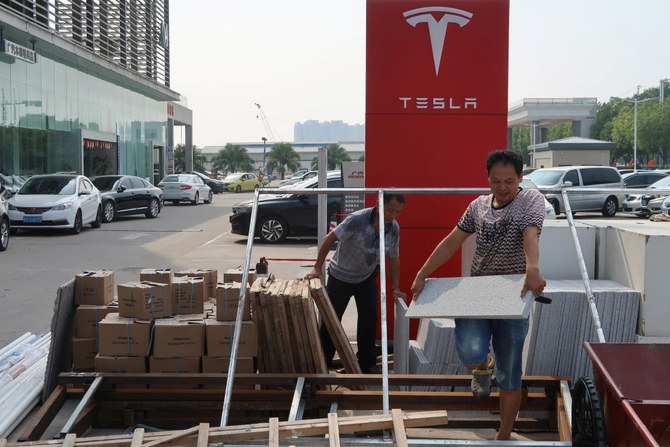
- Tesla had already treated China, the world’s biggest electric vehicle market, differently than elsewhere
- Tesla plans to turn some of its showrooms in China into one-stop shops called ‘Tesla Centers’
Oman-Saudi industry expo seeks to deepen manufacturing, investment ties
RIYADH: Around 50 companies have gathered for the Oman-Saudi Industries Exhibition in Muscat, with both countries looking to deepen industrial and investment cooperation.
The four-day event that began on Dec. 21 is being held at the Oman Convention and Exhibition Center, with a focus on strengthening industrial integration, expanding export and joint investment opportunities, and facilitating direct engagement between manufacturers and investors, the Oman News Agency reported.
The exhibition also highlights the latest industrial innovations and national companies in the energy, mining, manufacturing, and technology sectors, with the participation of supporting entities and industrial incubators.
This comes in the context of broader economic cooperation between Oman and Saudi Arabia, including the signing of three agreements in February covering trade, legal services, and manufacturing to strengthen private sector collaboration.
It also aligns with growing economic ties between the two nations, with bilateral trade reaching 2.18 billion Omani rials ($5.65 billion) by December 2024 and 1,496 Saudi-partnered companies operating in Oman.
Saleh bin Said Masan, undersecretary for commerce and industry at Oman’s Ministry of Commerce, Industry, and Investment Promotion, affirmed that the exhibition serves as a vital platform bringing together industrialists, investors, and entrepreneurs from Oman and Saudi Arabia to exchange expertise, explore cooperation opportunities, and build promising industrial, commercial, and investment partnerships, the ONA report stated.
It added: “In his address, he explained that the exhibition contributes to strengthening economic relations between the two countries and supports joint efforts to develop local industry, opening broader horizons for exports and investment. It also provides an opportunity to learn about the latest industrial solutions and products and to participate in dialogue sessions and bilateral meetings that enhance industrial and commercial integration.”
During his address, Masan noted that the two countries have achieved tangible progress in industrial integration, citing the completion of the first phase of the integration project, the acceptance of Omani certificates of origin for access to Saudi markets, and the implementation of the “Future Factories” initiative.
He also said that 12 agreements have been signed to link supply chains between factories in both countries, contributing to the creation of joint manufacturing opportunities with added value.
Masan added that trade between Oman and Saudi Arabia has witnessed remarkable growth, emphasizing continued efforts to activate memoranda of understanding and enhance cooperation between the public and private sectors to further expand trade volumes.
For his part, Ibrahim bin Saad bin Bishan, Saudi ambassador to Oman, said the exhibition aims to strengthen economic cooperation by opening new avenues for commercial partnerships between Omani and Saudi companies and institutions.
He added that the event reflects the depth of relations and the level of cooperation between the two countries across various fields and at all levels.
Bishan also said the exhibition underscores the role of the private sector as a key partner in achieving economic integration under Oman Vision 2040 and Saudi Vision 2030, and represents an extension of the development of strategic economic relations between the two sides, which have seen sustained growth.
The exhibition includes a series of panel discussions and specialized workshops aimed at promoting economic, trade, and investment exchange, while providing a platform for networking between businesspeople and investors from both countries.
During the event, a Saudi platform was launched to support Saudi factories and brands in expanding into Gulf and international markets, particularly the Omani market, and to connect them with investors and partners through an integrated export system.


