DHAKA: Bangladesh’s plan to relocate 100,000 Rohingya to a new island in the Bay of Bengal is yet to receive the green light from the UN although authorities on the ground have completed all requirements, officials told Arab News on Tuesday.
The Bhasan Char island project has been built at a cost of $275 million to ease pressure on Bangladesh, which is host to the world’s largest refugee camps at Cox’s Bazaar.
It also aims to provide refugees with better living conditions as they will be able to earn a livelihood through agriculture, cattle breeding and fish farming.
However, the UN insists that the island is “isolated” and “flood prone” and therefore not suitable for the relocation of the Rohingya.
“A joint technical team comprising UN experts and Bangladesh government members will visit the Bhashan Char island from Nov. 17-19. The UN will provide their assessment report after the visit of that technical team,” Shah Kamal, senior secretary of the disaster management ministry, told Arab News.
He added that representatives from both sides will hold another round of talks on Wednesday,
with the Bangladeshi side to be led by Foreign Secretary Shahidul Haque.
“I am hopeful that the UN will agree with the relocation initiative taken by the Bangladesh government,” Kamal said.
UN agencies at Cox’s Bazar have stressed the need to undertake “independent and thorough technical assessments before relocations take place.”
“These assessments focus on such issues as exposure to cyclone risks and other natural hazards, as well as the adequacy of water resources,” Louise Donovan, UN High Commissioner for Refugees (UNHCR) spokeswoman at Cox’s Bazar, told Arab News.
“The critical protection and operational issues must be considered, including refugee access to basic rights and services, such as health care and education, livelihoods opportunities, as well as their ability to move within Bhasan Char and to and from the mainland. We look forward to resuming discussions with the government on these key issues soon,” Donovan said.
Bangladeshi authorities said that they were drawing up a list of Rohingya refugees who were voluntarily relocating to the island.
“(Up to) today, we have received a good number of families who are interested in the relocation. All the families who have enrolled their names came up voluntarily and we are not putting anybody under pressure,” a spokesman from the Kutupalong Rohingya camp told Arab News. He requested not to be named as he is not authorized to speak to the media.
Mohammad Noor, a Rohingya community leader and secretary of Kutupalong camp 2, said that he had found 56 refugee families from his camp who had volunteered for the relocation.
“I have handed over the list of the families who voluntarily came up to the camp under the charge of the Bangladesh government. But I didn’t hear about any particular date or anything else regarding the relocation,” Noor told Arab News.
He also said that there was no pressure on the Rohingya to relocate: “We are just informing them (the Rohingya) about the facilities and livelihood opportunities built over there for the refugees.”
“From camp 6, a neighboring camp of mine, I have heard that 32 more refugee families have expressed their interest to be relocated,” Noor said.
There are more than 1,150,000 Rohingya currently living in 34 squalid refugee camps in Cox’s Bazar.


UN stalls relocation plan for 100,000 Rohingya
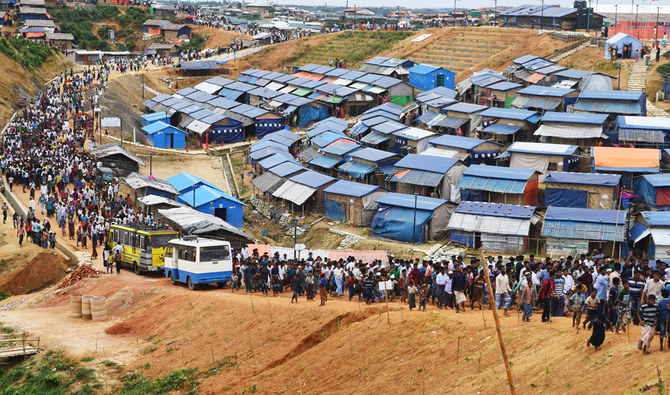
UN stalls relocation plan for 100,000 Rohingya

- There are more than 1,150,000 Rohingya currently living in 34 squalid refugee camps in Cox’s Bazar


Activist Peter Tatchell arrested over ‘globalize the intifada’ placard
- Arrest in London during Saturday protest an ‘attack on free speech,’ his foundation says
- Intifada ‘does not mean violence and is not antisemitic,’ veteran campaigner claims
LONDON: Prominent activist Peter Tatchell was arrested at a pro-Palestine march in central London, The Independent reported.
According to his foundation, the 74-year-old was arrested for holding a placard that said: “Globalize the intifada: Nonviolent resistance. End Israel’s occupation of Gaza & West Bank.”
The Peter Tatchell Foundation said in a statement that the activist labeled his Saturday arrest as an “attack on free speech.”
It added: “The police claimed the word intifada is unlawful. The word intifada is not a crime in law. The police are engaged in overreach by making it an arrestable offense.
“This is part of a dangerous trend to increasingly restrict and criminalize peaceful protests.”
Tatchell described the word “intifada,” an Arab term, as meaning “uprising, rebellion or resistance against Israel’s occupation of the West Bank and Gaza.
“It does not mean violence and is not antisemitic. It is against the Israeli regime and its war crimes, not against Jewish people.”
According to his foundation, Tatchell was transported to Sutton police station to be detained following his arrest.
In December last year, London’s Metropolitan Police said that pro-Palestine protesters chanting “globalize the intifada” would face arrest, attributing the new rules to a “changing context” in the wake of the Bondi Beach attack in Australia.
“Officers policing the Palestine Coalition protest have arrested a 74-year-old man on suspicion of a public order offense. He was seen carrying a sign including the words ‘globalize the intifada’,” the Metropolitan Police said on X.
According to a witness, Tatchell had been marching near police officers with the placard for about a mile when the group came across a counterprotest.
He was then stopped and “manhandled by 10 officers,” said Jacky Summerfield, who accompanied Tatchell at the protest.
“I was shoved back behind a cordon of officers and unable to speak to him after that,” she said.
“I couldn’t get any closer to hear anything more than that; it was for Section 5 (of the Public Order Act).
“There had been no issue until that. He was walking near the police officers. Nobody had said or done anything.”


