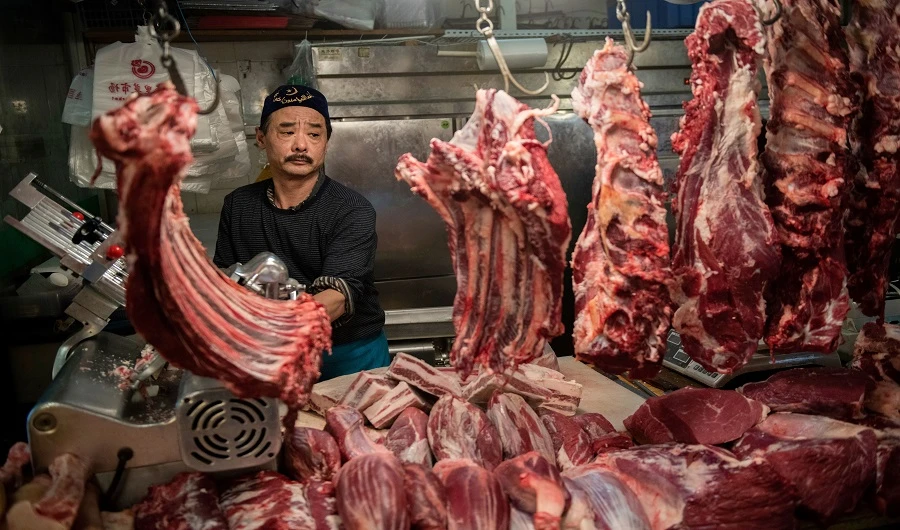
- The market offers $12-15 billion potential
- Pakistan will start exporting meat to China after experts scan animals for disease
KARACHI: Pakistan is expected to start export of meat and meat preparations to China within a year following progress on setting up the Foot and Mouth Disease-free zone, officials told Arab News as Chinese meat buyers showed interest in importing halal meat products from Pakistan.
Pakistan and China had signed two agreements during the visit of Chinese Vice President Wang Qishan in May this year that included the Framework Agreement on Agricultural Cooperation and Memorandum on the Requirements of Foot and Mouth Disease-Free Zone for which Chinese will provide technical assistance and support.
“To review the progress on the FMD-free zone, a Chinese team visited Pakistan a couple of days ago and held meetings with Pakistani officials,” Rao Muhammad Ajmal Khan, Chairman of National Assembly Standing Committee on National Food Security and Research, told Arab News. “They are coming back next week and we have asked them to focus on value addition to which they have agreed. They have agreed to allocate 15 percent space for the agriculture and dairy sector,” he added.
“I think it will take a year,” Rao said while responding to a question about the start of meat exports to China. “The Chinese are visiting Pakistan for their own assessment. They are more interested in setting up slaughter houses in the free zone and from there they want to export.”
The first meeting of the China-Pakistan Joint Working Group (JWG) between the Ministry of Agriculture and Rural Affairs, China, and the Ministry of National Food Security and Research, Pakistan, on agricultural cooperation was held in Islamabad on Friday.
“In the meeting it was agreed, on the basis of cooperation in protection and control of animal epidemics, to enhance the regional management of animal epidemics and FMD Free Zone with the technical support of experts,” a statement by National Food Security and Research said.
Meanwhile, a Chinese delegation from Sichuan province in a meeting with the Minister for States and Frontier Regions and Narcotics Control Shahryar Khan Afridi expressed their interest on Sunday to import Halal meat from Pakistan for the Middle East and China to cater to the need of Muslim populations, a statement issued by the ministry said. “Leader of a Chinese delegation Zhu Maa said China has good equipment and services and vowed to showcase Pakistani products and halal food in Chinese markets,” the statement added.
Pakistan exported meat and meat preparations worth $242.8 million during the fiscal year FY19 as compared to $242.7 million of previous year, showing an increase of 8 percent, data from the Pakistan Bureau of Statistics and State Bank of Pakistan show.
The South Asian nation mainly exports to Gulf countries along with Vietnam and Malaysia. The country remains out of the Chinese market of $12 to 15 billion due to a ban imposed on Pakistan owing to the FMD background while stringent quarantine standards and registration processes are also major hurdles.
Exporters say the country’s meat reaches the Chinese market but not directly.
“Pakistani meat is supplied to China, though not directly but through the indirect route of Vietnam, which is illegal and via smuggling,” Mian Abdul Hannan, Chairman of the All Pakistan Meat Exporters and Processors Association, told Arab News. “We don’t have any trade agreement with China for the export of meat. The main reason for that is the FMD.”
Pakistan at present stands at Stage II of FMD and expects to move to Stage III after the FMD-free zones are set up to control and eradicate the epidemic.
“The countries that are at the same stage can import and exports. It is not possible to sign agreement and start exports until we attain the same level of FMD with China or meet the requirements of the Chinese authorities,” Hannan noted adding: “Exports will start when our FMD status will be cleared and we will move to stage three.”
The status upgrade will also allow the country to enter another big meat market of Indonesia.