

Iraq PM says anti-government protests cost country ‘billions’

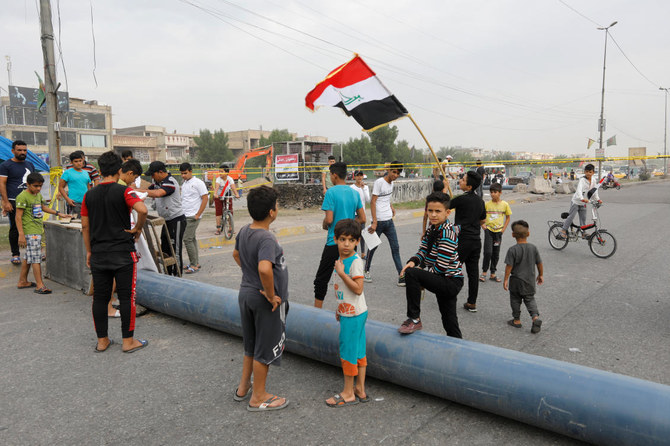
Iraqi demonstrators block the road during ongoing anti-government protests, in Baghdad, Iraq November 3, 2019. (Reuters)
Updated 03 November 2019
Follow

Iraq PM says anti-government protests cost country ‘billions’

  • Abdul-Mahdi said the protests have delayed the arrival of goods and this has contributed to an increase in prices paid by citizens
  • He differentiated between peaceful protesters and “saboteurs” who had used the demonstrators as “human shields”

BAGHDAD: Protests threatening the oil industry and blocking access to Iraq’s ports have cost the country “billions,” Prime Minister Adel Abdul-Mahdi said on Sunday.
The embattled leader issued a long statement in response to weeks of demonstrations against the government that have been met with a brutal response from the security forces, killing more than 250 people.
Abdul-Mahdi said the protests have delayed the arrival of goods and this has contributed to an increase in prices paid by citizens, the poor in particular.
He also said demonstrations have affected the growth of the economy and delayed the submission of the budget for 2020.
Last week, President Barham Salih said Abdul-Mahdi is willing to resign amid the crisis once political leaders agree on a replacement.
But the prime minister made no mention of standing down, instead focussing on the economic damage of the protests.
He said the Baghdad International Fair was delayed because of the demonstrations, and that sick people’s lives have been put at risk because medical clinics have been forced to close and ambulances obstructed.
He called on anti-government protesters to reopen roads saying “it’s time for life to return to normal.”
The prime minister differentiated between peaceful protesters, who he said had turned the demonstrations into “popular festivals” that bring the nation together, and “saboteurs” who had used the demonstrators as “human shields” while attacking security forces.
He also called for markets, factories, schools and universities to reopen after days of protests in the capital and across the mostly Shiite south.
Tens of thousands of protesters have gathered in Baghdad’s central Tahrir Square and across southern Iraq in recent days, calling for the overhaul of the political system established after the 2003 US-led invasion.
Protesters have also taken over a large tower in the square that was abandoned after it was damaged in the war.
Thousands of students have skipped classes to take part in the street rallies, blaming the political elite for widespread corruption, high unemployment and poor public services.
Earlier Sunday, protesters blocked roads around their main protest site with burning tires and barbed wire, unfurling a banner at one roadblock reading: “Roads closed by order of the people.”
They appeared to be borrowing a tactic from Lebanon, where similar anti-government demonstrations have been underway since Oct. 17, and have repeatedly blocked major roads in order to ramp up pressure on authorities.

(With AP)


Spain highlights importance of Gaza reconstruction

Palestinian prime minister, Mohammed Mustafa, and the Spanish foreign minister, Jose Manuel Albares. (AP)
Updated 02 January 2026
Follow

Spain highlights importance of Gaza reconstruction

  • Spain officially recognized Palestine as a state in May 2024, in a coordinated move alongside Ireland and Norway

RAMALLAH: The Palestinian prime minister, Mohammed Mustafa, and the Spanish foreign minister, Jose Manuel Albares, on Friday discussed the latest developments in the West Bank and Gaza Strip.
During their telephone conversation they emphasized the need to intensify international efforts to end the Israeli occupation and halt attacks and settler violence, and to secure the release of Palestinian funds held by Israeli authorities.
They affirmed the importance of ongoing efforts relating to plans for the reconstruction of Gaza, and Europe’s significant role in this process. Mustafa and Albares highlighted the need to unify Palestinian institutions in Gaza with those in the West Bank, with the aim of establishing a Palestinian state in line with international resolutions, including last year’s New York Declaration.
They also discussed coordination between their countries, and the strengthening of Spain’s political, diplomatic and financial support for Palestine, and Mustafa thanked Spain for its ongoing support.
Spain officially recognized Palestine as a state in May 2024, in a coordinated move alongside Ireland and Norway. Estephan Salameh, the Palestinian finance and planning minister, is set to visit Spain this month to discuss enhanced cooperation, particularly in the areas of development and reconstruction. Meanwhile, Israel continues operating in the occupied West Bank.
The Palestinian Prisoners media office said on Friday that Israel carried out numerous raids across the territory, including the major cities of Ramallah and Hebron, according to The Associated Press.
Nearly 50 people were detained, following the arrest of at least 50 other Palestinians on Thursday, most of those in the Ramallah area.
As 2026 begins, the shaky 12-week-old ceasefire between Israel and Hamas has largely ended large-scale Israeli bombardment of Gaza. 
But Palestinians are still being killed by Israeli fire, especially along the so-called Yellow Line that delineates areas under Israeli control, and the humanitarian crisis is compounded by frequent winter rains and colder temperatures.
On Friday, American actor and film producer Angelina Jolie visited the Rafah border crossing between Egypt and the Gaza Strip. 
The only crossing between the territory and a country other than Israel, it remains closed despite Palestinian requests to reopen it to people and aid.
Jolie met with members of the Red Crescent on the Egyptian side of the Rafah border crossing and then visited a hospital in the nearby city of Arish to speak with Palestinian patients on Friday, according to Egyptian officials.
Aid groups say not enough shelter materials are getting into Gaza during the truce.