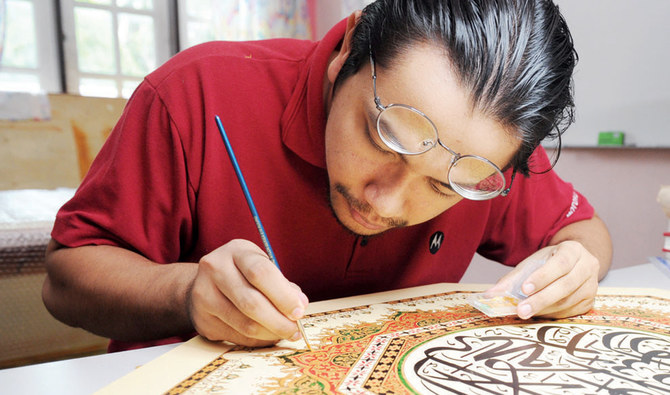

ALOR SETAR, KEDAH (MALAYSIA): On an early October morning, the greens and blues of rice paddy landscapes entered the kiswah of an Ottoman sultan, four hundred years after his reign and several thousand miles away from Istanbul.
“This kiswah was ordered by Sultan Ahmed I, the one who commissioned the construction of the Blue Mosque,” said a young artist while uncovering his copy of the cloth that had once covered the Kaaba in the 17th-century.
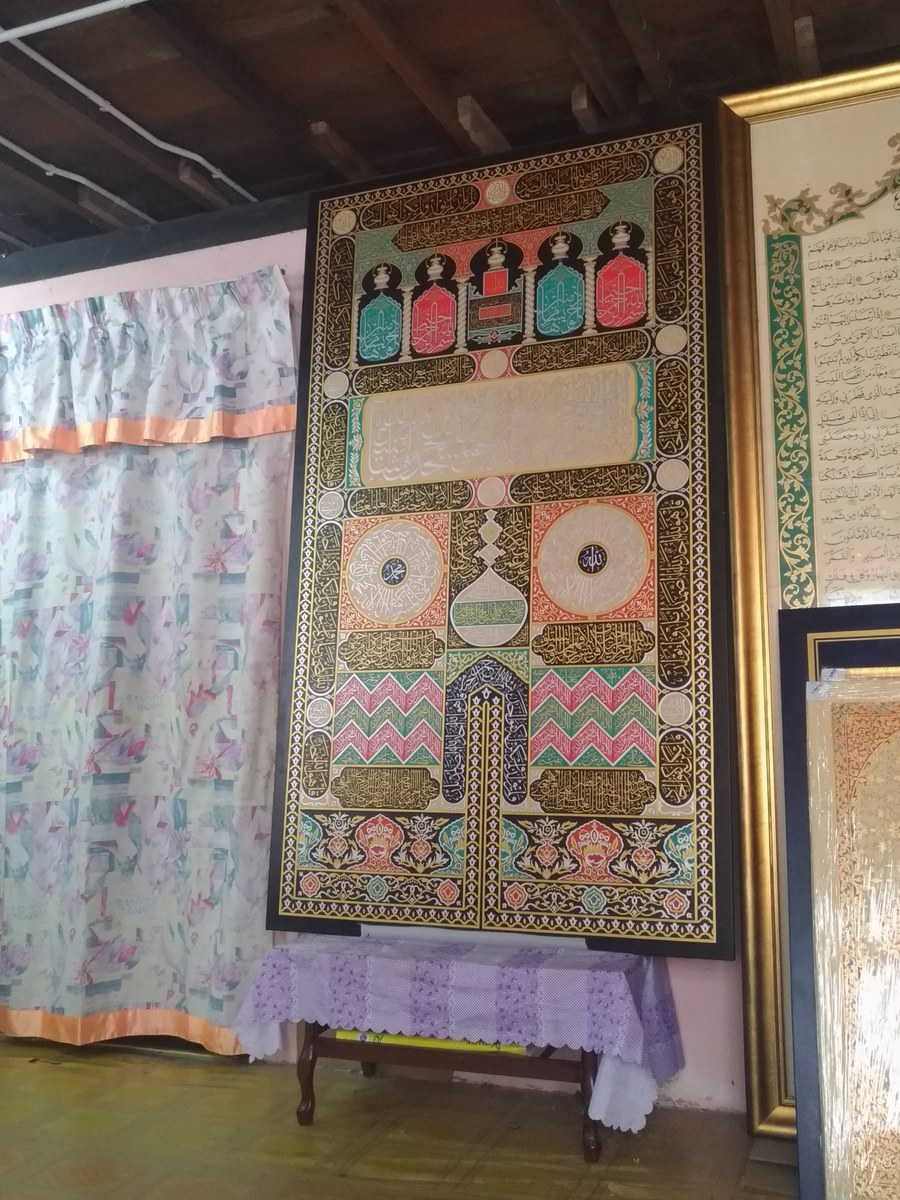
Hafizan Halim's copy of the kiswah of Sultan Ahmed I displayed at the artist's home in Alor Setar, Kedah, Oct. 2. (AN)
Nowadays, the kiswah is embroidered in black, gold and silver, “but in the sultan’s times they also used blue. Back then, the pigment was nearly as costly as gold. Obtained from turquoise, it had to be brought from Iran. The whole process was long and very expensive,” Hafizan Halim explained in an interview with Arab News, at his home and workshop in the countryside of Kedah, north Malaysia, on Oct. 2.
The 240 by 120-centimeter piece on linen canvas took one year to complete with the involvement of another 20 people – mostly children who come from the same village as Halim. He taught them how to prepare the ground and apply paint layers. He often does it. Apart from receiving technical training, his young helpers broaden their horizons and knowledge of art history. “I also want them to realize that being born in a village doesn’t mean that you have to end up growing rice like your fathers and grandfathers. You can do anything,” he said.
Halim’s father, who for decades has been waking up every morning to tend to his paddy field, admitted that the son had never shown any interest in farming: “Hafizan has only been into art, since early childhood.”
Art takes him to foreign lands and royal palaces, for calligraphy still is, like the 12th-century Persian historian Muhammad ibn Ali Rawandi preached, “a craft blessed among the crafts,” which brings the best of luck and “by which the humble are able to rise.”
When the kids from Halim’s neighborhood took part in coloring, it was the final stage of making the kiswah, preceded by a months-long process of calligraphy composition and studying history.
“I need to know about history, philosophy, I need to study them. This is essential in creating a work of art,” Halim said, adding that meaning and craft must not be kept apart. Only when they merge, can a beautiful thing come into existence.
His understanding of art has not been informed by direct transmission from a certain teacher, as is usually the case in the careers of calligraphers and illuminators. The person who has had the greatest influence on him is Syed Muhammad Naquib Al-Attas, a prominent Malaysian scholar of Islam, philosopher, and the founder of the International Institute of Islamic Thought and Civilization (ISTAC), to whom Halim refers as “a polymath, someone who creates written work on history and philosophy, and at the same time can produce architectural design and calligraphy in which all details are meaningful.”
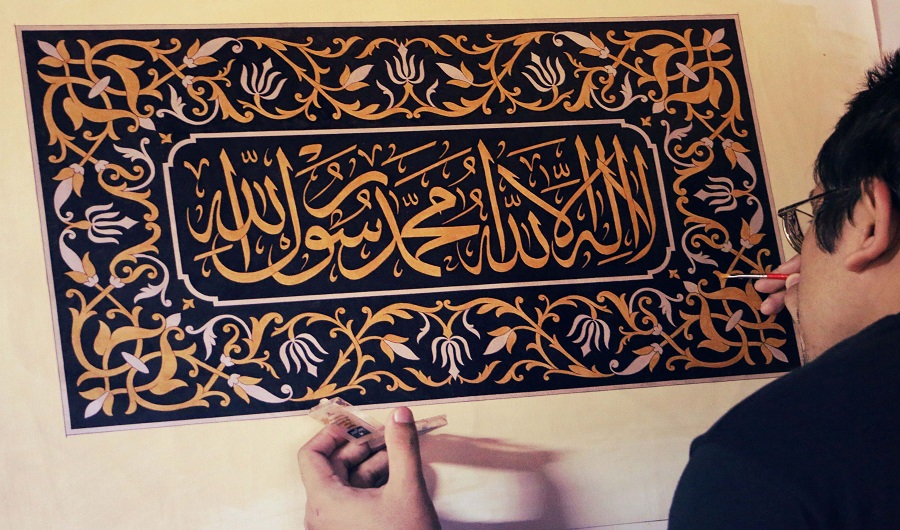
The Shahadah with ornaments inspired by the modern-day kiswah. (Photo courtesy of Hafizan Halim)
The ISTAC building in Kuala Lumpur, designed by Al-Attas, is for Halim a manifestation of how “a thing put in the right place becomes beautiful. Professor Al-Attas considered the direction of wind, water, everything. In each single detail, there is meaning, purpose.”
In art, especially the art of writing and ornament, there is also identity, one that is of particular importance for the entire culture of the Muslim world.
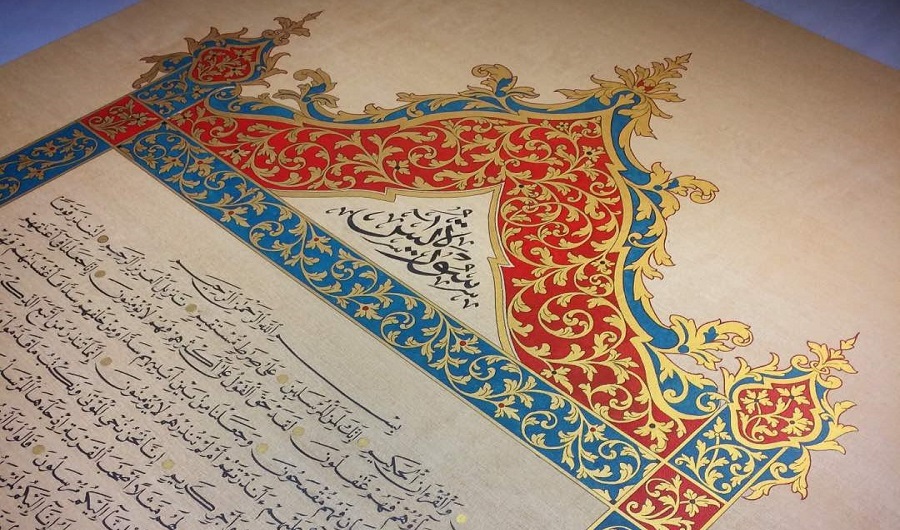
Surah Yasin decorated by Hafizan Halim with illumination based on a 19th-century royal Malay letter from Johor. (Photo courtesy of Hafizan Halim)
“Demand for Islamic art is increasing, you can see it at auctions at Sotheby’s or Christie’s. The collectors are not only Muslims,” Halim said, adding that for the latter it has additional significance. “In their countries, you will find many new buildings, which are great, but their cultural identity is unclear.”
“Art needs to have an identity to become an asset for tourism, to attract with something unique. But what is even more important is its role for future generations. They need to have clarity about their own culture,” he said. Writing, ornament and illumination are the most natural forms of artistic expression in the Muslim world, where since the medieval ages calligraphy has been referred to not only as “the language of the hand,” but also “the ambassador of intellect, the trustee of thought.”
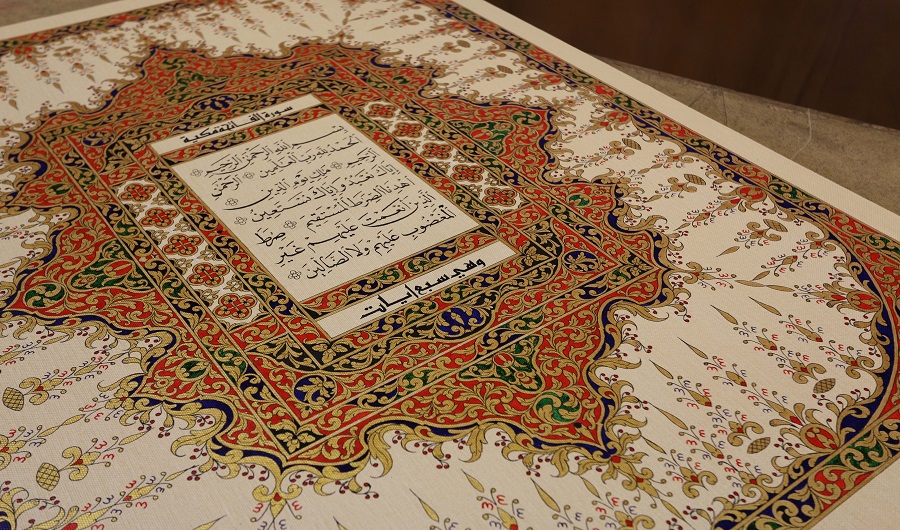
Surah Al-Fatihah in decorated frames. Hafizan Halim based the illumination on ornaments from the Terengganu school. (Photo courtesy of Hafizan Halim)
Halim finds his own identity in Terengganu, eastern Malaysia. For the past few years, he has been devoted to studying the school of Qur’an illumination which emerged there in the early 18th century.
This Terengganu school, according to Annabel Teh Gallop, the lead curator for Southeast Asia at the British Library, “towers above all others, alone in the Malay world in evoking a level of connoisseurship, patronage and artistic organization associated with the ateliers or kitabkhana of the Persianate court tradition.”
With their finesse, rich hues, “jewel-like radiance, with truly virtuosic decorative details,” the Qur’ans of Terengganu are for her “the most brilliant illuminated Qur’ans in the whole of Southeast Asia.”
There is no sufficient evidence to explain why this unique tradition was born in Terengganu.
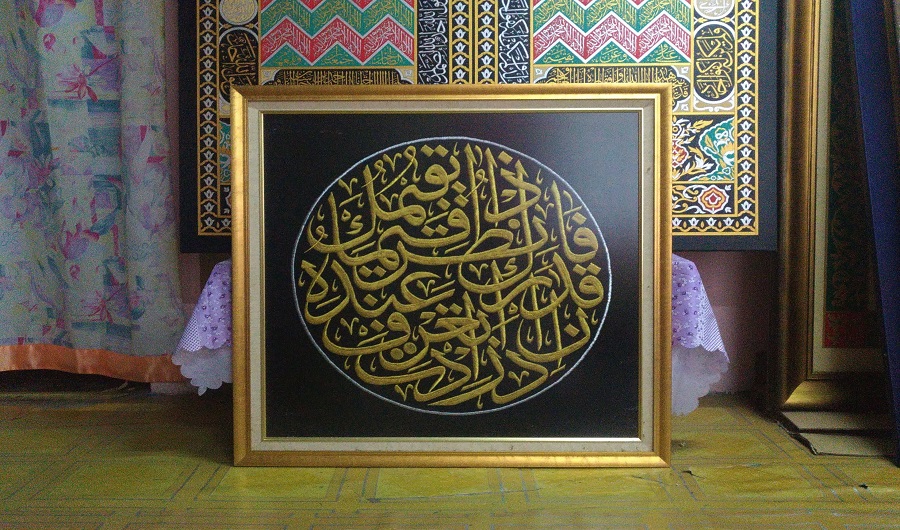
Hafizan Halim's calligraphy with an aphorism from the Hikam of Ibn Ata Allah in Alor Setar, Kedah, Oct. 2. (AN)
“From an examination of the manuscripts themselves, I believe that perhaps only in Terengganu – of all the Malay states – was manuscript illumination carried out in a professionalized, atelier, system, probably centered on the royal court, where artists were able to develop and hone their expertise to an exceptional standard,” Dr. Gallop told Arab News. “In all other Malay states, illuminated manuscripts give the impression of village-level production, with artists mainly working by themselves, albeit still conforming to distinctive regional styles.”
Halim too works by himself, as the art of ornament is no longer present in Malaysia. Doing it, he said, “is a way for me to fulfill my obligations to the community, to give back to society.”