Pakistani traders strike against tax measures brought on by IMF bailout

1 / 2
A banner announcing the strike against the government’s tax policies is displayed at Karachi’s Bolton Market. Picture taken on Oct. 29, 2019. (AN Photo)
2 / 2
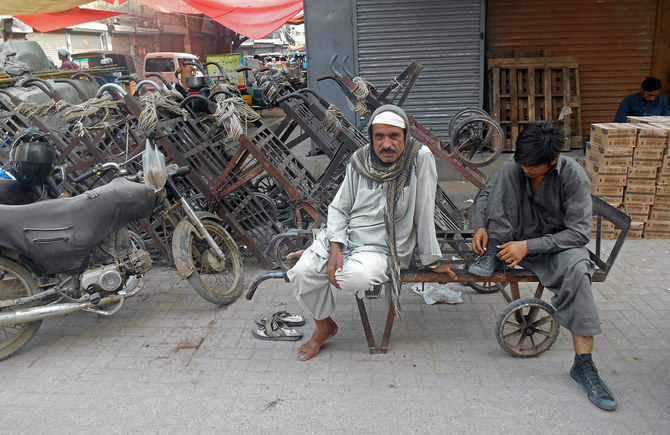
Lal Bakhsh, a daily wage laborer, waits for work at Karachi’s Bolton Market on October 29, 2019, as traders go on a countrywide shutter-down strike against the government’s tax policies. (AN Photo)
Updated 30 October 2019
Follow

Pakistani traders strike against tax measures brought on by IMF bailout

  • Business activities in Karachi, Lahore, Islamabad, Peshawar, Quetta and Faisalabad remain suspended
  • Traders demand withdrawal of CNIC, sales tax registration conditions

KARACHI: Pakistani traders on Tuesday began a two-day shutter-down strike against the government’s tax policies, bringing business activities in major urban centers across the country to a grinding halt.
“Markets remained closed across Pakistan – from Khyber to Karachi and even Azad Kashmir – against the tax policies of the government,” Kashif Chaudhry, president of Markazi Tanzeem-e-Tajran Pakistan, told Arab News.
The Pakistan Tehreek-e-Insaf (PTI) administration that negotiated and secured a $6 billion bailout package from the International Monetary Fund (IMF) is currently introducing financial and tax reforms that are viewed by many as harsh and dictated by the international financial institution.


Otherwise a busy trading center, the Jodia Bazaar’s main market presents a deserted look on October 29, 2019, as traders observe a two-day strike against the tax policies of the government. (AN Photo)

The government is trying to achieve a revenue target of Rs5.5 trillion that has been fixed for the current fiscal year (FY20) and has been termed as both “ambitious and challenging” by the country’s central bank.
The documentation of the country’s economy and registration of traders for sales tax collection are moves that are being resisted by traders in Pakistan who complain that these demands cannot be met by semi-literate traders.
“Our demands are very simple,” Chaudhry said. “The condition of maintaining the record of Computerized National Identity Cards (CNIC) of customers on the purchase of Rs50,000 and the unnecessary documentation for sales tax registration must be withdrawn for small traders.”
Prime Minister Imran Khan and his administration has repeatedly insisted on pursuing its reforms agenda and declined to retreat despite mounting pressure.


Karachi’s biggest mobile market wears a deserted look as traders go on a shutter-down strike on October 29, 2019, against the government’s tax policies. (AN Photo)

Traders say the government’s stance has led to a stagnation of business activities across the country.
“The tax rates, sales tax registration and documentation are the main causes of concern to small traders,” Atiq Mir, chairman of Karachi Tajir Itehad, told Arab News. “The government must break this deadlock over the CNIC and the documentation requirement for small traders.”
As commercial activities come to a standstill across the county’s major markets, daily wage laborers are suffering the most since they live from hand to mouth in a depressed economic environment.
“Two year ago, I used to earn about Rs1500 per day. Now my daily income has reduced to about Rs500,” said Lal Bakhsh, a daily wage laborer, while sitting on his push cart. “This is not enough to run my family’s expenses. So I have to find more work.”
Traders maintain the business shut down for a day can cost an estimated Rs4 billion to the city of Karachi alone.


Pakistan’s finance chief heads to Riyadh to highlight climate funding priorities at global summit

Updated 4 sec ago
Follow

Pakistan’s finance chief heads to Riyadh to highlight climate funding priorities at global summit

  • Muhammad Aurangzeb will join high-level talks on securing capital for climate adaptation and resilience
  • The visit includes bilateral meetings with senior Saudi officials to deepen bilateral economic cooperation

ISLAMABAD: Federal Minister for Finance and Revenue Muhammad Aurangzeb left for Saudi Arabia on Wednesday to attend the Global Development Finance Conference in Riyadh, said an official statement, where he will present Islamabad’s perspective on climate adaptation and financing.

Pakistan is among the world’s most climate-vulnerable countries, grappling with recurrent floods, heatwaves and rising adaptation costs that far exceed its domestic resources.

Last month, while addressing COP30 in Brazil via video link, Aurangzeb urged reforms to global climate-finance mechanisms, arguing the Green Climate Fund was mired in “bureaucracy” and the Loss and Damage Fund had made little progress four years after its launch.

The finance division said the minister had departed for Riyadh to take part in the conference, a three-day gathering focused on new development-finance models.

“During the conference, Finance Minister Senator Muhammad Aurangzeb will participate in a high-level session on climate adaptation and resilience, where he will join global leaders in discussing how developing countries can secure the capital needed to address climate vulnerabilities,” the statement said.

“His participation will highlight Pakistan’s priorities in climate finance and the government’s efforts to strengthen economic resilience in the face of global environmental challenges,” it added.

Aurangzeb is also scheduled to hold bilateral meetings with senior Saudi officials, including leadership of the National Development Fund and the Ministry of Finance, to discuss development financing, investment opportunities and broader economic cooperation.

The statement said he will give interviews to international media outlets such as CNN and CGTN to outline Pakistan’s reform trajectory and development-finance needs.

The finance chief will additionally meet Pakistan’s diplomatic mission in Riyadh to review ongoing economic diplomacy initiatives.

The Global Development Finance Conference, organized under the patronage of Saudi Crown Prince Mohammed bin Salman, aims to bring together more than 100 speakers from over 120 international and regional organizations.

The conference is positioned as a key platform within Vision 2030 to accelerate innovative financing models and support countries seeking sustainable growth amid rising global climate and development pressures.