Truck driver remanded at UK court over 39 dead migrants

1 / 2
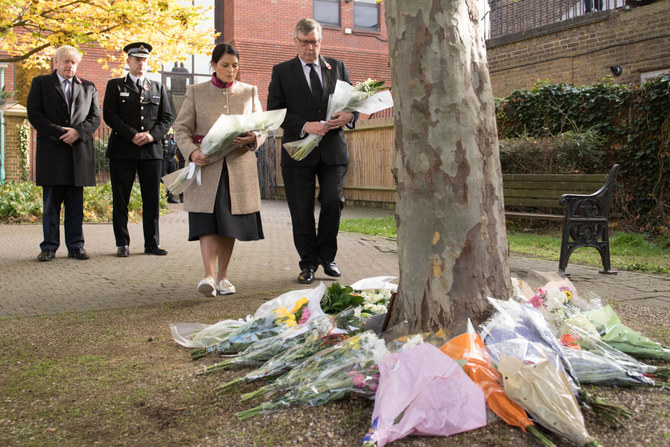
Britain's Prime Minister Boris Johnson (L) stands with with Chief Constable of Essex Police, Ben-Julian Harrington (2L), as Britain's Home Secretary Priti Patel (3L) lays flowers during a visit to Thurrock Council Offices in Thurrock, east of London on October 28, 2019, following the October 23, 2019, discovery of 39 bodies concealed in a lorry. (AFP)
2 / 2
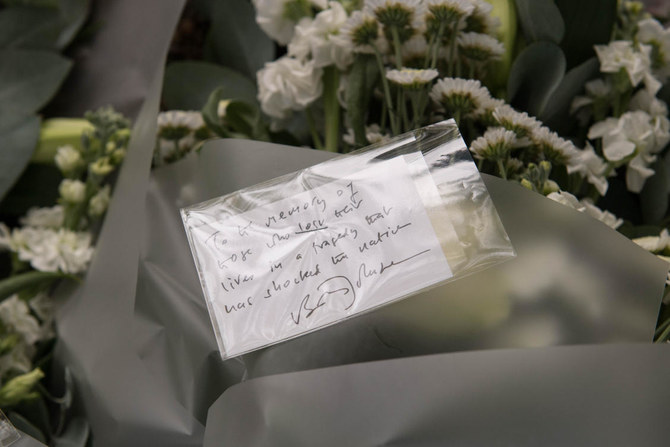
A message left on flowers laid by Britain's Prime Minister Boris Johnson is pictured during his visit to Thurrock Council Offices in Thurrock, east of London on October 28, 2019, following the October 23, 2019, discovery of 39 bodies concealed in a lorry. (AFP)
Updated 28 October 2019
Follow

Truck driver remanded at UK court over 39 dead migrants

  • Maurice Robinson was charged Saturday with 39 counts of manslaughter, money laundering and conspiracy
  • Several Vietnamese families have come forward since, saying they feared their relatives were among the dead

LONDON: A UK court on Monday remanded in custody a truck driver over the deaths of 39 Asian migrants he had been smuggling, in a case that has horrified Britain and sparked a search for their country of origin.
Maurice Robinson, a 25-year-old from Northern Ireland known as Mo, was charged Saturday with 39 counts of manslaughter, money laundering and conspiracy to assist unlawful immigration.
As bereaved families in Vietnam prayed for their missing sons and daughters, some of whose identies emerged online, Robinson made no statement in a brief video appearance at a court in Chelmsford, northeast of London.
He has been scheduled to enter a plea at London’s Old Bailey court on November 25.
The eight women and 31 men found Wednesday in a refrigerated container in Essex, southeast England, were originally identified as Chinese.
But several Vietnamese families have come forward since, saying they feared their relatives were among the dead, and UK authorities have walked back their original statement.
The grim case has again cast light on the extreme dangers facing illegal migrants seeking better lives in Europe, and reopened debates across Britain about ways to prevent such tragedies from happening again.
Britain is now conducting its largest murder investigation since the July 7, 2005 London suicide bombings that killed 52 people.
Officials started collecting DNA samples from families in Nghe An and Ha Tinh, impoverished provinces in central Vietnam where most of the suspected victims came from.
On Monday, Vietnam said Britain had sent documents to help with the complicated task of identifying the bodies, many of whom were believed to be carrying falsified passports.
“The UK side has sent four sets of dossiers related to the Essex lorry deaths... for verification coordination,” Vietnam’s Deputy Foreign Minister Bui Thanh Son said.
Vietnam’s foreign ministry is gathering information on the suspected victims, the report said, after hair and blood samples were collected from several families.
UK authorities arrested another man wanted in the case on Saturday in Dublin, while three others detained earlier have been released on bail.
The man arrested Saturday is also believed to be in his 20s and from Northern Ireland, although no details about his identity have been released.
UK Prime Minister Boris Johnson, who campaigned for stronger borders while pushing Britain to leave the EU in the 2016 referendum, signed a book of condolence Monday and laid flowers in Grays, east of London, where the truck was found.
Interior minister Priti Patel was also due to answer questions about the case in parliament.
The tragedy has plunged communities in central Vietnam into mourning as families desperately wait for news from their missing relatives.
Vietnamese media reported that as many as 24 of the victims could be Vietnamese although officials have not confirmed the number.
Central Vietnam has long been a source of illegal migration to Britain for people seeking better lives.
Vietnamese migrants often work illegally in nail bars or cannabis farms, heavily indebted and vulnerable to exploitations.


Starmer arrives in China to defend ‘pragmatic’ partnership

Updated 28 January 2026
Follow

Starmer arrives in China to defend ‘pragmatic’ partnership

  • British Prime Minister Keir Starmer arrived in Beijing on Wednesday to meet with Chinese leader Xi Jinping, hoping to restore long fraught relations

BEIJING: British Prime Minister Keir Starmer arrived in Beijing on Wednesday to meet with Chinese leader Xi Jinping, hoping to restore long fraught relations.
It is the first visit to China by a UK prime minister since 2018 and follows a string of Western leaders courting Beijing in recent weeks, pivoting from a mercurial United States.
Starmer, who is also expected to visit Shanghai on Friday, will later make a brief stop in Japan to meet with Prime Minister Sanae Takaichi.
For Xi, the trip is an opportunity to show Beijing can be a reliable partner at a time when President Donald Trump’s policies have rattled historic ties between Washington and its Western allies.
Starmer is battling record low popularity polls and hopes the visit can boost Britain’s beleaguered economy.
The trip has been lauded by Downing Street as a chance to boost trade and investment ties while raising thorny issues such as national security and human rights.
Starmer will meet with Xi for lunch on Thursday, followed by a meeting with Premier Li Qiang.
The British leader said on Wednesday this visit to China was “going to be a really important trip for us,” vowing to make “some real progress.”
There are “opportunities” to deepen bilateral relations, Starmer told reporters traveling with him on the plane to China.
“It doesn’t make sense to stick our head in the ground and bury in the sand when it comes to China, it’s in our interests to engage and not compromise on national security,” he added.
China, for its part, “is willing to take this visit as an opportunity to enhance political mutual trust,” foreign ministry spokesman Guo Jiakun reiterated Wednesday during a news briefing.
Starmer is the latest Western leader to be hosted by Beijing in recent months, following visits by Canadian Prime Minister Mark Carney and French President Emmanuel Macron.
Faced with Trump’s threats to impose tariffs on Canada for signing a trade agreement with China, and the US president’s attempts to create a new international institution with his “Board of Peace,” Beijing has been affirming its support for the United Nations to visiting leaders.
Reset ties 
UK-China relations plummeted in 2020 after Beijing imposed a sweeping national security law on Hong Kong, which severely curtailed freedoms in the former British colony.
They soured further since with both powers exchanging accusations of spying.
Starmer, however, was quick to deny fresh claims of Chinese spying after the Telegraph newspaper reported Monday that China had hacked the mobile phones of senior officials in Downing Street for several years.
“There’s no evidence of that. We’ve got robust schemes, security measures in place as you’d expect,” he told reporters on Wednesday.
Since taking the helm in 2024, Starmer has been at pains to reset ties with the world’s second-largest economy and Britain’s third-biggest trade partner.
In China, he will be accompanied by around 60 business leaders from the finance, pharmaceutical, automobile and other sectors, and cultural representatives as he tries to balance attracting vital investment and appearing firm on national security concerns.
The Labour leader also spoke to Xi on the sidelines of the G20 summit in Brazil in November 2024.
Jimmy Lai
The prime minister is also expected to raise the case of Hong Kong media mogul and democracy supporter Jimmy Lai, 78, a British national facing years in prison after being found guilty of collusion charges in December.
When asked by reporters about his plans to discuss Lai’s case, Starmer avoided specifics, but said engaging with Beijing was to ensure that “issues where we disagree can be discussed.”
“You know my practice, which is to raise issues that need to be raised,” added Starmer, who has been accused by the Conservative opposition of being too soft in his approach to Beijing.
Reporters Without Borders urged Starmer in a letter to secure Lai’s release during his visit.
The British government has also faced fierce domestic opposition after it approved this month contentious plans for a new Chinese mega-embassy in London, which critics say could be used to spy on and harass dissidents.
At the end of last year, Starmer acknowledged that China posed a “national security threat” to the UK, drawing flak from Chinese officials.
The countries also disagree on key issues including China’s close ties with Russian President Vladimir Putin amid the war in Ukraine, and accusations of human rights abuses in China.