

Dread builds in Vietnam over fate of missing UK migrants

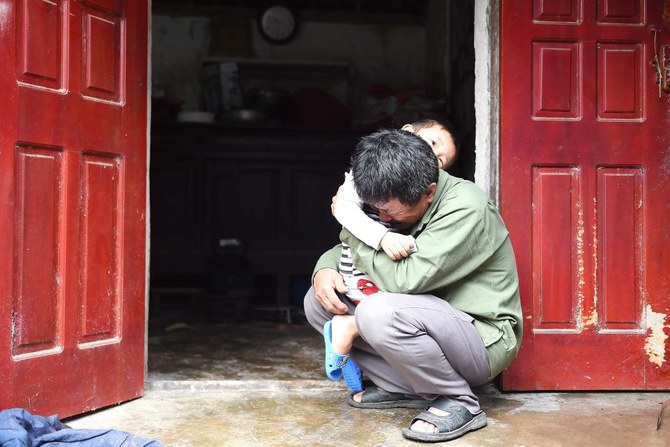
Le Minh Tuan, father of 30-year old Le Van Ha, who is feared to be among the 39 people found dead in a truck in Britain, cries while holding Ha's son outside their house in Vietnam's Nghe An province on October 27, 2019. (File/AFP)
Updated 27 October 2019
Follow

Dread builds in Vietnam over fate of missing UK migrants

  • The 31 men and eight women were initially believed to be Chinese
  • Several Vietnamese families have now come forward with fears their relatives are among the dead

NGHE AN, Vietnam: Dread mounted across Vietnam on Sunday as relatives of migrants feared to be among 39 people found dead in a truck in Britain revealed new heart-wrenching details of their last contact with their loved ones.

The driver of the refrigerated trailer discovered in an industrial park on Wednesday has been charged with 39 counts of manslaughter and people trafficking in a case that has shocked Britain and cast light on the extreme dangers facing illegal migrants seeking better lives in Europe.

The 31 men and eight women were initially believed to be Chinese, but several Vietnamese families have now come forward with fears their relatives are among the dead.

Many are believed to have come from impoverished villages in central Vietnam, where some families now fear the worst.

Le Minh Tuan has not heard from his son Le Van Ha since a message over Facebook around a week ago saying “I’m about to board a car to Britain. I will contact the family when I arrive in England, Dad.”

That was two days before the refrigerated trailer stuffed with bodies was discovered in Essex, east of London.

“We’ve heard no news from him since,” Tuan told AFP, his eyes red from crying.

“For sure he was in that lorry. I just want my son’s (body) back home,” he said in Yen Hoi village, Nghe An province.

The 30-year-old left his two young sons and wife in Vietnam in June, traveling to Turkey then Greece and France en route to the UK.

Ha hoped to find work to pay back $30,000 paid to smugglers to get him to Europe, and another $8,500 loan to build the family home.

“He wanted to go to pay the debts... and send money back to his kids so they would have a better life,” said his father, clinging to his grandson and weeping.

Nearby, the mother of missing 28-year-old man Vo Ngoc Nam said she had not yet heard anything on the fate of her son, who had been working in Romania and planned to travel to Britain.

“I have been waiting anxiously over the past few days for any news from him, but we got nothing,” the stricken mother told AFP.

Villagers planned to gather for Sunday mass later in the day to pray for the 39 victims.

Central Vietnam is a common feeder for illegal migrants chasing promises of riches overseas. Many end up working in Britain illegally in nail bars or on cannabis farms, heavily indebted and subject to exploitation.

Five people have so far been arrested in Britain in connection with the tragedy, the country’s largest murder probe since the 2005 London suicide bombings.
Vietnam’s ambassador, Tran Ngoc An, visited police investigating the case on Saturday and also spoke on the phone to British interior minister Priti Patel, the embassy said.

Essex police say they want to fast-track the process of fingerprint identification and DNA testing, but said it would take time.


Bangladesh halts controversial relocation of Rohingya refugees to remote island

Updated 29 December 2025
Follow

Bangladesh halts controversial relocation of Rohingya refugees to remote island

  • Administration of ousted PM Sheikh Hasina spent about $350m on the project
  • Rohingya refuse to move to island and 10,000 have fled, top refugee official says

DHAKA: When Bangladesh launched a multi-million-dollar project to relocate Rohingya refugees to a remote island, it promised a better life. Five years on, the controversial plan has stalled, as authorities find it is unsustainable and refugees flee back to overcrowded mainland camps.

The Bhasan Char island emerged naturally from river sediments some 20 years ago. It lies in the Bay of Bengal, over 60 km from Bangladesh’s mainland.

Never inhabited, the 40 sq. km area was developed to accommodate 100,000 Rohingya refugees from the cramped camps of the coastal Cox’s Bazar district.

Relocation to the island started in early December 2020, despite protests from the UN and humanitarian organizations, which warned that it was vulnerable to cyclones and flooding, and that its isolation restricted access to emergency services.

Over 1,600 people were then moved to Bhasan Char by the Bangladesh Navy, followed by another 1,800 the same month. During 25 such transfers, more than 38,000 refugees were resettled on the island by October 2024.

The relocation project was spearheaded by the government of former Prime Minister Sheikh Hasina, who was ousted last year. The new administration has since suspended it indefinitely.

“The Bangladesh government will not conduct any further relocation of the Rohingya to Bhasan Char island. The main reason is that the country’s present government considers the project not viable,” Mizanur Rahman, refugee relief and repatriation commissioner in Cox’s Bazar, told Arab News on Sunday.

The government’s decision was prompted by data from UN agencies, which showed that operations on Bhasan Char involved 30 percent higher costs compared with the mainland camps in Cox’s Bazar, Rahman said.

“On the other hand, the Rohingya are not voluntarily coming forward for relocation to the island. Many of those previously relocated have fled ... Around 29,000 are currently living on the island, while about 10,000 have returned to Cox’s Bazar on their own.”

A mostly Muslim ethnic minority, the Rohingya have lived for centuries in Myanmar’s western Rakhine state but were stripped of their citizenship in the 1980s and have faced systemic persecution ever since.

In 2017 alone, some 750,000 of them crossed to neighboring Bangladesh, fleeing a deadly crackdown by Myanmar’s military. Today, about 1.3 million of them shelter in 33 camps in the coastal Cox’s Bazar district, making it the world’s largest refugee settlement.

Bhasan Char, where the Bangladeshi government spent an estimated $350 million to construct concrete residential buildings, cyclone shelters, roads, freshwater systems, and other infrastructure, offered better living conditions than the squalid camps.

But there was no regular transport service to the island, its inhabitants were not allowed to travel freely, and livelihood opportunities were few and dependent on aid coming from the mainland.

Rahman said: “Considering all aspects, we can say that Rohingya relocation to Bhasan Char is currently halted. Following the fall of Sheikh Hasina’s regime, only one batch of Rohingya was relocated to the island.

“The relocation was conducted with government funding, but the government is no longer allowing any funds for this purpose.”

“The Bangladeshi government has spent around $350 million on it from its own funds ... It seems the project has not turned out to be successful.”
