

Most Arabs in the dark about Japan’s power structure

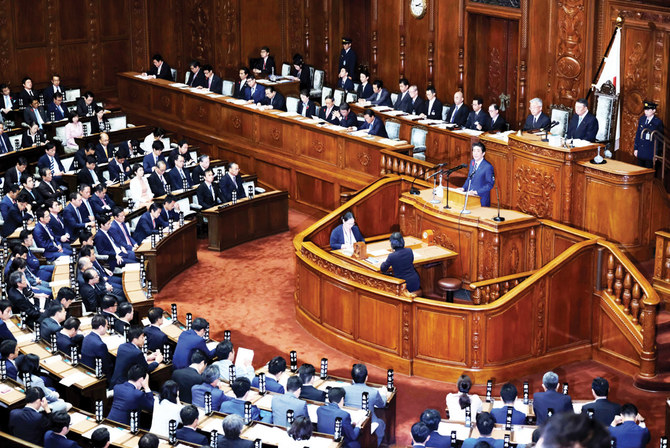
Japan’s Prime Minister Shinzo Abe delivers a policy speech from the podium at an extraordinary Diet (Parliament) session in Tokyo this month. (AFP)
Updated 29 October 2019
Follow

Most Arabs in the dark about Japan’s power structure

  • A YouGov poll of Arabs' perception of Japan finds confusion about executive authority
  • The prime minister was correctly identified as the final decision-maker by 44 percent

DUBAI: Many Arabs are not aware of Japan’s power structure, according to a YouGov survey of Arabs’ perception of the country, conducted for Arab News.
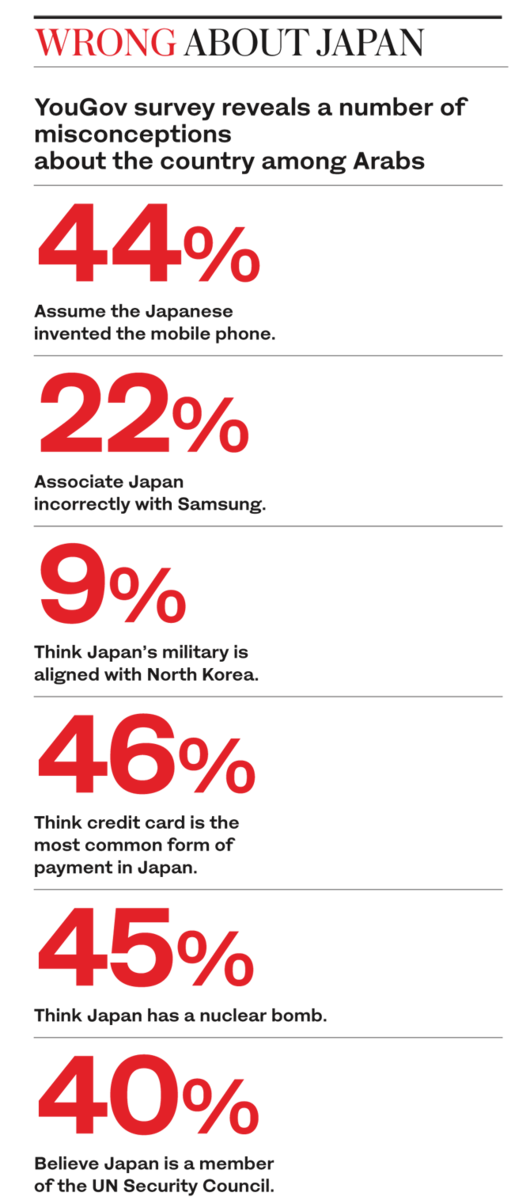
More than half (56 percent) of the 3,033 respondents from the GCC bloc, the Levant and North Africa, aged 16 or above, said they were unfamiliar with the power structure in Japan, although 44 percent correctly identified the prime minister as the final decision-maker.
“I don’t find this particularly surprising,” said Khobaib Osailan, a PhD candidate in the Department of Political Science at the University of California, Santa Barbara.
“There is little reason to expect a large number of Arabs to have an accurate knowledge of Japanese political structures.”
He told Arab News that while many Arabs are avid consumers of Japanese cultural products, from anime and manga to sushi, the majority do not view Japan as a key political player in the Arab world.
“Thus, there is little interest in gaining accurate knowledge of their internal political structure,” he said. “Also, many in the Arab world associate democracy with the West.
“For them, Japan is viewed as a model of economic success and less as a country with a democratically elected prime minister and an emperor with only ceremonial powers.” 
The nature of Japanese politics was another possible explanation, he said.
“While Japan is a democracy where parliamentary elections occur every four years, one party, that is the Liberal Democratic Party (LDP), has been dominating government for at least six decades,” Osailan said.
“The lack of a heated and visible electoral competition may have reduced Arabs’ attention to Japanese politics.”
Theodore Karasik, senior adviser at Gulf State Analytics in Washington DC, agreed, stating that the role of the prime minister is similar in some other Arab countries.
“But Japan’s power structure is unique in itself in terms of structure, function, and outreach in terms of international economic affairs,” he told Arab News.
Overall, GCC nationals in the study were less aware of the political power structure in Japan, with as many GCC nationals identifying the emperor as the final decision-maker on laws as those correctly identifying the prime minister.
“It may sound like a stereotype, but GCC nationals may assume that Japan’s emperor has a final say because of story tales, movies and other means of communicating fiction or non-fictional images,” Karasik said.
“Images of a Japan with an emperor gets into the psyche and perhaps this may explain such thinking. Understanding the drivers for why this perception exists means educating people about Japan’s political structure and concepts surrounding Tokyo’s policy development.”
For Osailan, given the absence of accurate knowledge of Japan’s political institutions, many people in the GCC could be projecting their own political institutions onto Japan’s.
“Many people in GCC countries view monarchs as necessarily having considerable executive prerogatives,” he told Arab News.
“In other Arab countries, even monarchies like Jordan and Morocco, citizens are accustomed to having prime ministers as chief executives.”
Awareness of the powers of the prime minister is lowest in the UAE and Saudi Arabia, with only 35 percent of Saudi and UAE residents selecting the prime minister as the person who decides the laws.
According to Karasik, the reason may lie in the different style of governance found in the Arabian Peninsula as opposed to most other parts of the Middle East, while Osailan found such results surprising given that Saudi Arabia and the UAE are Japan’s largest trading partners in the Arab world.
“Why don’t these strong economic ties translate into greater knowledge of Japanese politics?” he asked.
“One possible answer is that, unlike economic ties with the US and some European countries, which are influenced by domestic political considerations, Saudi and Emirati economic ties with Japan are much less exposed to domestic political dynamics.
“However, one may expect a growing interest in Japan’s domestic politics among citizens of the Gulf, given the strong economic ties and, more recently, the Saudi-Japanese cooperation on Vision 2030.”


As India claims fourth-largest economy spot, what it means on the ground

People gather to shop for clothes at a weekend market in Bengaluru, India, on Dec. 28, 2025. (AFP)
Updated 10 sec ago
Follow

As India claims fourth-largest economy spot, what it means on the ground

  • Indian government review says economy grew to $4.19 billion, overtaking Japan
  • Claim still needs IMF review as only organized sector counted, economist says

NEW DELHI: When Ramesh Chandra Biswal left his job as a space scientist in the US, he returned to eastern India and ran an agriculture startup on a promise of his country’s rapid economic growth.

Nine years on, as India positions itself as the world’s fourth largest economy, he is still waiting for the promise to come true.

India’s economy was the sixth largest in the world, valued at about $2.6 trillion in 2017, when Biswal launched his Villamart project in his home village in Odisha.

According to calculations in the Indian government’s end-of-year economic review, it has now grown to $4.19 trillion, overtaking Japan’s economy in terms of nominal Gross Domestic Product.

The review also projects that India will overtake Germany to become the world’s third-largest economy within the next three years, trailing only the US and China in economic weight.

But on the ground, Biswal was not sure what the projections meant because they had no impact on his life or business.

“The hype around India becoming the fourth largest economy is not grounded. People cannot relate to that,” he said.

“The number of people here in India is much more than Japan ... We have to improve the per capita income instead of telling the story of being the fourth largest economy.”

Over the years that he has been running his company, Biswal has not noticed much change, but hoped that the news of the country’s growth would at least create a positive hype and motivate everyone.

“People are trying. As an entrepreneur, we are also trying, struggling every day, trying to do something new,” he said.

“I’m getting some respect in society. That way, it is giving me the driving force.”

But not everyone was immediately optimistic. For Sarvesh Sau, a fruit seller in Delhi, it has been increasingly difficult to keep his family afloat.

“Rich people are getting rich, those who have resources ... but a low-income group person like me finds it difficult to manage a decent living despite putting in more than 12 hours of work every day.

“We are a big nation, and we will look big compared to others. Are we able to match Japan?”

The world’s most populous nation, India has about 1.46 billion people and a GDP per capita estimated by the World Bank to be about $2,700. It is about 12 times lower than Japan’s.

Yogendra Kumar, a plumber in Noida, said his income has been rising, but it is consistently outpaced by the cost of living, leaving him feeling poorer over time.

“I have heard that India has become the fourth largest economy, but I don’t know how to react to that. It does not make any difference to our lives. It sounds good that India is growing, but the matter of fact is that for people like me the struggle for survival is more acute now than before,” he said.

“Today I earn more but the inflation takes away all the money, and it makes it difficult to have a comfortable life,” he told Arab News. “Mustard oil was 50 rupees 10 years ago. It is now 200 rupees. A cooking gas cylinder used to cost 500 rupees — now it costs more than double. Everything is so expensive.”

While India’s claim of being the fourth-largest economy is still awaiting review by the International Monetary Fund, Prof. Arun Kumar, a development economist, does not expect it to be confirmed.

“Our GDP data, as the IMF has said, is suspect because it doesn’t include the informal sector ... According to my estimate, we are still the seventh largest economy, just ahead of Italy,” he told Arab News, also estimating India’s actual growth to be much lower than the government’s projection.

“Even though official data shows a 7 percent to 8 percent rate of growth, people realize that it’s not growing so well,” Prof. Kumar said.

“The rate of growth is only of the organized sector, not of the unorganized sector ... The unorganized sector is declining and that is where 94 percent of the employment is.”