

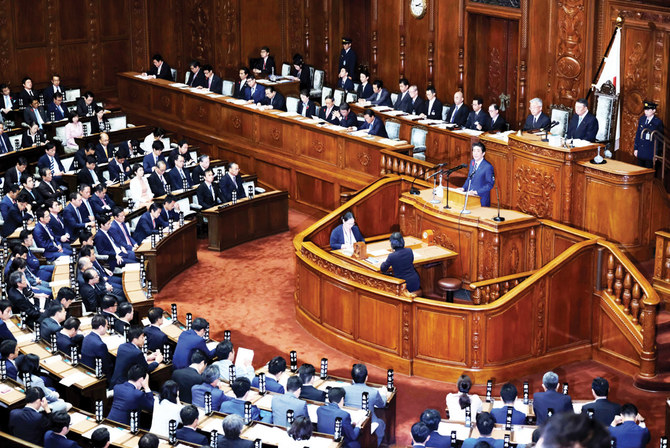

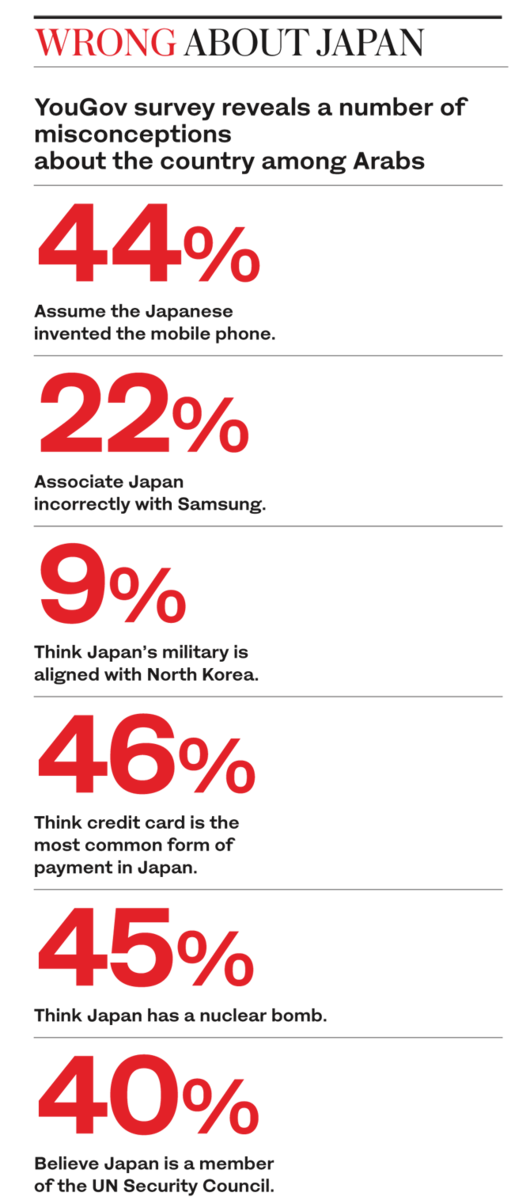
DUBAI: Many Arabs are not aware of Japan’s power structure, according to a YouGov survey of Arabs’ perception of the country, conducted for Arab News.
More than half (56 percent) of the 3,033 respondents from the GCC bloc, the Levant and North Africa, aged 16 or above, said they were unfamiliar with the power structure in Japan, although 44 percent correctly identified the prime minister as the final decision-maker.
“I don’t find this particularly surprising,” said Khobaib Osailan, a PhD candidate in the Department of Political Science at the University of California, Santa Barbara.
“There is little reason to expect a large number of Arabs to have an accurate knowledge of Japanese political structures.”
He told Arab News that while many Arabs are avid consumers of Japanese cultural products, from anime and manga to sushi, the majority do not view Japan as a key political player in the Arab world.
“Thus, there is little interest in gaining accurate knowledge of their internal political structure,” he said. “Also, many in the Arab world associate democracy with the West.
“For them, Japan is viewed as a model of economic success and less as a country with a democratically elected prime minister and an emperor with only ceremonial powers.”
The nature of Japanese politics was another possible explanation, he said.
“While Japan is a democracy where parliamentary elections occur every four years, one party, that is the Liberal Democratic Party (LDP), has been dominating government for at least six decades,” Osailan said.
“The lack of a heated and visible electoral competition may have reduced Arabs’ attention to Japanese politics.”
Theodore Karasik, senior adviser at Gulf State Analytics in Washington DC, agreed, stating that the role of the prime minister is similar in some other Arab countries.
“But Japan’s power structure is unique in itself in terms of structure, function, and outreach in terms of international economic affairs,” he told Arab News.
Overall, GCC nationals in the study were less aware of the political power structure in Japan, with as many GCC nationals identifying the emperor as the final decision-maker on laws as those correctly identifying the prime minister.
“It may sound like a stereotype, but GCC nationals may assume that Japan’s emperor has a final say because of story tales, movies and other means of communicating fiction or non-fictional images,” Karasik said.
“Images of a Japan with an emperor gets into the psyche and perhaps this may explain such thinking. Understanding the drivers for why this perception exists means educating people about Japan’s political structure and concepts surrounding Tokyo’s policy development.”
For Osailan, given the absence of accurate knowledge of Japan’s political institutions, many people in the GCC could be projecting their own political institutions onto Japan’s.
“Many people in GCC countries view monarchs as necessarily having considerable executive prerogatives,” he told Arab News.
“In other Arab countries, even monarchies like Jordan and Morocco, citizens are accustomed to having prime ministers as chief executives.”
Awareness of the powers of the prime minister is lowest in the UAE and Saudi Arabia, with only 35 percent of Saudi and UAE residents selecting the prime minister as the person who decides the laws.
According to Karasik, the reason may lie in the different style of governance found in the Arabian Peninsula as opposed to most other parts of the Middle East, while Osailan found such results surprising given that Saudi Arabia and the UAE are Japan’s largest trading partners in the Arab world.
“Why don’t these strong economic ties translate into greater knowledge of Japanese politics?” he asked.
“One possible answer is that, unlike economic ties with the US and some European countries, which are influenced by domestic political considerations, Saudi and Emirati economic ties with Japan are much less exposed to domestic political dynamics.
“However, one may expect a growing interest in Japan’s domestic politics among citizens of the Gulf, given the strong economic ties and, more recently, the Saudi-Japanese cooperation on Vision 2030.”


