MOSUL: Five years after he made their hometown infamous as the heart of his “caliphate,” residents of Iraq’s Mosul said Abu Bakr Al-Baghdadi’s death should be marked only one way — with “a huge party.”
In June 2014, Al-Baghdadi climbed a set of stairs at the Al-Nuri Mosque in the northern Iraqi city and declared himself “caliph” over millions of people in Iraq and Syria.
The announcement unleashed a volley of violence that killed thousands, displaced millions and left cities across both countries in ruin — including Mosul.
On Sunday, US President Donald Trump announced Al-Baghdadi’s death in a US special operations raid some 700 kilometers (430 miles) away in rural northwestern Syria.
“The people of Mosul should have a huge party,” said 37-year-old city resident Khaled Waleed, wearing a baseball camp and white shirt.
“This criminal, this butcher Abu Bakr Al-Baghdadi, he killed and slaughtered everyone,” he said bitterly.
Born in Iraq’s western Samarra in 1971, Ibrahim Awad Al-Badri took up the name Abu Bakr Al-Baghdadi as he rose through the ranks to become Daesh’s feared chieftain.
His fighters burst into Mosul in the summer of 2014 and he made his first and only public appearance shortly afterwards to declare an Islamic “caliphate.”
Extremists imposed a strict interpretation of “sharia” there: music and smoking were banned, and any perceived violations were met with brutal punishments — including public beheadings.
“I’ve had three strokes because of Daesh,” recalled Hani Mahmoud, 54.
“My house burned down. My car was set on fire,” said the portly man with a closely-trimmed white beard.
Umm Alaa, an Iraqi woman dressed in a worn black robe, said Al-Baghdadi “made our lives hell.”
“There’s not a single house they didn’t attack, not a single house they didn’t oppress,” she said.
“This is a festival, a festival for all Iraqis because he destroyed us,” she added.
Daesh kept Mosul in its grip for three years, until a ferocious offensive by US-backed Iraqi troops ousted the extremists in 2017.
But the group left behind a horrifying legacy.
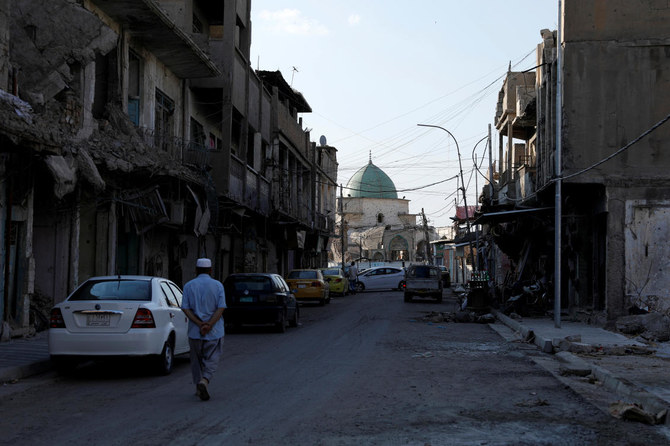
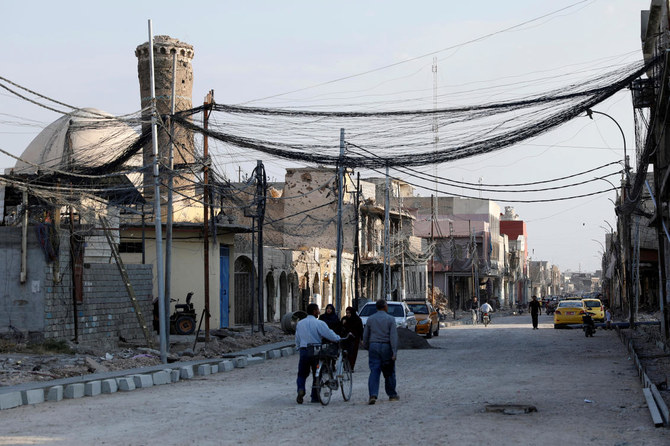
Many of Mosul’s neighborhoods, particularly the historic Old City which was the last area to be retaken, remain in ruins.
Slabs of concrete hang off destroyed and abandoned buildings like oversized hangnails.
The historic Al-Nuri Mosque stands gutted and covered in graffiti, while the adjacent ancient minaret — long the city’s symbol — was blown up in the violence.
Many residents have yet to return because their houses remain littered with unexploded ordnance or are damaged beyond habitation.
There are some 200 mass graves across the country where the remains of thousands of suspected Daesh victims have yet to be identified.
Several thousand people from the Yazidi minority are still missing, five years after Daesh ravaged their heartland near Mosul.
Bashar Hussam, 31, survived life under Daesh — unlike his father.
“My father had a blood clot and they didn’t let us leave until he died in front of my own eyes,” Hussam said.
While glad to see Baghdadi perish, he said it was not quite the happy ending he had hoped for.
“We want the other good news — that they rebuild our houses, that we go back to work and to our livelihoods.”


![]()
![]()

Iraq’s Mosul breathes easier after death of ‘butcher’ Al-Baghdadi
Iraq’s Mosul breathes easier after death of ‘butcher’ Al-Baghdadi
- “The people of Mosul should have a huge party,” said one city resident
- “I’ve had three strokes because of Daesh,” recalled another


Latest updates


© 2026 SAUDI RESEARCH & PUBLISHING COMPANY, All Rights Reserved And subject to Terms of Use Agreement.