

Tourists flock to Australia’s Uluru for last ever climb

1 / 2
Tourists are seen climbing Uluru, formerly known as Ayers Rock, at Uluru-Kata Tjuta National Park in the Northern Territory on October 25, 2019. (AAP Image/Lukas Coch/via REUTERS)
2 / 2
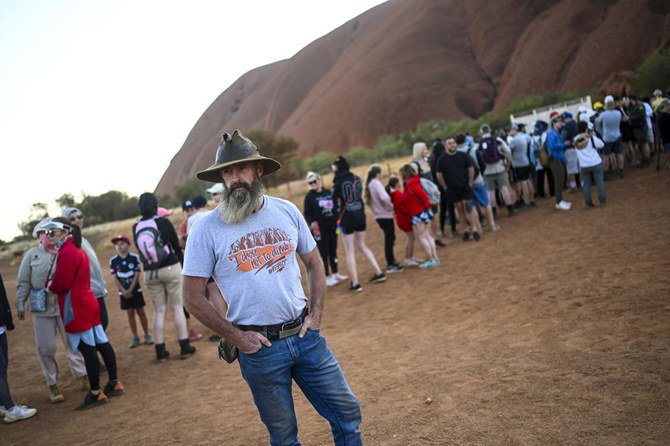
A man wearing a T-shirt saying "I chose not to climb" stands next to tourists lining up to climb Uluru, formerly known as Ayers Rock, at Uluru-Kata Tjuta National Park in the Northern Territory, Australia, October 25, 2019. (AAP Image/Lukas Coch/via REUTERS)
Updated 25 October 2019
Follow

Tourists flock to Australia’s Uluru for last ever climb

  • A permanent ban on scaling Uluru — also known as Ayers Rock — comes into place on Oct. 26
  • This is in line with the long-held wishes of the traditional Aboriginal owners of the land, the Anangu

ULURU, Australia: Hundreds of tourists flocked to Uluru on Friday for one last chance to climb the sacred site ahead of a ban, despite heavy winds preventing early attempts to scale the giant red monolith.
A permanent ban on scaling Uluru — also known as Ayers Rock — comes into place Saturday in line with the long-held wishes of the traditional Aboriginal owners of the land, the Anangu.
This has led to a surge of climbers in recent months.
Hundreds were left waiting for hours early Friday due to safety concerns over heavy winds, before rangers allowed climbers to head up the rock at 10 a.m. local time.
Parks Australia said they would reassess the weather conditions throughout the day to determine if climbers could continue to mount the rock.
More than 395,000 people visited the Uluru-Kata National Park in the 12 months to June 2019, according to Parks Australia, about 20 percent more than the previous year.
Around 13 percent of those who visited during that period made the climb, park authorities said.

Uluru has great spiritual and cultural significance to indigenous Australians, with their connection to the site dating back tens of thousands of years.
Indigenous Affairs Minister Ken Wyatt likened the surge of people rushing to climb Uluru with “a rush of people wanting to climb over the Australian War Memorial.”
“Our sacred objects, community by community, are absolutely important in the story and the history of that nation of people,” he told national broadcaster ABC.
Saturday marks 34 years since that the park’s title was handed back to the traditional owners.


Spanish police evict hundreds of migrants from squat deemed a safety hazard

Updated 7 sec ago
Follow

Spanish police evict hundreds of migrants from squat deemed a safety hazard

BARCELONA: Police in northeastern Spain began carrying out eviction orders Wednesday to clear an abandoned school building where hundreds of mostly undocumented migrants were living in a squat north of Barcelona.
Knowing that the eviction was coming, most of the occupants had left before police in riot gear from Catalonia’s regional police entered the school’s premises early in the morning under court orders.
The squat was located in Badalona, a working class city that borders Barcelona. Many sub-Saharan migrants, mostly from Senegal and Gambia, had moved into the empty school building since it was left abandoned in 2023.
The mayor of Badalona, Xavier García Albiol, announced the evictions in a post on X. “As I had promised, the eviction of the squat of 400 illegal squatters in the B9 school in Badalona begins,” he wrote.
Lawyer Marta Llonch, who represents the squatters, said that many of them lived from selling scrap metal collected from the streets, while a few others have residency and work permits but were forced to live there because they couldn’t afford housing.
“Many people are going to sleep on the street tonight,” Llonch told The Associated Press. “Just because you evict these people it doesn’t mean they disappear. If you don’t give them an alternative place to live they will now be on the street, which will be a problem for them and the city.”
García Albiol, of the conservative Popular Party, has built his political career as Badalona’s long-standing mayor with an anti-immigration stance.
The Badalona town hall had argued that the squat was a public safety hazard. In 2020, an old factory occupied by around a hundred migrants in Badalona caught fire and four people were killed in the blaze.
Like other southern European countries, Spain has for more than a decade seen a steady influx of migrants who risked their lives crossing the Mediterranean or Atlantic in small boats.
While many developed countries have taken a hard-line position against migration, Spain’s left-wing government has said that legal migration has helped its economy grow.