Trump sends $4.5 million aid to Syria’s White Helmets: White House

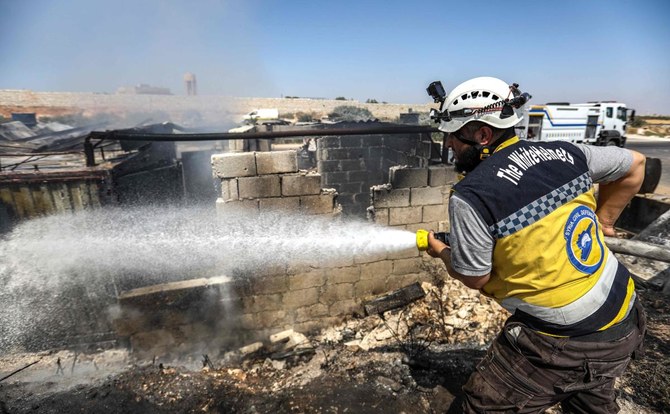
In this file photo taken on August 25, 2019, firefighters from the Syrian Civil Defence, also known as the "White Helmets", extinguish a fire at a vehicle gathering point for fleeing civilians, which was hit by reported government forces' bombardment, in Maar Shurin on the outskirts of Maaret al-Numan in Syria's northwestern Idlib province. (AFP)
Updated 22 October 2019
Follow

Trump sends $4.5 million aid to Syria’s White Helmets: White House

  • Trump ordered the funds for what is formally known as the Syria Civil Defense group
  • The White Helmets have received global recognition for dashing into heavy bombing to pull victims from the rubble

WASHINGTON: President Donald Trump has authorized $4.5 million in aid for Syria’s White Helmets group, famed for rescuing wounded civilians from the frontlines in the civil war, the White House said Tuesday.
Trump ordered the funds for what is formally known as the Syria Civil Defense group “to continue United States support for the organization’s important and highly valued work in the country,” spokeswoman Stephanie Grisham said in a statement.
The White Helmets have received global recognition for dashing into heavy bombing to pull victims from the rubble and get them to hospitals, which themselves have frequently been bombed or shelled.
The Syrian military, which is backed by Russia, has repeatedly targeted White Helmets activists, saying they are not independent but support anti-government insurgents.
Trump’s humanitarian gesture came amid a firestorm of criticism at home and abroad over his abrupt decision to withdraw a small but politically signficant contingent of US troops from Kurdish areas near Syria’s border with Turkey.
The withdrawal effectively opened the door for Turkey to launch a cross-border operation against the Kurds. Turkey sees them as a security threat but until now they had been a crucial ally of the US troops in fighting jihadist militants with the Daesh movement.


Cuba to protect essential services as US moves to cut off oil supply

Updated 4 sec ago
Follow

Cuba to protect essential services as US moves to cut off oil supply

HAVANA: Cuba detailed a wide-ranging plan on Friday to protect essential services and ration fuel ​as the communist-run government dug in its heels in defiance of a US effort to cut off oil supply to the Caribbean island.
The rationing measures are the first to be announced since President Donald Trump threatened to slap tariffs on the US-bound products of any country exporting fuel to Cuba and suggested hard times ahead for Cubans already suffering severe shortages of food, fuel ‌and medicine.
Government ‌ministers said the measures would guarantee ‌fuel supply ⁠for ​key sectors, ‌including agricultural production, education, water supply, health care and defense.
Commerce Minister Oscar Perez-Oliva struck a defiant tone as he laid out details of the government plan.
“This is an opportunity and a challenge that we have no doubt we will overcome,” Perez-Oliva told a television news program. “We are not going to collapse.”
The government will supply fuel to the ⁠tourism and export sectors, including for the production of Cuba’s world-famous cigars, to ensure ‌the foreign exchange necessary to fund other basic ‍programs, Perez-Oliva said, adding, “If we ‍don’t have income, then we will not overcome this situation.”
Domestic ‍and international air travel will not be immediately affected by the fuel rationing, although drivers will see cutbacks at the pump until supply normalizes, he said.
The government said it would protect ports and ensure fuel for ​domestic transportation in a bid to protect the island nation’s import and export sectors.
Perez-Oliva also announced an ambitious ⁠plan to plant 200,000 hectares (500,000 acres) of rice to guarantee “an important part of our demand,” but acknowledged fuel shortfalls would push the country to depend more on renewable energy for irrigation needs and animal-power for tilling fields.
Education Minister Naima Ariatne, appearing on the same program, said infant-care centers and primary schools would remain open and in person, but secondary schools and higher education would implement a hybrid system that would require more “flexibility” and vary by institution and region.
“As a priority, we want to leave (open) our primary schools,” Ariatne said.
Top officials said ‌health care would also be prioritized, with special emphasis on emergency services, maternity wards and cancer programs.