Uber turns to India, Africa and Middle East as losses mount

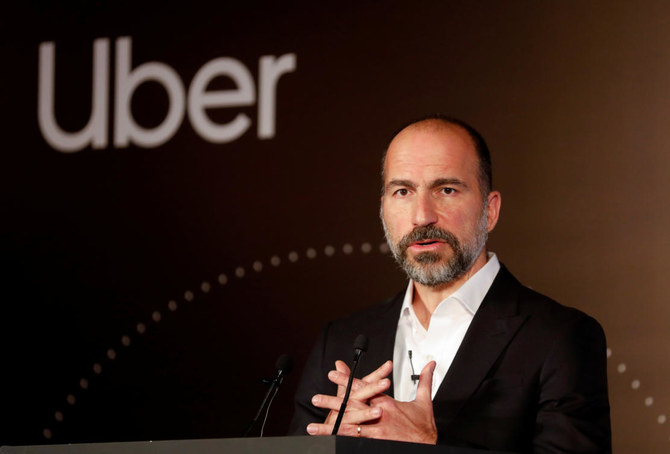
Uber CEO Dara Khosrowshahi speaks to the media at an event in New Delhi, India, October 22, 2019. (Reuters)
Updated 22 October 2019
Follow

Uber turns to India, Africa and Middle East as losses mount

  • Khosrowshahi brushed aside fears the stock price could fall further after the expiration of a lock-up period in November
  • Uber has exited several markets — including China and Southeast Asia — to pare back losses

NEW DELHI: The head of Uber said Tuesday that the global ride services firm was counting on India, Africa and the Middle East for future growth amid investor fears about mounting losses and a slump in its share price.
Uber has exited several markets — including China and Southeast Asia — to pare back losses, and is in fierce competition with rival Ola in India, a market estimated to be worth $7 billion a year.
Since its public offering in May, Uber’s share price has tumbled some 30 percent, while the company lost $5.2 billion in the second quarter.
“India is a fundamental part of Uber’s growth going forward... it’s a top 10 market for us,” chief executive Dara Khosrowshahi told reporters in New Delhi.
“The profitability characteristics of our business here are improving. If I look at Uber’s growth over the next 10 years, it’s... going to be defined by India, Africa and the Middle East, more so than the developed markets.”
Khosrowshahi brushed aside fears the stock price could fall further after the expiration of a lock-up period in November, after which company employees and early investors can sell their shares.
The chief executive, who was in Delhi to unveil an updated version of Uber’s app linking the Delhi Metro public transport system with its services, said he was focused on long-term prospects.
The revamped app is part of a global campaign to attract more users.
While India is one of Uber’s biggest markets — with 12 percent of its global rides — the firm still lags behind Ola in the nation of over 1.3 billion people.
It has also struggled to keep up with the two largest online food-delivery players Zomato and Swiggy.
The company laid off some staff in India as part of global job cuts as it tries to map a route to profitability.
But chief product officer Manik Gupta told AFP that Uber would double its technology team to 1,000 as proof of its commitment to Asia’s third-largest economy.
“We definitely want to show our commitment to India,” Gupta said.
Uber’s third-quarter results will be released in two weeks.


Egypt defies African FDI trend with inflows of $11bn in 2025: UNCTAD 

Updated 4 sec ago
Follow

Egypt defies African FDI trend with inflows of $11bn in 2025: UNCTAD 

RIYADH: Egypt emerged as Africa’s top destination for foreign direct investment in 2025, attracting an estimated $11 billion in inflows in a year marked by declining investment across the continent. 

According to UNCTAD’s latest Global Investment Trends Monitor, the North African country ranked ahead of other major African economies despite a sharp regional slowdown. 

The performance underscores Egypt’s relative resilience at a time when foreign investment into Africa has normalized following an unusually strong 2024, which UNCTAD said was inflated by a single large project. As a result, the 2025 data reflects a return to more typical investment levels across the continent. 

“Among African economies, inflows to Angola reached an estimated $3 billion, marking a return to positive values after nine consecutive years of net divestments,” the report stated. 

It added: “Egypt, with inflows of $11 billion, remained the largest FDI host country in Africa.”  

While Egypt solidified its position as Africa’s leading FDI host, other notable movements on the continent included Mozambique, where inflows surged 80 percent to $6 billion, driven by renewed activity in major liquified natural gas projects.  

Angola also saw a positive shift, recording an estimated $3 billion in FDI after nine consecutive years of net divestments. 

UNCTAD noted that Egypt’s strength extended beyond headline inflows, with the country also contributing to an increase in greenfield investment activity across Africa. While the number of greenfield projects fell globally and across most lower-income economies, Africa recorded a 5 percent increase in project numbers in 2025, supported in part by growth in Egypt and Côte d’Ivoire. 

Globally, FDI flows rose by 14 percent in 2025 to approximately $1.6 trillion, though growth was heavily concentrated in developed economies, which saw a 43 percent increase.  

In contrast, flows to developing economies declined by 2 percent, with the least developed countries particularly affected; three-quarters experienced stagnant or falling investment. 

The report highlighted that new project announcements remained weak globally amid elevated policy uncertainty, with international project finance declining for the fourth consecutive year.  

Looking ahead, UNCTAD warned that geopolitical tensions, regional conflicts, and economic fragmentation could continue to suppress real investment activity in 2026, even as financing conditions are expected to ease.  

For Africa, sustaining FDI inflows will require navigating persistent challenges such as financing constraints, risk perceptions, and structural vulnerabilities.