

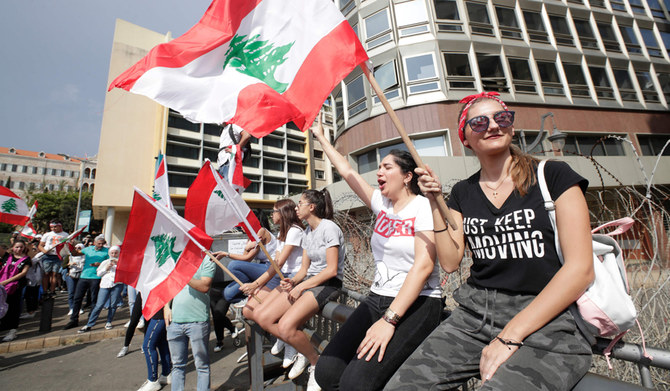

BEIRUT: Up to a million people thronged the streets of Beirut and other cities in Lebanon on Sunday as four days of protests against corruption and economic mismanagement showed no sign of abating.
The scene was more festival than riot. As music boomed from loudpeakers, a sea of protesters draped in Lebanese flags sang patriotic songs, danced in the streets, formed human chains and chanted for their leaders to be ousted.
“I am disgusted by our politicians. Nothing works. This is not a state. Salaries are low, prices are high. We don’t even have work,” said Cherine Shawa, 32. Hanan Takkouche, one of a group of women protesting in the capital, said: “We’re here to say to our leaders, ‘Leave.’ We have no hope in them but we’re hopeful that these protests will bring change. They came to fill their pockets. They’re all crooks and thieves.”
The protesters mocked a deadline of 7 p.m. on Monday set by Prime Minister Saad Hariri for his coalition partners to agree to a package of reforms. The government has backed down on proposed austerity measures and taxes, including a levy on WhatsApp calls, which sparked the first protests last Thursday. Demonstrators told Arab News they would not give up. “The people want everyone in power to resign, not only the prime minister,” said Mahmoud Fakih, protesting in Riad Al-Solh Square in Beirut.
READ MORE:
- Lebanese unite in anger at their political elite
- Lebanon’s Hariri agrees reforms amid nationwide protests over economic crisis
- Amid turmoil, Lebanese Forces ministers quit coalition government
“They want a technocrat mini-government to establish an electoral law that will ensure proper representation, early parliamentary elections and a new president.”
Politicians should “not bet on the waning of the momentum of the protests in the street,” Fakih said. “The more they speak, the more the people will reject them, that is what we saw after the Hezbollah leader Hassan Nasrallah’s speech on Saturday. The Lebanese people have seen the results of his party’s presence in power.”
Future Movement MP Samir Jisr told Arab News Hariri had proposed a package of 10 reform items. “The most important is approving a tax-free budget and sending it immediately to Parliament,” he said. “If the package is not fully realized, Hariri will step down.”
Dr. Nasser Yassin, a public policy expert at the American University of Beirut, called for early parliamentary elections, fair representation, a rescue government and a serious reform program. The protests were the result of government mismanagement and failure to launch reforms, and its condescending attitude, he said.
“Officials have been speaking as if they were in denial. It is frightening, and what comes next will be even more painful if they do not withdraw to make way for a transitional phase with clean people.”


