

Kurdish leader’s killing a ‘war crime,’ says former US envoy

1 / 2
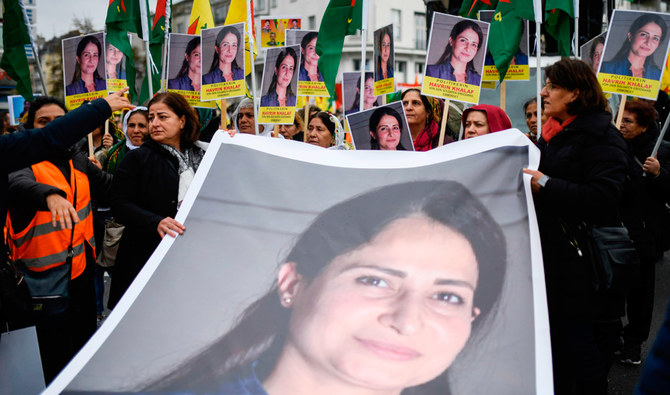
Kurdish protesters hold a photo of Hevrin Kahlaf during a pro-Kurdish demonstration in Cologne, western Germany on October 19, 2019. (AFP)
2 / 2
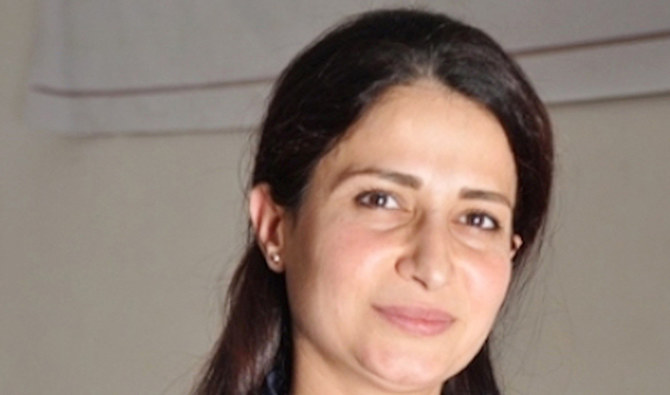
Hevrin Khalaf, a Kurdish leader.
Updated 21 October 2019
Follow

Kurdish leader’s killing a ‘war crime,’ says former US envoy

  • The human rights group said Ankara has a responsibility to halt violations carried out by forces under its control

ANKARA: The killing of a female Kurdish party official during a Turkish offensive on Kurdish-held border towns in northeastern Syria has been condemned as a “war crime” by a former US special envoy.
Hevrin Khalaf, secretary general of the Future Syria Party, was one of nine civilians killed by Ankara-backed fighters on Oct. 12 on a highway outside Raqqa.
Khalaf and her driver are believed to have been forced from their car and summarily executed by a rebel group named Ahrar Al-Sharqiya fighting alongside Turkish forces in Syria.
Brett McGurk, the former special presidential envoy for the Global Coalition to Counter Daesh, condemned the execution as a “war crime.” The US State Department also issued a statement calling the news of Khalaf’s death “troubling.”
Local and international observers also criticized the killings.
In a statement on Oct 18, Amnesty International cited a medical report listing Khalaf’s injuries, including gunshot wounds to her head, face and back.
“Killing defenseless people in cold blood is utterly reprehensible and a blatant war crime,” the statement said. “The murder of Khalaf and others must be independently investigated and the perpetrators brought to justice.”
The human rights group said Ankara has a responsibility to halt violations carried out by forces under its control.
“Unless Turkey reins in its proxy forces and ends impunity for violations, it will encourage further atrocities,” the statement said.

FASTFACT

Hevrin Khalaf, secretary general of the Future Syria Party, was one of nine civilians killed by Ankara-backed fighters on Oct. 12 on a highway outside Raqqa.

Turkish troops and allied fighters launched a military offensive on Oct 9 to push Syrian Kurdish YPG militia and its political wing Democratic Union Party (PYD) away from Turkey’s border with Syria. Ankara accuses the PYD of having links with Kurdish PKK militants who have been waging a decades-long insurgency inside Turkey.
The Future Syria Party is considered by the Turkish government as a branch of the PYD.
Khalaf, a resident of the northeastern Syrian town of Malikiyah, was known for her efforts to unite religious groups in northeastern Syria and replace the Assad regime with a multi-ethnic democracy.
The Syrian Network for Human Rights, a nongovernment group that monitors fighting in the country, told Arab News that its investigations into the incident were hampered by the lack of a strong network in the area.
“The incident seems to have taken place on a road, not in a residential zone. We are unable to verify how she was killed or who killed her,” the group said.


Morocco pushes to reform social security system amid inflation and economic pressure, PM says

Updated 6 sec ago
Follow

Morocco pushes to reform social security system amid inflation and economic pressure, PM says

  • Speaking at the World Economic Forum in Davos, Aziz Akhannouch said his government had expanded healthcare to more than 80 percent of its population

DUBAI: Morocco’s prime minister said on Tuesday that the country was pursuing radical social and economic reforms in the wake of inflationary and economic pressures.

Speaking at the World Economic Forum in Davos, Aziz Akhannouch said his government had expanded healthcare to more than 80 percent of its population, up from just 42 percent when he took office three years ago.

He said this also coincided with consistently strong economic growth and headline inflation reducing to below 1 percent. 

“In a world that doubts itself, Morocco has decided to protect its population, reform and look forward,” he told attendees in Davos.

In late 2025, Morocco was rocked by its largest demonstrations in over a decade as youth‑led groups mobilized nationwide against deteriorating public services, deepening social inequality, and chronic unemployment.

Akhannouch said the country was aware of the difficulties facing Moroccans and was determined to ensure the country would remain on a positive trajectory.

Part of this included the provision of financial aid to more than 12 million citizens, and the formation of trusts for orphans to be paid out when they turn 18.

“Health means dignity, if you want to have a decent life you have to have good health,” he said.

Nevertheless, Akhannouch noted that the government had not forgone its budgetary principles — and had in fact balanced the country’s debt payments and achieved successful fiscal reforms. He noted S&P’s decision in 2025 to raise Morocco’s sovereign rating to BBB‑/A‑3 and restore its investment‑grade status.

Speaking on the World Cup, set to be co-hosted with neighbors Spain and Portugal in 2030, he said the project was seen as a nation-building exercise that would help spur Morocco to develop its underlying infrastructure and provide employment opportunities for young Moroccans.

“It will be a growth accelerator,” he said.

“When we build new rail networks and upgrade cities it will have a long-term impact on people.”