Japan allocates millions in aid for typhoon-hit regions

1 / 3
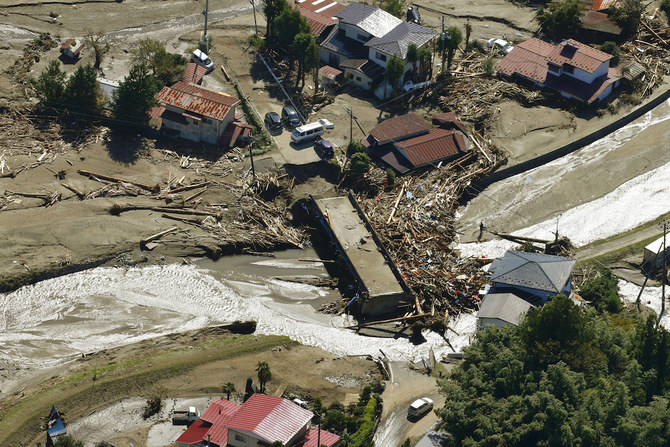
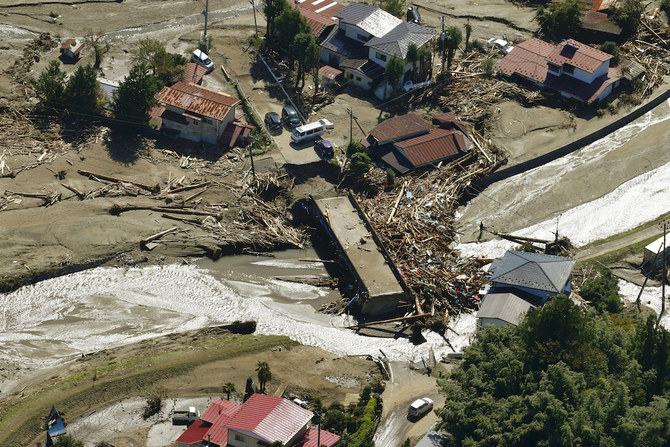
Driftwood is piled around a bridge after Typhoon Hagibis hits the town in Marumori, Miyagi prefecture, northern Japan Wednesday, Oct. 16, 2019. (AP)
2 / 3
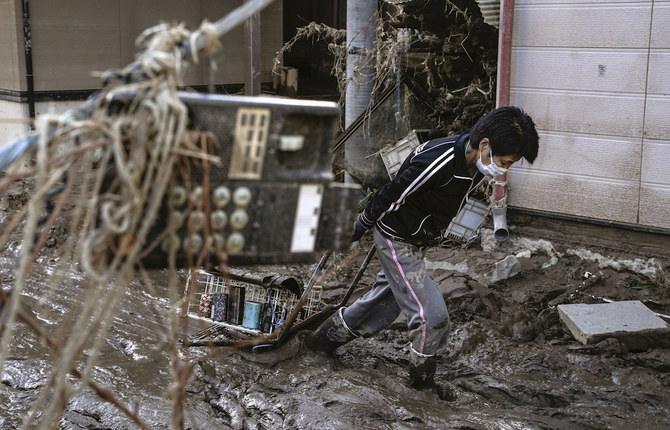
A woman makes her way though the mud and debris from Typhoon Hagibis, with a phone hanging on the wire, front, at Hoyasu district in Nagano, central Japan Wednesday, Oct. 16, 2019. (AP)
3 / 3
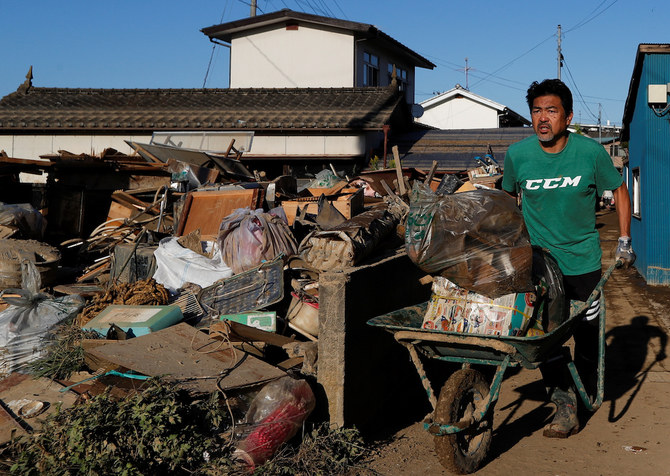
A man cleans debris in the aftermath of Typhoon Hagibis in Yanagawamachi district, Date City, Fukushima prefecture, Japan October 16, 2019. (Reuters)
Updated 16 October 2019
Follow

Japan allocates millions in aid for typhoon-hit regions

  • Japanese government will spend $6.5m to cover evacuees’ expenses
  • Rescue work in Nagano and Fukushima is gradually shifting to clean up

TOKYO: Japan's government said Wednesday it would set aside millions of dollars to help areas devastated by Typhoon Hagibis, which killed more than 70 people across the country.
Hagibis slammed into Japan on Saturday, unleashing fierce winds and unprecedented rain that triggered landslides and caused dozens of rivers to burst their banks.
By midday Wednesday, the government put the toll at 74, with more a dozen people still missing.
Prime Minister Shinzo Abe said his government would offer 710 million yen ($6.5 million) to help areas affected by the storm.
The money will come from some a 500 billion yen emergency reserve, he said.
Tokyo will also fast-track the disbursement of subsidies to more than 300 disaster-hit municipalities.
"The government will stand united to tackle the issue of supporting victims, so that they will be able to return to normal life as quickly as possible," Abe said.
As of Wednesday morning, more than 10,000 households were still suffering from electricity blackouts, while more than 110,000 households are without running water, top government spokesman Yoshihide Suga told reporters.
"Today, too, rescue workers are making their utmost efforts in search and rescue work," he said.
"Due to the heavy rains we've experienced, the level of water is rising in rivers and there are spots where the ground is getting muddy."
"We call on people to keep vigilant about landslides and floods," he added.
Television footage showed devastated residents returning to homes filled with brown mud, and rescuers searching a hillside for a family missing after a landslide.
The country's northeast was particularly hard hit by the typhoon -- with a death toll of 26 in Fukushima prefecture, the highest among the 36 of Japan's 47 prefectures that were affected.
Collapsed embankments were observed at around 80 locations along 55 rivers in the country, the infrastructure ministry said, as it continues to asses the extent of the damage.
Local trains have gradually resumed operation but some Shinkansen bullet trains were still suspended in the hard-hit Nagano and Niigata regions in central Japan.


Tug of war: how US presidents battle Congress for military powers

Updated 01 March 2026
Follow

Tug of war: how US presidents battle Congress for military powers

  • The last official declaration of war by Congress was as far back as World War II

WASHINGTON, United States: Donald Trump’s unleashing of operation “Epic Fury” against Iran has once more underscored the long and bitter struggle between US presidents and Congress over who has the power to decide on foreign military action.
In his video address announcing “major combat” with the Islamic republic, Trump didn’t once mention any authorization or consultation with the US House of Representatives or Senate.
In doing so he sidelined not only Democrats, who called for an urgent war powers vote, but also his own Republican party as he asserts his dominance over a largely cowed legislature.
A US official said Secretary of State Marco Rubio had called top congressional leaders known as the “Gang of Eight” to give them a heads up on the Iran attack — adding that one was unreachable.
Rubio also “laid out the situation” and consulted with the same leaders on Tuesday in an hour-long briefing, the US official said.
According to the US Constitution, only Congress can declare war.
But at the same time the founding document of the United States first signed in 1787 says that the president is the “commander in chief” of the military, a definition that US leaders have in recent years taken very broadly.
The last official declaration of war by Congress was as far back as World War II.
There was no such proclamation during the unpopular Vietnam War, and it was then that Congress sought to reassert its powers.
In 1973 it adopted the War Powers Resolution, passed over Richard Nixon’s veto, to become the only lasting limit on unilateral presidential military action abroad.
The act allows the president to carry out a limited military intervention to respond to an urgent situation created by an attack against the United States.
In his video address on Saturday, Trump evoked an “imminent” threat to justify strikes against Iran.

- Sixty days -

Yet under this law, the president must still inform Congress within 48 hours.
It also says that if the president deploys US troops for a military action for more than 60 days, the head of state must then obtain the authorization of Congress for continued action.
That falls short of an official declaration of war.
The US Congress notably authorized the use of force in such a way after the September 11, 2011 attacks on the United States by Al-Qaeda. Presidents have used it over the past two decades for not only the 2001 invasion of Afghanistan but a series of operations in several countries linked to the “War on Terror.”
Trump is far from the first US president to launch military operations without going through Congress.
Democrat Bill Clinton launched US air strikes against Kosovo in 1999 as part of a NATO campaign, despite the lack of a green light from skeptical lawmakers.
Barack Obama did the same for airstrikes in Libya in 2011.
Trump followed their example in his first term in 2018 when he launched airstrikes in Syria along with Britain and France.
But since his return to power the 79-year-old has sought to push presidential power to its limits, and that includes in the military sphere.
Trump has ordered strikes on alleged drug trafficking boats in Latin America without consulting Congress, and in June 2025 struck Iran’s nuclear facilities.
Perhaps the most controversial act was when he ordered the capture of Venezuelan president Nicolas Maduro in a lightning military raid on January 3.
Republicans however managed to knock down moves by Democrats for a rare war powers resolution that would have curbed his authority over Venezuela operations.
Trump has meanwhile sought to extend his powers over the home front. Democrats have slammed the Republican for deploying the National Guard in several US cities in what he calls a crackdown on crime and immigration.