TheFace: Haifa Abuzabibah, Saudi human resources leader

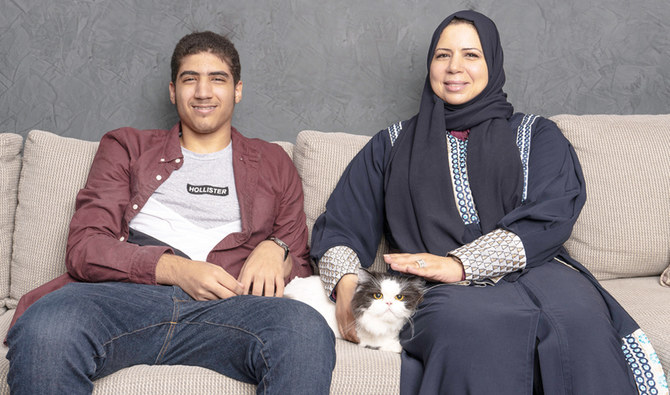
Hayfa AbuZabibah and her Son Abdulrahman & Panda the Cat! (AN photo by Ziyad Alarfaj)
Updated 11 October 2019
Follow

TheFace: Haifa Abuzabibah, Saudi human resources leader

I am a human resources leader at a prestigious private company. In the summer of 1983, a traditional Saudi family broke out of their cultural bubble and began a new life experience. My father applied for early retirement after 20 years of working in a big company. In one month, we had packed and moved to the Sunshine State: California.

We were a typical Saudi family of six children, which was not a normal sight in California. My youngest brother was barely 2 years old and my older sister was around 13. I am the second oldest and had just turned 11. I didn’t know a word of English except “yes” and “no.”

My father went to the US to complete his higher education. He took a risk and traveled with his whole family for the purpose of education. Education and learning became forever ingrained in me.

Being immersed in America was easy for me because I was young. I learned the language and acquired an American accent quickly enough. More importantly, I thrived on practicality, inclusiveness and multi-cultural landscape inherent in the DNA of America.

Returning to Saudi Arabia in 1997 was easy, too. I landed my first job in human resources, started a family and managed to balance family and a fulfilling career.

I have two children. Bayanne is 18 years old and Abdulrahman is 16. As my father invested in me, I now invest in my daughter’s college education at Dar Al-Hekma College.

Before college Bayanne, along with my son Abdulrahman, went to an international school. Their father and I wanted them to gain a global perspective and become responsible global citizens.

Challenges in life helped me become empathetic. I feel strongly that everything happens in life to help us understand that life is a journey. Discovering that people and materialistic things come and go, I knew that what remains constant is Allah. 

When I was younger, my parents solved all my problems. As I came into adulthood and became a parent myself, I noticed that problems got bigger and more difficult and that only God can help me overcome them and improve the quality of my life, and I seek his guidance to become a better person.

I truly saw life as a mirror, as it was important for me to reflect by assessing where I was in life. So I like focusing on what I can control and I know that I always have choices in life, because I do not like playing the victim.

In my opinion, my greatest achievement in life is being an independent mother, leader and a corporate citizen. I aim to become my best self, help others who cross my path to fulfill their potential and have a positive impact where I can. My curiosity for learning and my wish to inspire others to learn continues to grow.

My favorite quote is by someone I think of as my hero — Oprah Winfrey — and it reads: “When you do your best, people notice. So, wherever you are, always do your best, and doing your best puts you at the next level.” 


Threat to Kingdom’s security is ‘red line’ that will be ‘addressed and neutralized,’ Saudi envoy says

Updated 14 January 2026
Follow

Threat to Kingdom’s security is ‘red line’ that will be ‘addressed and neutralized,’ Saudi envoy says

  • Abdulaziz Alwasil tells UN Security Council the situation in southern Yemen is ‘a just cause with social and historic dimensions’ that can only be resolved through dialogue
  • Recent military activity in the south was unilateral, resulting in an escalation that harms the interests of Yemeni people and undermines efforts to address issues in the south, he said

NEW YORK CITY: Any attempt to threaten Saudi Arabia’s national security is a “red line” and will be met with decisive action, the Kingdom’s ambassador to the UN told the Security Council on Wednesday.

Speaking during a meeting of the council to discuss Yemen, Abdulaziz Alwasil said the situation in the south of the country is “a just cause with social and historic dimensions” that can only be resolved through dialogue.

“We stress that any attempt to threaten our national security is a red line, and we will not hesitate to take the necessary actions and steps to address it and neutralize it,” he added.

Alwasil reaffirmed Saudi Arabia’s support for Yemeni President Rashad Al-Alimi, the Presidential Leadership Council, and the Yemeni government in their efforts to achieve security, stability, development and peace while preserving national unity.

He said military activity by Southern Transitional Council forces in Hadramout and Al-Mahra on Dec. 2, 2025, was unilateral, did not have the approval of the Presidential Leadership Council, and was not carried out in coordination with the Coalition to Restore Legitimacy in Yemen.

It had resulted in an unjustified escalation that harmed the interests of the Yemeni people, undermined efforts to address the issues in the south, and ran counter to the coalition’s objectives, Alwasil added.

The Kingdom, working with its coalition partners, the Presidential Leadership Council and the Yemeni government, had moved to contain the situation by dispatching a military force to coordinate arrangements with the Southern Transitional Council in Aden, he said.

The aim was to ensure the return of the southern council’s forces to their previous positions outside of Hadramout and Al-Mahra, and the handover of camps to legitimate government forces and local authorities in line with agreed procedures, Alwasil added.

He expressed regret over the military operations that took place in Hadramout and Al-Mahra, close to Saudi Arabia’s southern border, which he said posed a direct threat to the Kingdom’s national security, as well as the security of Yemen and regional stability. Such steps were extremely dangerous, he added, and contradicted the principles on which the Coalition to Restore Legitimacy in Yemen had been founded.

Alwasil welcomed a prisoner and detainee exchange agreement signed in Muscat on Dec. 23, which he described as an important humanitarian measure to alleviate suffering and build confidence.

He praised Oman for hosting and sponsoring the consultations and supporting negotiations, and commended the efforts of UN’s special envoy for Yemen, Hans Grundberg, the International Committee of the Red Cross and all others that has played a part.

Regarding the political efforts to resolve the crisis, Alwasil said Saudi Arabia welcomed President Al-Alimi’s call for an inclusive conference in Riyadh to bring together all stakeholders to discuss just solutions to the situation in southern Yemen.

Preparations for the conference have begun, he added, in cooperation with the Yemeni government and southern representatives, reflecting the close ties between the two countries and their shared interests in stabilizing Yemen.

He urged all southern stakeholders to participate actively and constructively in the talks, to help find comprehensive and just solutions that meet the legitimate aspirations of the people of southern Yemen.

Alwasil called on all Yemeni forces and stakeholders to cooperate and intensify their efforts to reach a lasting political settlement that would ensure security and stability.

He described the southern issue as “a just cause with social and historic dimensions,” adding that “the only way to address it is through dialogue that leads to a comprehensive political solution” based on nationally and internationally agreed terms of reference.