

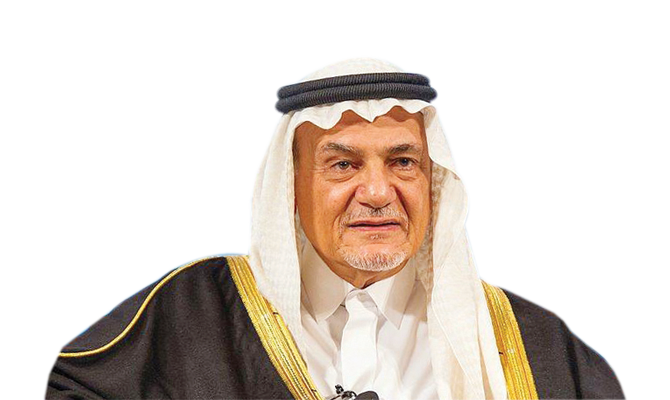
Prince Turki Al-Faisal, co-founder of the King Faisal Foundation

Prince Turki Al-Faisal
Updated 09 October 2019
Follow

Prince Turki Al-Faisal, co-founder of the King Faisal Foundation

Prince Turki Al-Faisal is a co-founder and trustee of the King Faisal Foundation and currently serves as chairman of its Center for Research and Islamic Studies. He has also been an adviser at the Royal Court since 1973.

Between 1977 and 2001, Prince Turki was the director general of the General Intelligence Directorate (GID).

In October 2002, Prince Turki became the Kingdom’s ambassador to the UK and Ireland. In 2005 he took up an ambassadorial role in the US, a position he held until his retirement in 2007.

He received an honorary Ph.D. in Law from the University of Ulster in Ireland in 2010, and another honorary Ph.D. in International Politics from the University of Hankuk in Korea in 2011. He is a visiting Distinguished Professor at Georgetown University.

Prince Turki holds a bachelor’s degree from the Edmund A. Walsh School of Foreign Service at Georgetown University, where he studied alongside former US President Bill Clinton.

He also studied at Princeton, University of Cambridge, and the University of London, where he attended courses in Islamic law and jurisprudence.

Prince Turki recently received one of Afghanistan’s highest honors — the Ghazi Mir Bacha Khan medal — for his work in support of Afghan independence.

Afghan Minister of Finance Mohammad Qayoumi and the country’s ambassador to Saudi Arabia, Sayed Jalal Karim, made the presentation at a ceremony in the Prince Sultan bin Abdul Aziz Hall on Monday, which included a video message from Afghan President Ashraf Ghani congratulating Prince Turki on his medal.

“The Ghazi Mir Bacha Khan medal is a symbol of honor and admiration awarded to exceptional personalities to acknowledge their remarkable efforts on behalf of Afghanistan,” Ghani said.

Prince Turki thanked the Afghan leader for the award, and expressed his desire for peace and stability in Afghanistan.


Saudi Arabia, UAE and allies condemn Gaza ceasefire violations

Updated 34 min 59 sec ago
Follow

Saudi Arabia, UAE and allies condemn Gaza ceasefire violations

  • They joined Qatar, Jordan and Egypt, who on Saturday also condemned ongoing violations

RIYADH: Saudi Arabia on Sunday led renewed regional condemnation of Israel’s repeated violations of the ceasefire in Gaza, which have resulted in the killing and wounding of more than 1,000 Palestinians.

In a joint statement, the foreign ministers of the Kingdom, the UAE, Indonesia, Pakistan and Turkiye said the breaches represented a dangerous escalation that risked inflaming tensions and undermining efforts to restore calm and stability, the Saudi Press Agency reported.

They joined Qatar, Jordan and Egypt, who on Saturday condemned what they described as ongoing ceasefire violations and warned they threatened de-escalation efforts and regional stability.

The ministers said the latest developments come at a critical moment, as regional and international efforts intensify to advance the second phase of the peace plan proposed by US President Donald Trump and implement UN Security Council Resolution 2803, SPA added.

They warned that the repeated violations pose a direct threat to the political process and could derail attempts to create the conditions for a more stable phase in Gaza, both in security and humanitarian terms. They stressed the need for full adherence to the ceasefire to ensure the success of the next phase of the peace plan.

The statement called on all parties to assume their responsibilities during this sensitive period, exercise maximum restraint, sustain the ceasefire, and avoid any actions that could undermine current diplomatic efforts. It also urged steps to facilitate early recovery and reconstruction in the Gaza Strip.

Reaffirming their commitment to a just, comprehensive and lasting peace, the ministers said this must be based on the Palestinian people’s inalienable right to self-determination and the establishment of an independent state, in line with international law, relevant UN Security Council resolutions and the Arab Peace Initiative.