


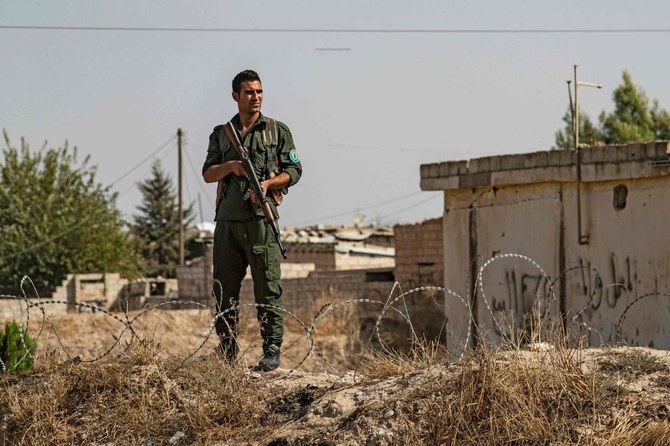

QAMISHLI, Syria: The Kurdish administration in northeastern Syria called up civilians on Wednesday to defend the region against a feared Turkish assault, believed to be imminent.
“We announce three days of general mobilization in northern and eastern Syria,” it said in a statement, urging all civilians to “head to the border with Turkey... to resist during this delicate historical moment.”
It also called on Kurds in Syria and abroad to protest against Ankara’s planned offensive. Ankara said on Tuesday it would “shortly” begin an offensive into northern Syria, as it sent more armored vehicles to the border.
Meanwhile, Iran’s President Hassan Rouhani called on Turkey to show restraint and avoid military action in Northern Syria, and said US forces should leave the region.
“Turkey is rightfully worried about its southern borders. We believe that a correct path should be adopted to remove those concerns... American troops must leave the region... Kurds in Syria... should support the Syrian army,” state news agency IRNA quoted Rouhani as saying.
Turkey’s communications director, Fahrettin Altun, wrote in the Washington Post that Kurdish forces can either “defect” or Turkey will “have no choice but to stop them from disrupting our counter-Islamic State efforts.”
The head of the Arab League said he is alarmed at Turkey's planned military offensive into northeastern Syria, against the Syrian Kurdish fighters there. Ahmed Aboul Gheit said in a statement on Wednesday that such an invasion would be a "blatant violation of Syria's sovereignty and threatens Syria's integrity."
He added that Turkey's planned incursion also threatens to inflame further conflicts in eastern and northern Syria, and "could allow for the revival" of the Islamic State group. Turkey has been preparing for an attack on the Kurdish fighters in Syria whom Ankara considers terrorists allied with a Kurdish insurgency within Turkey.
Opinion
This section contains relevant reference points, placed in (Opinion field)
US President Donald Trump has blown hot and cold since a surprise announcement on Sunday that Washington was pulling back 50 to 100 “special operators” from Syria’s border with Turkey.
After appearing to give a green light to the Turkish invasion, he later threatened to “obliterate” Turkey’s economy if it went too far.
He also insisted the United States had not abandoned its Kurdish allies by pulling forces out of the area.
Russian Foreign Minister Sergei Lavrov on Wednesday warned of the risks of Washington sending mixed signals on an American withdrawal from northern Syria.
“(US actions in Syria) are full of contradictions and reflect our American colleagues’ inability to reach agreements,” Lavrov said on a visit to Kazakhstan’s capital Nur-Sultan.
“Americans have violated their promises many times.”
He also accused the United States of violating Syria’s territorial integrity and seeking to create “quasi-states” in northern Syria to the displeasure of Arab tribes living on those territories.
“This is a very dangerous game,” Lavrov said.
Russia’s top diplomat, who visited Baghdad and the Iraqi Kurdish capital Irbil earlier this week, said he discussed the topic with the Kurdish leaders in Iraq.
“They are extremely alarmed that such a lightweight treatment of this extremely delicate subject could ignite the entire region,” Lavrov said.
“This must be avoided at all costs.”
On Wednesday, the Kurdish administration said it would hold its US ally and the whole international community responsible for any “humanitarian catastrophe” that unfolds in the territory under its control.
Kurdish forces took heavy losses in the US-backed campaign against the Daesh group in Syria which they spearheaded.
In March, they declared the territorial defeat of Daesh after overrunning the jihadists’ last redoubt in the village of Baghouz in eastern Syria.
Ankara strongly opposed Washington’s support for Kurdish forces in Syria citing their links to the outlawed Kurdistan Workers’ Party (PKK) which has fought a deadly insurgency against the Turkish state since 1984.
Turkey has already carried out two cross-border offensives into Syria, including one in 2018 that saw it and allied Syria rebels overrun the majority-Kurdish Afrin enclave in the northwest.


