WASHINGTON: The US Commerce Department announced Monday it is blacklisting 28 Chinese entities that it says are implicated in rights violations and abuses targeting Uighurs and other mostly Muslim minorities in the Xinjiang region.
Secretary of Commerce Wilbur Ross announced the move, which bars the named entities from purchasing US products, saying the United States “cannot and will not tolerate the brutal suppression of ethnic minorities within China.”
According to an update to the US Federal Register set to be published Wednesday, the blacklisted firms included video surveillance company Hikvision, as well as artificial intelligence companies Megvii Technology and SenseTime.
Right groups say China has detained around one million Uighurs and other Muslims in re-education camps in western Xinjiang region in a step Washington says is reminiscent of Nazi Germany.
China had until recently denied the camps existed but now claims they are “vocational training schools” necessary to control terrorism, while decrying interference in its “internal affairs.”
The US move came after Washington banned technology giant Huawei and other Chinese firms from government contracts, amid the trade war between the two countries.

US blacklists 28 Chinese entities over abuses in Xinjiang
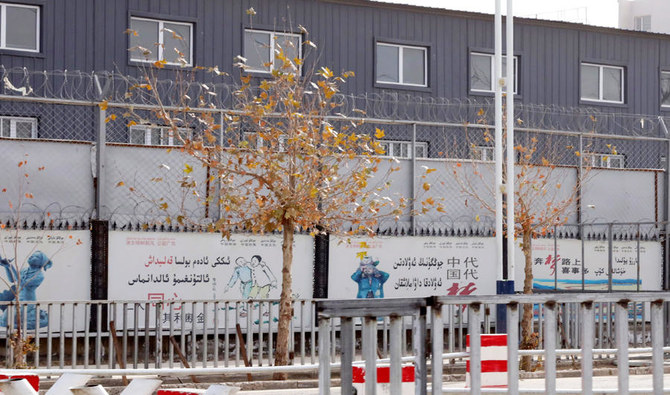
- China had until recently denied the camps existed but now claims they are “vocational training schools” necessary to control terrorism, while decrying interference in its “internal affairs”
Russian minister visits Cuba as Trump ramps up pressure on Havana
- The Russian embassy in Havana said the minister would “hold a series of bilateral meetings” while in Cuba
HAVANA: Russia’s interior minister began a visit to ally Cuba on Tuesday, a show of solidarity after US President Donald Trump warned that the island’s longtime communist government “is ready to fall.”
Trump this month warned Havana to “make a deal,” the nature of which he did not divulge, or pay a price similar to Venezuela, whose leader Nicolas Maduro was ousted by US forces in a January 3 bombing raid that killed dozens of people.
Venezuela was a key ally of Cuba and a critical supplier of oil and money, which Trump has vowed to cut off.
“We in Russia regard this as an act of unprovoked armed aggression against Venezuela,” Russia’s Interior Minister Vladimir Kolokoltsev told Russian state TV Rossiya-1 of the US actions after landing in Cuba.
“This act cannot be justified in any way and once again proves the need to increase vigilance and consolidate all efforts to counter external factors,” he added.
The Russian embassy in Havana said the minister would “hold a series of bilateral meetings” while in Cuba.
Russia and Cuba, both under Western sanctions, have intensified their relations since 2022, with an isolated Moscow seeking new friends and trading partners since its invasion of Ukraine.
Cuba needs all the help it can get as it grapples with its worst economic crisis in decades and now added pressure from Washington.
Trump has warned that acting President Delcy Rodriguez will pay “a very big price” if she does not toe Washington’s line — specifically on access to Venezuela’s oil and loosening ties with US foes Cuba, Russia, China and Iran.
On Tuesday, Russia’s ambassador to Havana, Victor Koronelli, wrote on X that Kolokoltsev was in Cuba “to strengthen bilateral cooperation and the fight against crime.”
The US chief of mission in Cuba, Mike Hammer, meanwhile, met the head of the US Southern Command in Miami on Tuesday “to discuss the situation in Cuba and the Caribbean,” the embassy said on X.
The command is responsible for American forces operating in Central and South America that have carried out seizures of tankers transporting Venezuelan oil and strikes on alleged drug-trafficking boats.
- Soldiers killed -
Cuba has been a thorn in the side of the United States since the revolution that swept communist Fidel Castro to power in 1959.
Havana and Moscow were close communist allies during the Cold War, but that cooperation was abruptly halted in 1991 with the dissolution of the Soviet bloc.
The deployment of Soviet nuclear missile sites on the island triggered the Cuban Missile Crisis of 1962, when Washington and Moscow came close to war.
During his first presidential term, Trump walked back a detente with Cuba launched by his predecessor Barack Obama.
Thirty-two Cuban soldiers, some of them assigned to Maduro’s security detail, were killed in the US strikes that saw the Venezuelan strongman whisked away in cuffs to stand trial in New York.
Kolokoltsev attended a memorial for the fallen men on Tuesday.


