China’s Xi and India’s Modi to hold summit this week amid strains

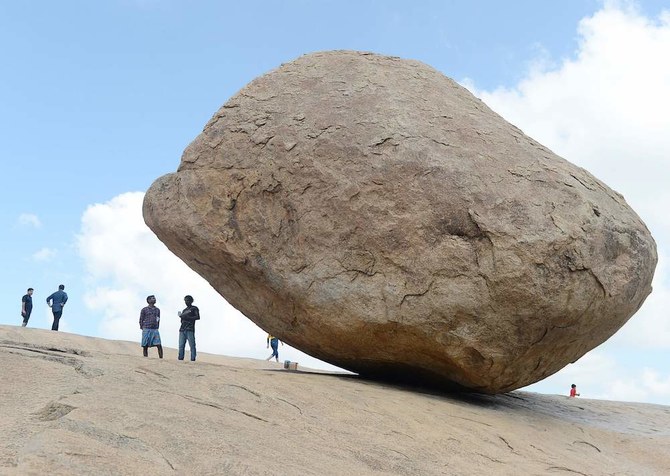
Visitors stand beside the granite boulder 'Krishna's Butterball' at Mahabalipuram. (AFP/File)
Updated 07 October 2019
Follow

China’s Xi and India’s Modi to hold summit this week amid strains

  • Indian media reports said Xi and Modi will visit Mamallapuram’s attractions
  • Beijing singled out India’s decision to create a separate administrative territory in Ladakh

NEW DELHI: India’s Prime Minister Narendra Modi and China’s President Xi Jinping will hold an informal summit in southern India on Friday, officials said, amid strains in their relationship.
The meeting follows months of niggling between the world’s two most populous nations over trade, border disputes, and their respective diplomatic moves.
India’s foreign ministry has not formally announced the meeting in the Tamil Nadu town of Mamallapuram, known for its historic temples and architecture.
But it has opened media registration for a “second India-China informal summit,” and Chinese officials have been scouting out the seaside town for several weeks.
Indian media reports said Xi and Modi will visit Mamallapuram’s attractions on the follow up to their first informal summit in Wuhan, China, in April last year.
That meeting followed an intense high-altitude stand-off at a disputed border post in the Himalayas.
Xi is expected to leave Saturday, as Nepalese media have said he will visit Katmandu this weekend on his way back from the India talks.
The historic rivalry between India and China has been strained in recent months after Beijing criticized New Delhi’s decision to revoke autonomy in Kashmir, the Himalayan region also claimed by Pakistan.
Beijing singled out India’s decision to create a separate administrative territory in Ladakh, a Buddhist-dominated part of Kashmir, as part of the change.
China also claims parts of the Ladakh region, perched on a steep Himalayan border with China’s restive Xinjiang to its north and Tibet to the east.
“India has continued to undermine China’s territorial sovereignty by unilaterally changing its domestic law,” China’s foreign ministry said in August.
India too claims part of Ladakh region under Chinese control.
India has also objected to Beijing’s Belt and Road initiative, a global infrastructure program that includes a major project through Pakistan-administered Kashmir, a territory claimed by New Delhi.
The two went to war in 1962 over Arunachal Pradesh state in northeast India, where China claims about 90,000 square kilometers (35,000 square miles) of the territory, next to Tibet.
Trade is another sore point in the relationship.
India recently raised the issue of its rising trade deficit of about $55 billion, according to some reports, and pressed China for better market access for Indian companies.
Xi, in turn, can be expected to press Modi to open Indian markets to Huawei’s 5G telecom systems amidst global debate on security concerns.
The United States is blocking Huawei and encouraging its allies to do the same because of the company’s links to the Beijing government.


Terror at Friday prayers: Witnesses describe blast rocking Islamabad mosque

Updated 2 sec ago
Follow

Terror at Friday prayers: Witnesses describe blast rocking Islamabad mosque

  • The Daesh group has claimed responsibility for the attack, according to the SITE Intelligence Group, which monitors jihadist communications
ISLAMABAD: A worshipper at the Shiite mosque in Islamabad where dozens of people were killed in a suicide blast on Friday described an “extremely powerful” explosion ripping through the building just after prayers started.
Muhammad Kazim, 52, told AFP he arrived at the Imam Bargah Qasr-e-Khadijatul Kubra mosque shortly after 1:00 p.m. (0800 GMT) on Friday and took up a place around seven or eight rows from the Imam.
“During the first bow of the Namaz (prayer ritual), we heard gunfire,” he told AFP outside the Pakistan Institute of Medical Sciences (PIMS) hospital, where many of the wounded were brought for treatment.
“And while we were still in the bowing position, an explosion occurred,” he said.
Kazim, who is from Gilgit-Baltistan in northern Pakistan and lives in Islamabad, escaped unharmed, but accompanied his wounded friend to the PIMS hospital for treatment.
“It was unclear whether it was a suicide bombing, but the explosion was extremely powerful and caused numerous casualties,” Kazim said.
“Debris fell from the roof, and windows were shattered,” he added. “When I got outside, many bodies were scattered... Many people lost their lives.”
The Daesh group has claimed responsibility for the attack, according to the SITE Intelligence Group, which monitors jihadist communications.
Another worshipper, Imran Mahmood, described a gunfight between the suicide bomber, a possible accomplice and volunteer security personnel at the mosque.
“The suicide attacker was trying to move forward, but one of our injured volunteers fired at him from behind, hitting him in the thigh,” Mahmood, in his fifties, told AFP.
“He fell but got up again. Another man accompanying him opened fire on our volunteers,” he said, adding the attacker “then jumped onto the gate and detonated the explosives.”
As of Saturday morning, the death toll stood at 31, with at least 169 wounded.
The attack was the deadliest in the Pakistani capital since September 2008, when 60 people were killed in a suicide truck bomb blast that destroyed part of the five-star Marriott hotel.

Lax security

Describing the aftermath of the attack, Kazim said unhurt worshippers went to the aid of those wounded.
“People tried to help on their own, carrying two or three bodies in the trunks of their vehicles, while ambulances arrived about 20 to 25 minutes later,” he told AFP.
“No one was allowed near the mosque afterwards.”
Kazim, who has performed Friday prayers at the mosque “for the past three to four weeks,” said security had been lax.
“I have never seen proper security in place,” he told AFP.
“Volunteers manage security on their own, but they lack the necessary equipment to do it effectively,” he said.
“Shiite mosques are always under threat, and the government should take this seriously and provide adequate security,” he added.