

Israeli Arabs go on strike to protest deadly crime wave

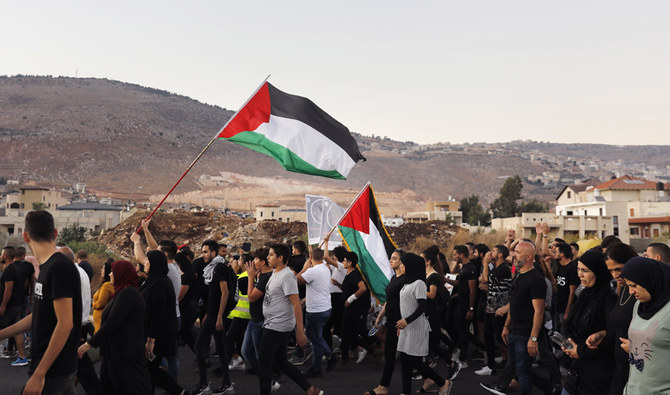
Israeli Arabs protest against violence, organized crime and recent killings among their communities, in the Arab town of Majd Al-Krum in Northen Israel on October 3, 2019. (AFP)
Updated 03 October 2019
Follow

Israeli Arabs go on strike to protest deadly crime wave

  • Israel’s Arab citizens make up 20 percent of the population and are descended from Palestinians who remained in the state after its creation in 1948

JERUSALEM: Arab citizens of Israel observed a general strike and held protests on Thursday over a wave of deadly violence within the minority community.

Schools and businesses in Arab towns and villages were closed following a call by local and national Arab leaders, and newly elected Arab members of Parliament skipped the official swearing-in out of solidarity.

Police say there have been more than 70 killings in Arab communities this year, nearly as many as in each of the past two years, when Arabs made up more than half of all murder victims nationwide. Earlier this week, two brothers and a third individual were killed in a brawl involving guns and knives in the northern town of Majd Al-Krum.

Arab leaders say Israeli police largely ignore the violence in their communities, everything from family feuds and mafia turf wars to domestic violence and so-called honor killings. Israel’s Arab citizens make up 20 percent of the population and are descended from Palestinians who remained in the state after its creation in 1948. They have the right to vote but suffer discrimination and say authorities treat them like second-class citizens.

An Arab coalition made major gains in last month’s parliamentary elections, and has made improving public safety one of its top priorities. The 13 newly elected lawmakers did not attend the swearing-in at the Knesset because they were taking part in the strike.

“A racist government has neglected us and the police have abandoned our neighborhoods to gangs and criminals,” Ayman Odeh, the head of the Arab parliamentary bloc, tweeted. He said the strike was to demand weapons searches, tougher action against organized crime and higher budgets for education.

“If there is no other choice, we will block streets to return safety to the streets,” he said.

The police adamantly reject the allegations of indifference and say they are doing everything they can to stem the violence.

“Police are continuing to speak to the leaders of the communities in order to try and prevent the incidents from taking place, but at the same time also working inside the communities, patrolling more,” police spokesman Micky Rosenfeld said.

He said seven new police stations have been opened in Arab communities this year and there are plans to open eight more in the coming months. This year alone, police have confiscated 4,000 weapons and arrested some 2,800 people on weapons-related charges, according to Rosenfeld.

But he said local leaders need to do more to cooperate with police and to prevent violence.

“It has to come also from inside the community,” he said. “They can’t just, you know, decide at a wedding to open fire and shoot in the air. These are basic issues that have to be dealt with by the leaders of the communities.”

Thabet Abu Rass, the co-director of the Abraham Fund Initiatives, a group that promotes coexistence between Arabs and Jews, says he has personally worked to improve relations between the police and Arab communities as part of the group’s public safety program. But he said there is still a security vacuum in many Arab towns and villages that allows criminals to thrive.

“In terms of public and private safety our Arab towns are kind of ex-territorial, it’s kind of outside of Israel,” he said. “While we are citizens of the state of Israel, the state is not here, not in our towns.”

He said there’s a high level of mistrust between police and Arab citizens that makes cooperation difficult, and that the lack of a police presence inside the communities makes people reluctant to come forward with information for fear of violent reprisal.

“We are willing to cooperate with the police in issues related to combatting violence and crime in our community,” he said. But “before cooperation, we would like to see a police presence in our towns.”

Leaders receive US invite for ‘Board of Peace’ to go beyond Gaza conflict

Updated 15 sec ago
Follow

Leaders receive US invite for ‘Board of Peace’ to go beyond Gaza conflict

  • The White House did not detail the responsibilities of each member of the board
  • White House said more ⁠members will be announced over the coming weeks
WASHINGTON: Leaders from several countries on Saturday received a letter inviting them to join a so-called US-led “Board of Peace” initiative that would initially aim to end conflict in Gaza but then be expanded to tackle conflicts elsewhere, diplomats said.
The White House on Friday announced some members of this board, which would outlive its role supervising the temporary governance of Gaza, under a fragile ceasefire since October.
The names include US Secretary of State Marco Rubio, President Donald Trump’s special envoy Steve Witkoff, former British prime minister Tony Blair and Trump’s son-in-law, Jared Kushner. Trump is the chair of the board, according to a plan his White House unveiled in October.
Israel and the Palestinian militant group Hamas signed off on Trump’s plan, which says a Palestinian technocratic administration will be overseen by an international board, which will supervise Gaza’s governance ‌for a transitional period.
Trump ‌goes for global peace role
“It’s going to, in my opinion, start ‌with ⁠Gaza and then do ‌conflicts as they arise,” President Donald Trump told Reuters in an interview earlier this week.
“... like — other countries that are going to war with each other,” Trump said when asked what its objective would be.
Many rights experts and advocates have said that Trump overseeing a board to supervise a foreign territory’s governance resembles a colonial structure, while Blair’s involvement was criticized last year due to his role in the Iraq war and the history of British imperialism in the Middle East.
The White House did not detail the responsibilities of each member of the board. The names do not include any Palestinians. The White House said more ⁠members will be announced over the coming weeks.
It also named a separate, 11-member “Gaza Executive Board” to support the technocratic body, including Turkish Foreign Minister Hakan Fidan, UN ‌Middle East peace coordinator Sigrid Kaag, United Arab Emirates International Cooperation Minister Reem ‍Al-Hashimy, and Israeli-Cypriot billionaire Yakir Gabay.
But Israeli Prime Minister ‍Benjamin Netanyahu’s office said the composition of this board had not been coordinated with Israel and contradicted its policy — ‍possibly a reference to Fidan’s presence, as Israel objects to Turkish involvement. The Israeli government did not immediately respond to a request for further comment.
France, Germany, Egypt, Turkey among those invited
Israel and Hamas have accused each other of ceasefire violations in Gaza, where more than 450 Palestinians, including over 100 children, and three Israeli soldiers have been reported killed during the truce.
Israel’s assault on Gaza since October 2023 has killed tens of thousands, caused a hunger crisis and internally displaced Gaza’s entire population. Multiple rights experts, scholars and a UN inquiry say this amounts to genocide. Israel has said it took action ⁠in self-defense after Hamas-led militants killed 1,200 people and took over 250 hostages in a late 2023 attack.
Four sources said on Saturday that the leaders of France, Germany, Australia and Canada were among those invited to sit on the Board of Peace.
The offices of the Egyptian and Turkish presidents confirmed they had been invited. An EU official said European Commission President Ursula von der Leyen had been invited to represent the European Union.
Two diplomatic sources said the invitation letter included a “charter.”
“It’s a ‘Trump United Nations’ that ignores the fundamentals of the UN charter,” said one diplomat aware of the letter, adding that it called the board a “bold new approach to resolving Global Conflict.”
The Board of Peace will also include private equity executive and billionaire Marc Rowan, World Bank President Ajay Banga and Robert Gabriel, a Trump adviser, the White House said, adding that Nikolay Mladenov, a former UN Middle East envoy, will be the high representative for Gaza.
Army Major General Jasper Jeffers, a US special operations commander, was appointed commander ‌of the International Stabilization Force, the White House said. A UN Security Council resolution, adopted in mid-November, authorized the board and countries working with it to establish that force in Gaza.