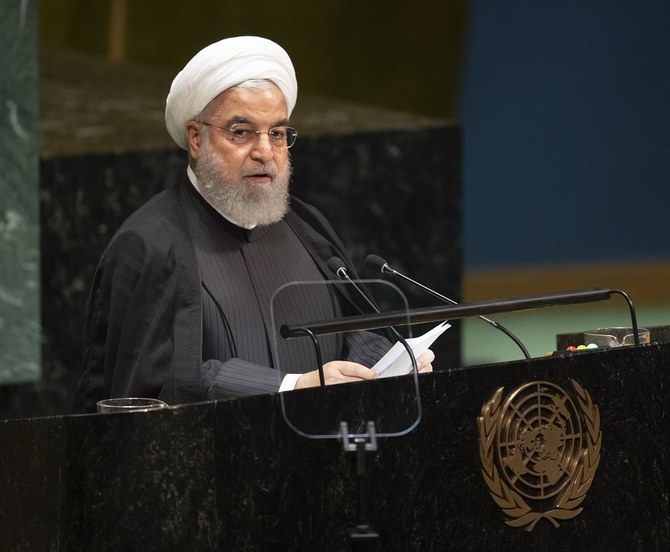

GENEVA: A plan for talks presented to the United States and Iran by French President Emmanuel Macron is broadly acceptable to the Islamic Republic, President Hassan Rouhani said on Wednesday during a cabinet meeting that was broadcast live on state TV.
He said some wording needed to be changed in the plan, which would require Iran not to pursue nuclear weapons and to help the security of the region and its waterways, while Washington would have to remove all sanctions. It would also allow Iran to immediately resume oil sales.
But Rouhani also told the cabinet that mixed messages about sanctions received from the United States while he was attending the United Nations General Assembly in New York last week had undermined the possibility of talks.
He said it was unacceptable for US President Donald Trump to say publicly that he would intensify sanctions while European powers told Iran in private that he was willing to negotiate.
“The American president on two occasions ... said explicitly that we want to intensify sanctions. I told these European friends, so which part should we accept? Should we accept your word that you say America is ready?” Rouhani said.
“Or the words of the president of America who in 24 hours said explicitly twice ... that I want to intensify sanctions? [The Europeans] didn’t have a clear answer.”
European powers were continuing efforts to arrange talks, Rouhani said. Germany, Britain and France were among signatories to Iran’s 2015 nuclear pact with world powers, which Trump quit last year.
Iran’s foreign minister Mohammad Javad Zarif said Macron’s four-point plan for talks was “presented in his words and does not contain our viewpoints” but that work would continue.
“It’s necessary that these negotiations continue until the issues are presented in a clear way. We will continue these contacts,” Zarif was quoted as saying by the official IRIB news agency, insisting that Iran is not pursuing nuclear weapons.
Separately, Supreme Leader Ayatollah Ali Khamenei said Iran would continue reducing its commitments under the 2015 nuclear deal until it reaches a “desired result,” according to his official website.
“We will continue the reduction of commitments and must continue with complete seriousness,” he told a meeting of commanders of the elite Revolutionary Guards.
Iranian officials have said they will reduce their commitments under the nuclear deal until the remaining signatories fully meet their commitments.