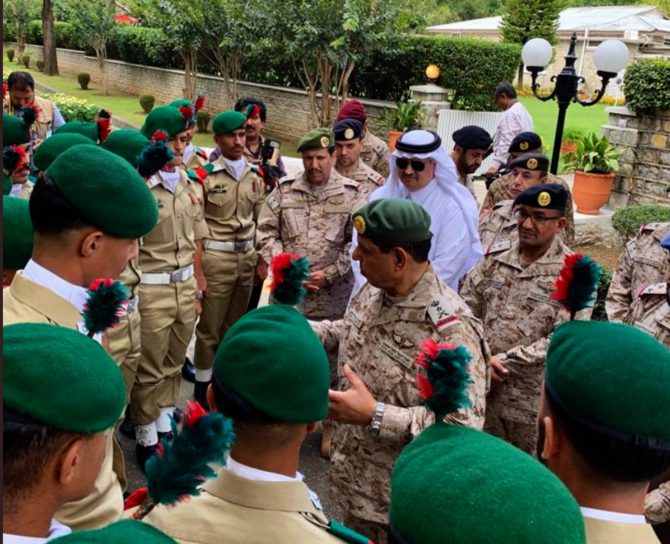
Kingdom’s Royal Forces commander meets Saudi cadets in Pakistan 

Lt. Gen. Fahad Bin Abdullah Mohammad Al-Motair, Commander of the Royal Saudi Land Forces met with Saudi cadets at the Pakistan Military Academy, Kakul in the garrison city of Abbottabad on Tuesday. (Photo Courtesy- Saudi Embassy Twitter)
Updated 03 October 2019
Follow

Kingdom’s Royal Forces commander meets Saudi cadets in Pakistan 

  • Saudi officers among those getting training at the prestigious institute
  • General Bajwa vowed to extend support for Saudi army’s capacity-building measures

ISLAMABAD: Lt. Gen. Fahad Bin Abdullah Mohammad Al-Motair, Commander of the Royal Saudi Land Forces (RSLF) visited the Pakistan Military Academy Kakul in the garrison city of Abbottabad on Tuesday where he met with Saudi cadets undergoing a training program.
Lt. Gen. Al-Motair was accompanied by Nawaf bin Said Al-Malki, Saudi Arabia’s ambassador in Pakistan during the visit, the Saudi Embassy tweeted on Tuesday.
Earlier on Monday, Lt. Gen. Al-Motair met with Pakistan’s Army Chief General Qamar Javed Bajwa in Rawalpindi where the two discussed the regional security situation.
During the meeting, Gen. Bajwa expressed the Pakistan army’s resolute support toward the training and capacity-building of RSLF personnel, the military’s media wing, the ISPR, said in a statement released after the meeting.
Pakistan and Saudi Arabia have always maintained cordial relations. The diplomatic ties between the two countries improved further after Prime Minister Imran Khan assumed office last year and had since visited the Kingdom on several occasions.
Last year, several military cadets from Saudi Arabia completed their training from the prestigious institution in Pakistan.
Earlier this year, the armed forces of Saudi Arabia and Pakistan conducted a joint military exercise called Kaseh 2 in northwestern Pakistan. These drills were aimed at enhancing the efficiency of engineers in unconventional warfare in both countries.


Islamabad steps up vehicle checks to boost security as 166,000 cars get electronic tags

Updated 4 sec ago
Follow

Islamabad steps up vehicle checks to boost security as 166,000 cars get electronic tags

  • Authorities say over 3,000 vehicles registered in past 24 hours as enforcement intensifies
  • Extended service hours introduced to push full compliance with digital monitoring system

ISLAMABAD: Authorities in the Pakistani capital have intensified enforcement against vehicles without mandatory electronic tags with more than 166,000 cars now registered, according to data released on Sunday evening, as Islamabad moves to strengthen security and digital monitoring at key entry and exit points.

The Islamabad Capital Territory (ICT) administration introduced the electronic tagging system late last year as part of a broader effort to regulate traffic, improve record-keeping and enhance surveillance in a city that hosts the country’s main government institutions, foreign missions and diplomatic enclaves.

Under the system, vehicles are fitted with electronic tags that can be read automatically by scanners installed at checkpoints across the capital, allowing authorities to identify unregistered vehicles without manual inspections. Vehicles already equipped with a motorway tag, or m-tag, are exempt from the requirement.

“A total of 166,888 vehicles have successfully been issued M-Tags so far, including 3,130 vehicles in the last 24 hours,” the ICT administration said, according to the Excise Department.

Officials said readers installed at checkpoints across Islamabad are fully operational and are being used to stop vehicles still without tags, as enforcement teams carry out checks across the city.

To facilitate compliance, authorities have expanded installation facilities and extended operating hours. The Excise Department said m-tag installation is currently available at 17 booth locations, while select centers have begun operating beyond normal working hours.

According to Director General Excise Irfan Memon, m-tag centers at 26 Number Chungi and 18 Meel are providing services round the clock, while counters at Kachnar Park and F-9 Park remain open until midnight to accommodate motorists unable to visit during daytime hours.

Officials said the combination of enforcement and facilitation was aimed at achieving full compliance with minimal disruption, adding that operations would continue until all vehicles operating in the capital are brought into the system.

The enforcement drive builds on a wider push by the federal government to integrate traffic management, emergency response and security monitoring through technology-driven “safe city” initiatives. Last month, Interior Minister Mohsin Naqvi reviewed Islamabad’s surveillance infrastructure and said reforms in monitoring systems and the effective use of technology were the “need of the hour.”

Authorities have urged motorists to obtain electronic tags promptly to avoid delays and penalties at checkpoints as enforcement continues across the capital.