

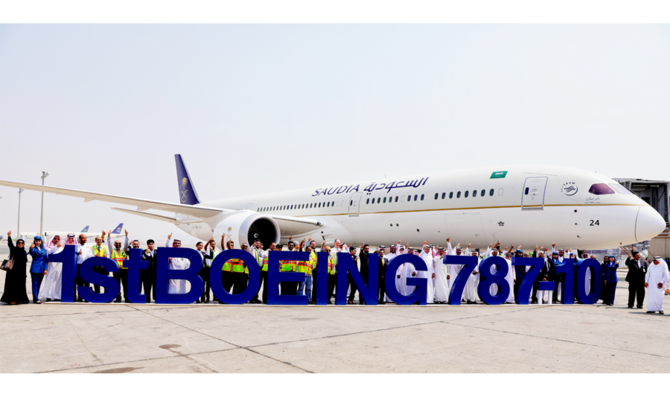
Saudi Arabian Airlines receives first Boeing 787-10 Dreamliner

The 787-10 Dreamliner was welcomed during a special ceremony at Jeddah’s King Abdul Aziz International Airport.
Updated 01 October 2019
Follow

Saudi Arabian Airlines receives first Boeing 787-10 Dreamliner

Saudi Arabian Airlines (Saudia), the Kingdom’s national flag carrier, welcomed its first 787-10 Dreamliner at a special ceremony at the new Terminal 1 of Jeddah’s King Abdul Aziz International Airport.

The largest member of the Dreamliner family sets the benchmark for fuel efficiency and operating economics and will complement Saudia’s existing fleet of 13 Boeing 787-9 aircraft. It is expected to play a key role in the airline’s fleet and network expansion. 

“Saudia operates a state-of-the-art fleet equipped with the latest technology, and in addition to the airline’s existing Boeing 787-9 Dreamliners, is now adding the 787-10 variant which will further support future network growth plans,” said Director General of Saudia Saleh bin Nasser Al-Jasser. 

“The airplane’s onboard cabin features, long-range capability and the latest in technological advancements are among the many aspects of what makes the Boeing 787 highly popular with our guests,” he added.

The layout of the Saudia Boeing 787-10 will be 357 seats in a two-class configuration, with 24 seats in business class and 333 seats in guest class (economy).

In addition to the 787-10, Saudia operates 13 787-9 Dreamliner airplanes, and 33 777-300ER (extended range) jets.

“Saudia has been a valued partner with Boeing for nearly 75 years and this delivery marks another major milestone in our partnership. Our team takes great pride in building and delivering quality aircraft to Saudia and we are honored by the continuing confidence in the 787 Dreamliner and 777 families,” said Ihssane Mounir, senior vice president of commercial sales and marketing, The Boeing Company. 

“The addition of the 787-10 to Saudia’s fleet will continue the superior inflight experience that passengers have come to expect of the Dreamliner. Moreover, the unmatched fuel efficiency of the 787 will help Saudia open new routes and achieve significant fuel savings and emission reduction,” he added.


Schneider Electric launches academy in Saudi Arabia to build future-ready talent

Updated 04 February 2026
Follow

Schneider Electric launches academy in Saudi Arabia to build future-ready talent

Schneider Electric has announced the launch of the Energy Tech Academy Middle East and Africa in Saudi Arabia, a regional capability platform dedicated to skilling, upskilling, and knowledge sharing.

The launch comes at a critical moment as the Kingdom accelerates energy transition, industrial localization, and human capability development under Vision 2030. The academy reinforces the Kingdom’s leadership role in building future-ready talent while supporting industrial and energy transformation across the wider Middle East and Africa region.

The Energy Tech Academy Middle East and Africa is not a traditional training center; it is a regional platform translating Schneider Electric’s global energy technology expertise into applied capability for Saudi Arabia and the broader region. Anchored in Riyadh, the academy is designed to serve as a benchmark for skills development and enablement across the MEA.

The launch reflects Schneider Electric’s long-term commitment to investing in people and capabilities, and to supporting national priorities across energy, industry, and digital infrastructure.

Mohamed Shaheen, cluster president of Schneider Electric Saudi Arabia and Yemen, said: “This launch reflects our long-term commitment to Saudi Arabia and to building capability that lasts. After more than 40 years in the Kingdom, we continue to invest where impact matters most: in people. Launching the Energy Tech Academy Middle East and Africa from Riyadh underscores our belief that sustainable transformation is built on local capability and trusted partnerships.”

The academy directly supports Saudi Arabia’s focus on human capability development, localization, and Saudi-made outcomes by enabling the skills behind advanced energy systems, industrial automation, and digital infrastructure. Capabilities developed through the academy will support Saudi manufacturing, national projects, and resilient supply chains, while also strengthening regional industrial ecosystems.

“The Energy Tech Academy Middle East and Africa is designed to enable real outcomes,” said Walid Sheta, zone president for the MEA at Schneider Electric. “By equipping talent with future-ready skills across electrification, automation, and digital intelligence, we are strengthening Saudi and regional capability to design, operate, and lead the energy and industrial systems of the future.”

The launch event in Riyadh brought together senior government representatives, industry partners, customers, and Schneider Electric’s leadership, highlighting the importance of cross-sector collaboration in aligning education, skills development, and labor market needs.

Designed as a long-term platform, the Energy Tech Academy Middle East and Africa will continue to evolve through partnerships, programs, and continuous capability development, reinforcing Saudi Arabia’s role as a regional hub for skills, knowledge, and industrial enablement.