

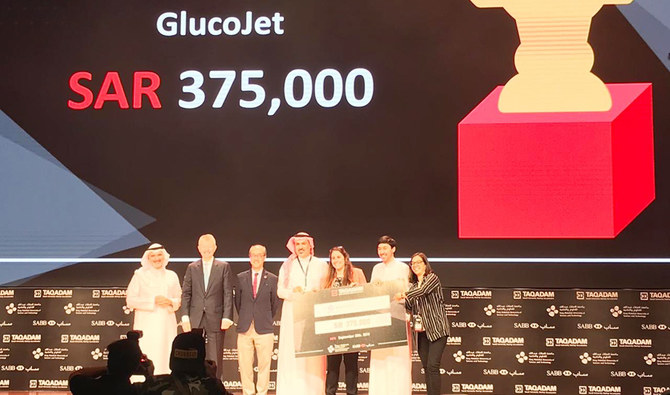
Saudi startups win cash prizes at finals of TAQADAM accelerator program

1 / 8
Launched in 2016 in partnership with The Saudi British Bank (SABB), the TAQADAM accelerator program has successfully graduated 78 startups and awarded over SR9 million ($2.4 million) in funding. (SPA)
2 / 8
Launched in 2016 in partnership with The Saudi British Bank (SABB), the TAQADAM accelerator program has successfully graduated 78 startups and awarded over SR9 million ($2.4 million) in funding. (SPA)
3 / 8
Launched in 2016 in partnership with The Saudi British Bank (SABB), the TAQADAM accelerator program has successfully graduated 78 startups and awarded over SR9 million ($2.4 million) in funding. (SPA)
4 / 8
Launched in 2016 in partnership with The Saudi British Bank (SABB), the TAQADAM accelerator program has successfully graduated 78 startups and awarded over SR9 million ($2.4 million) in funding. (SPA)
5 / 8
Launched in 2016 in partnership with The Saudi British Bank (SABB), the TAQADAM accelerator program has successfully graduated 78 startups and awarded over SR9 million ($2.4 million) in funding. (SPA)
6 / 8
Launched in 2016 in partnership with The Saudi British Bank (SABB), the TAQADAM accelerator program has successfully graduated 78 startups and awarded over SR9 million ($2.4 million) in funding. (SPA)
7 / 8
Photo/KAUST Innovation
8 / 8
Photo/KAUST Innovation
Updated 01 October 2019
Follow

Saudi startups win cash prizes at finals of TAQADAM accelerator program

  • The program gives Saudi students, staff and recent graduates the support to start a successful tech-based company through mentoring and training

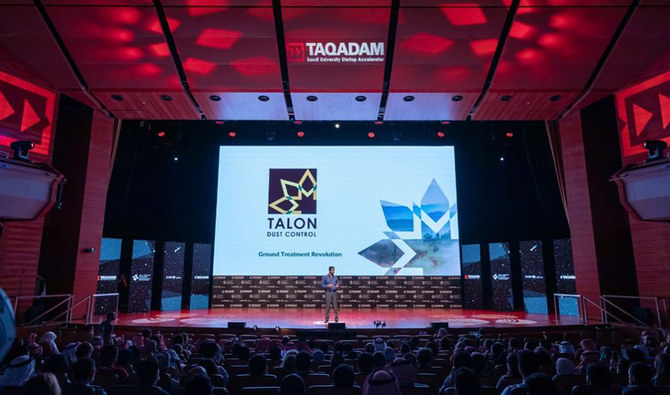
JEDDAH: Over 1,100 participants, investors, and mentors gathered at the King Abdullah University for Science and Technology (KAUST) headquarters in Thuwal to watch the conclusion of the third edition of the TAQADAM accelerator program, one of KAUST’s flagship entrepreneurship events.
In line with Saudi Arabia’s objectives of supporting new ventures, the program focuses on preparing new entrepreneurs for the challenges ahead, offering over six months of business training and mentorship in various industries, including e-commerce, health care and technology.
The program gives Saudi students, staff and recent graduates the support to start a successful tech-based company through mentoring and training.
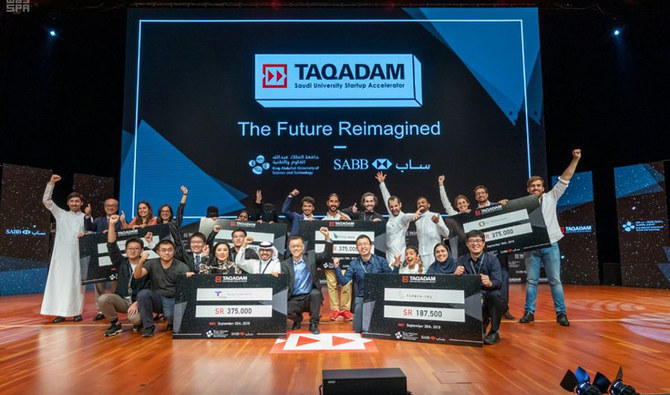
The theme of this year’s event was “The Future Reimagined.” This encouraged the program’s entrepreneurs to create technologies of the future that would benefit the Kingdom. Working with mentors from the Entrepreneurship Center at KAUST, they were able to design, develop and take their startup ideas to market.
Kevin Cullen, vice president of innovation and economic development at KAUST, said: “We are proud to support entrepreneurs and offer them the best environment and tools to create innovations that can change the world. Today, we have watched some incredible ideas and technologies that are solving issues across different industries in health care, agriculture, water, food, gaming, education and more. Congratulations winners, well done.”
Among the competing startups were 100 founders from 13 Saudi universities, representing a wide range of industries. During the event, each startup was given three minutes to pitch their ideas, followed by three minutes of Q&A and another three minutes of feedback from the judges.
Launched in 2016 in partnership with The Saudi British Bank (SABB), the TAQADAM accelerator program has successfully graduated 78 startups and awarded over SR9 million ($2.4 million) in funding.
Deputy managing director of transformation at SABB, Soren Nikolajsen, said that Saudi Arabia is enjoying huge changes and it is vital that the next generation of businesses is helped to seize these opportunities.


 “We’re determined to play our part in building a more diverse and sustainable economy, and one of the best ways we can do that is supporting the grassroots of the business ecosystem: Young entrepreneurs. Today’s winners show just what a great job TAQADAM has done developing new entrepreneurial talent,” Nikolajsen said.
The head of the Entrepreneurship Center at KAUST, Hattan Ahmed, said that its main goal is to create high quality, high impact new ventures from across Saudi Arabia by providing the professional training and mentorship needed to help take their ideas to the market.
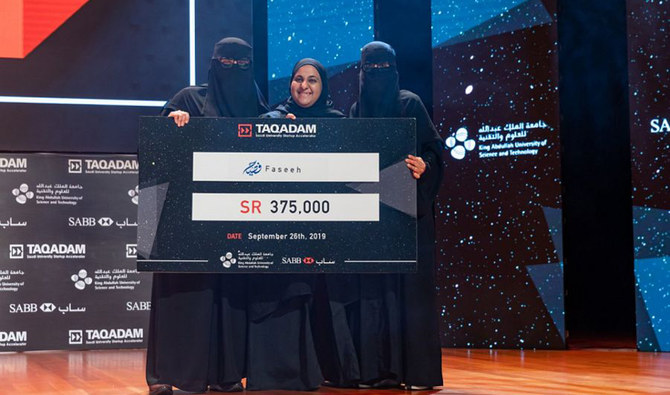
“We are so proud of the startups graduating from our accelerator program and we look forward to supporting more,” he said. The following program winners each received SR375,000.
Firnas Aero: Drones on demand for airport infrastructure inspection. Faseeh: Learning app to teach Arabic language skills to help raise Qiyas scores.
Genos Tech: Turning microalgae into products such as Vitamin A and dietary supplements. Peregrine Genomics: Providing accurate premarital genetic diagnoses in half the time and cost. 
Gluco Jet: Non-invasive and pain-free glucose testing for diabetes patients. Talon Dust Control: Low-cost, liquid spray-on solution for environmental dust control. Carbon CPU was the “People’s Choice Winner,” receiving SR187,500 after a live vote from the audience. 

Decoder

TAQADAM

is a Saudi startup accelerator for ideas that are pushing the boundaries of science and technology. Over the course of six months, it helps aspiring entrepreneurs bring their ideas to market through mentorship and training in ideation, product design, marketing and fundraising. Accepted teams receive SR75,000 in grant funding and access to working space in the KAUST Entrepreneurship Center and prototyping lab.


Saudi Arabia witnessing comprehensive cultural development, says expert

Updated 14 February 2026
Follow

Saudi Arabia witnessing comprehensive cultural development, says expert

  • Clotilde Entrecanales of Acciona hails pace of change in Kingdom

JEDDAH: Museums, exhibitions and art centers play a crucial role in the development of free and educated societies such as the one now burgeoning in Saudi Arabia, an expert has told Arab News.

Clotilde Entrecanales, the Spanish art historian and cultural executive who heads Acciona Living & Culture, a leading creator of technology-driven interactive museums, exhibits and events, said the Kingdom is making efforts to expand the role of culture development to show the world the greatest possible cultural offer.

She added that the Kingdom has quickly infused new energy into the region, and is rapidly establishing itself as a global cultural hub through massive investment in world-class museums, public art and international events, aligning with its 2030 vision.

She said: “With around 70 percent of the population under 30, cultural consumption looks very different than in Europe or the US. These spaces can’t feel like quiet, isolated institutions … they need to be fast, dynamic, brave and deeply connected to the city, blending into everyday urban life rather than sitting apart from it.”

Asked about the role of these sites in the evolving global cultural landscape, particularly in emerging cultural hubs like Saudi Arabia, Entrecanales said: “Our vision is to be a purpose-led partner for cultural and entertainment institutions, helping them be more relevant, connected, inclusive and sustainable.”

She added: “In emerging cultural hubs like Saudi Arabia, that approach feels especially relevant. The cultural transformation underway is moving fast — with major heritage and cultural destinations being developed and opened to the world.”

Speaking about her impression of the Kingdom’s approach to blending heritage with modernity face, Entrecanales said: “Others who attempt to achieve this balance often end up turning heritage into a theme, a layer of storytelling or a cultural program. What feels different about Saudi’s approach is how much pressure there is to treat heritage as the foundation, not just the surface.

“When you’re building at this speed and scale, there’s always a risk that history becomes a backdrop instead of a backbone. The projects that work best are the ones that slow down just enough to let the past set the rhythm for the present.”

Regarding opportunities and challenges, she said: “The opportunity is nothing less than positioning Saudi Arabia as a global cultural center. The challenge, as always, lies in balancing the speed and scale of that ambition with long-term sustainability and a sense of authenticity that remains credible and rooted.”

She added: “You can really feel this in places like the Islamic Arts Biennale, which shows hundreds of historical artefacts of the Islamic world, while re-framing them through contemporary scenography and designs by some of the best design studios in the world; or in AlUla, a world-class heritage site that hosts a major contemporary platform like Desert X, allowing ancient context and present-day artistic practice to coexist in a way that feels genuine.”

Under her guidance, ACCIONA Cultura aspires to create museums and cultural experiences that function as landmarks while fostering sustainable, inclusive and immersive interactions.

She elaborated on how the company is integrating technology, culture, and sustainability to preserve and promote the region’s cultural heritage: “We always start with human connection and storytelling: what’s the story, what should people leave with? Tech comes later.”

Recently, ACCIONA Cultura has been involved in significant projects in Saudi Arabia and is looking forward for more.

She said: “Right now, for example, we’re designing and curating a museum gallery where the entire space is shaped by the practice of a Saudi artist. Another example is the Net Zero exhibition at the King Abdulaziz Center for World Culture (Ithra), where we brought together Saudi and international artists to explore sustainability and our relationship with the planet, including voices like Dina Haddadin, Mohammed Al-Faraj, and Zahrah Al-Ghamdi.”

She added: “One of the projects I’m most proud of isn’t a museum, but our NEXT IN Summit, which we’ve hosted in two editions in our ACCIONA Campus in Madrid, highlighting the Kingdom’s unprecedented cultural momentum as it builds future-facing institutions with a startup mindset.”

About further collaboration with Saudi Arabia, she said: “Let’s just say … something’s definitely simmering in the kitchen.”

Commenting on being recognized among the Blooloop 50 Museum Influencers for 2025, she said: “It means a lot. More than anything, it feels like a nod to the years of teamwork and dedication behind Acciona Cultura, rather than to me personally.”