

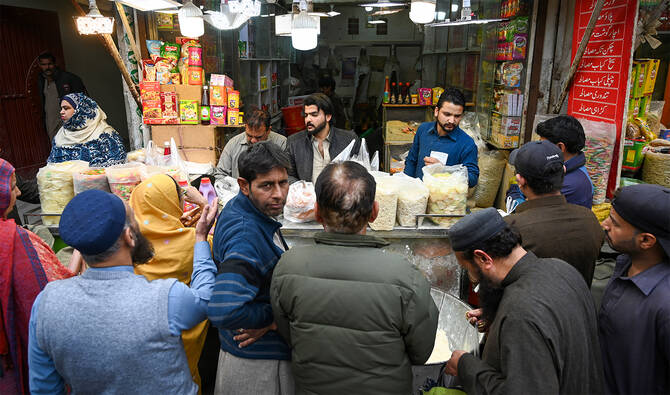
KARACHI: Pakistanis thronged markets on Friday and Saturday to shop for supplies ahead of the holy month of Ramadan, while keeping a watchful eye on rising food prices.
In cities such as Karachi, many people were seen buying commodities at the main wholesale market of the city. Some, like Islamabad resident Danish Ali, have noted high inflation as the cause of price hike.
“There are about six or seven days left for Ramadan, so the prices have started to increase,” Ali said. “Now, l have bought banana for 200 rupees a dozen, and it is small size.
“A few days ago it was being sold for 100 rupees a dozen. As Ramadan is starting, inflation is increasing. So is with the prices of vegetable.”
Pakistan endured one of Asia’s highest inflation spikes in 2023, nearing 40 percent, driven by a weakening rupee, rising fuel costs and price hikes linked to IMF-backed reforms.
“Look how much sales tax the government has imposed,” Najeebullah, a shopkeeper selling dates, said.
“I used to pay 100,000 ($357) or 130,000 rupees ($465) for one container. So guess what, the tax has reached 800,000 rupees ($2863) for one container,” he added.
Although inflation has since slowed to 5.8 percent, analysts warn the changes to power prices could add inflationary pressure.
Prime Minister Shehbaz Sharif on Saturday announced Rs38 billion [$136 million] Ramadan Relief Package which will be disbursed among deserving people across the country, his office said.


