CAIRO: Egypt’s President Abdel Fattah al-Sisi said Friday there was no cause for concern over protests against his rule that are planned for later in the day.
“There are no reasons for concern. Egypt is a strong country thanks to Egyptians,” he told reporters with a smile, shortly after his return from the UN General Assembly in New York.
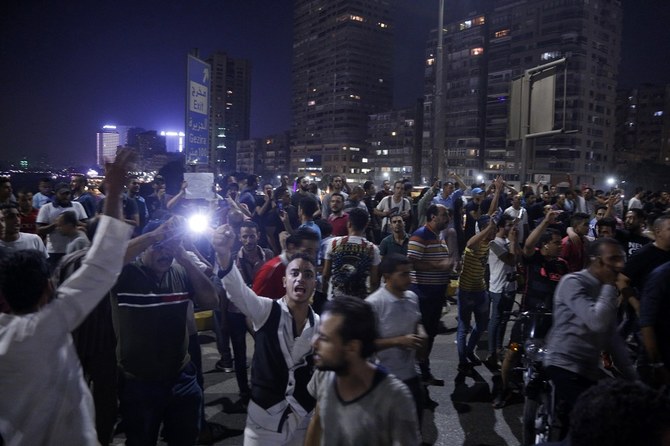
Rare protests against Sisi’s rule erupted last week in Cairo and other major cities, prompting a crackdown that has seen nearly 2,000 arrests, according to Human Rights Watch.
They were triggered by viral videos from exiled Egyptian businessman Mohamed Aly accusing the president of building lavish palaces while taxpayers grapple with the impact of austerity under an IMF loan programme totalling $12 billion.
In defiance of a years-long ban on demonstrations, Aly has called for further protests on Friday in Egyptian cities, where security forces have stepped up their presence in recent days.
“The case does not deserve all” this attention, Sisi said. “It is an attempt to create an image that is absolutely not real,” he added, without elaborating on this point.
“Do not listen to what they say. Do not believe them,” he urged, without naming those responsible for calling the protests against him.


![]()


Egypt’s Sisi says protests ‘no reason for concern’
Egypt’s Sisi says protests ‘no reason for concern’

Sudan paramilitary advances near Ethiopia border
KHARTOUM: Sudanese paramilitary forces have advanced on army positions near the southeastern border with Ethiopia, according to the group and an eyewitness who spoke to AFP Wednesday.
Control over Sudan’s southeastern Blue Nile State, bordering both Ethiopia and South Sudan, is split between the army and a faction of the Sudan People’s Liberation Movement-North, allies of the paramilitary Rapid Support Forces.
In a statement released Tuesday, the SPLM-N, led by Abdelaziz Al-Hilu, said they had “liberated the strategic city of Deim Mansour and areas of Bashir Nuqu and Khor Al-Budi.”
Since April 2023, the Sudanese army has been at war with the RSF. In February of last year, the RSF announced a surprise alliance with the SPLM-N, securing experienced fighters, land and border access.
Deim Mansour lies between the SPLM-N stronghold Yabus, birthplace of their deputy commander Joseph Tuka, and the army-held town of Kurmuk, which hosts a large army contingent.
Babiker Khaled, who fled to Kurmuk, told AFP that SPLM-N fighters began amassing in the forests around Deim Mansour on Sunday.
“The shelling began on Monday, they entered the city on Tuesday,” he said, adding that “some people fled into Ethiopia, others arrived in Kurmuk.”
From its foothold in the southern Blue Nile, a thin strip of land jutting south between Ethiopia and South Sudan, the SPLM-N maintains reported supply lines from both countries, building on decades-old links.
Close to three years of war in Sudan have left tens of thousands dead and around 11 million displaced, creating the world’s largest hunger and displacement crises.
It has also torn the country apart, with the army holding the center, north and east of Sudan while the RSF and its allies dominate the west and parts of the south.
Sudan’s Kordofan region, where the SPLM-N has its other foothold in the Nuba Mountains, is currently the war’s fiercest battleground.
On Tuesday, the army broke a paramilitary siege on South Kordofan state capital Kadugli, days after breaking another on the nearby city of Dilling.
Control over Sudan’s southeastern Blue Nile State, bordering both Ethiopia and South Sudan, is split between the army and a faction of the Sudan People’s Liberation Movement-North, allies of the paramilitary Rapid Support Forces.
In a statement released Tuesday, the SPLM-N, led by Abdelaziz Al-Hilu, said they had “liberated the strategic city of Deim Mansour and areas of Bashir Nuqu and Khor Al-Budi.”
Since April 2023, the Sudanese army has been at war with the RSF. In February of last year, the RSF announced a surprise alliance with the SPLM-N, securing experienced fighters, land and border access.
Deim Mansour lies between the SPLM-N stronghold Yabus, birthplace of their deputy commander Joseph Tuka, and the army-held town of Kurmuk, which hosts a large army contingent.
Babiker Khaled, who fled to Kurmuk, told AFP that SPLM-N fighters began amassing in the forests around Deim Mansour on Sunday.
“The shelling began on Monday, they entered the city on Tuesday,” he said, adding that “some people fled into Ethiopia, others arrived in Kurmuk.”
From its foothold in the southern Blue Nile, a thin strip of land jutting south between Ethiopia and South Sudan, the SPLM-N maintains reported supply lines from both countries, building on decades-old links.
Close to three years of war in Sudan have left tens of thousands dead and around 11 million displaced, creating the world’s largest hunger and displacement crises.
It has also torn the country apart, with the army holding the center, north and east of Sudan while the RSF and its allies dominate the west and parts of the south.
Sudan’s Kordofan region, where the SPLM-N has its other foothold in the Nuba Mountains, is currently the war’s fiercest battleground.
On Tuesday, the army broke a paramilitary siege on South Kordofan state capital Kadugli, days after breaking another on the nearby city of Dilling.
Latest updates


Recommended


© 2026 SAUDI RESEARCH & PUBLISHING COMPANY, All Rights Reserved And subject to Terms of Use Agreement.