

UK tanker docks in Dubai after detention by Iran

1 / 2
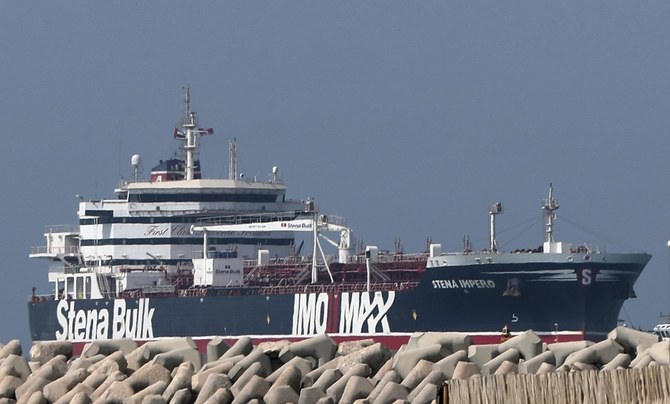
The British-flagged oil tanker Stena Impero arrives at Port Rashid in Dubai on Saturday, Sept. 28, 2019. (AP)
2 / 2
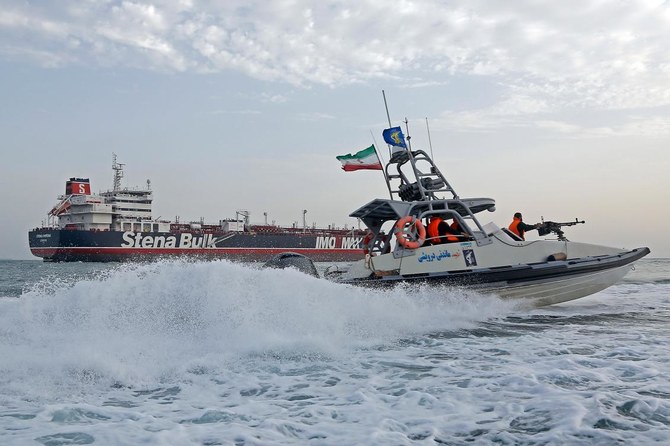
The Stena Impero has set a new destination for Port Rashid in Dubai in the United Arab Emirates, about 250 kilometers away, tracking data showed. (EPA)
Updated 29 September 2019
Follow

UK tanker docks in Dubai after detention by Iran

  • Iran’s Revolutionary Guards seized the tanker in the Strait of Hormuz on July 19
  • The vessel arrived off the coast of Dubai shortly after midnight local time

DUABAI, STOCKHOLM: A British-flagged tanker that was detained by Iran for 10 weeks, docked in Dubai on Saturday, after a standoff that has stoked tensions along a vital global shipping route for oil. The Stena Impero, which sailed out of Iranian waters on Friday, was seized by Iran’s Revolutionary Guards on July 19, shortly after British forces detained an Iranian tanker off the territory of Gibraltar. The Iranian ship was released in August.
The Stena Impero docked at Dubai’s Port Rashid, a Reuters photographer reported from the harbor.
Erik Hanell, the chief executive of Sweden’s Stena Bulk, which owns the ship, told Reuters in Stockholm in a text message earlier in the day that the tanker was “finally approaching berth in Dubai.”
Stena Bulk said the crew would receive medical checks and would be de-briefed in Dubai, which lies across the Gulf from Iran, before traveling home to their families. Seven of the 23 crew were freed earlier this month.
The crew who were still on the vessel came from India, Russia and the Philippines, a Stena Bulk spokesman said before the ship had docked.
“The crew are in high spirits, understandably. They will be checked by medical professionals once ashore, but the captain has informed us all are in good health,” he said.
The seizure of the vessel, which the Iranian authorities said was for marine violations, followed attacks on other merchant tankers in Gulf waters in May and June. The US blamed those attacks on Iran, which Tehran denied. Relations between Iran and the US and its allies have deteriorated since Washington withdrew last year from a global agreement to rein in Tehran’s nuclear work and imposed sanctions aimed at shutting down Iranian oil exports.

Retaliation
The ship’s seizure was widely seen as a tit-for-tat move after authorities in the British overseas territory of Gibraltar detained an Iranian tanker on suspicion it was shipping oil to Syria in breach of EU sanctions. Tehran repeatedly denied the cases were related.
The Stena Impero sailed from Iran and into international waters of the Gulf on Friday morning, according to local authorities.
“Despite the vessel’s clearance, its legal case is still open in Iran’s courts,” Hormozgan province’s maritime organization in southern Iran said on its website.
The tanker’s captain and crew have “given a written, official statement that they have no claims,” it added.
The vessel arrived off Dubai shortly after midnight local time (20:00 GMT) and halted in the busy waterway overnight, said ship tracking website MarineTraffic.com.
It began heading to its anchorage in the emirate on Saturday, according to the website which said it was “underway using engine.”
The CEO of Stena Bulk, the Swedish company that owns the vessel, said the ship’s sailing was “obviously a relief” and that the priority now was those on board.
“When we reach Dubai we will firstly take care of the crew and then try and get the ship in operational order again,” he told AFP on Friday.
Photos released by the Iranian agency Fars News on Saturday showed the black and red-hulled tanker sailing from Bandar Abbas in southern Iran the previous day.
The images also showed the captain apparently signing the ship’s release documents before it left port, and the crew — dressed in red overalls and safety gear — lifting anchor ahead of the journey.
The tanker’s crew are “safe and in high spirits” and arrangements have been made for them to return to their families upon arrival in Dubai, Hannel said earlier.
“The crew will have a period of time to be with their families following 10 weeks of detainment on the vessel. Full support will be offered to the crew and families in the coming weeks to assist with their recovery,” he added. The company did not release the names of the crew members.

HIGHLIGHTS

• Ship was seized by Iran’s Revolutionary Guards on July 19.

• Seizure followed detention of Iranian tanker by UK forces.

• Stena Impero sailed out of Iranian waters on Friday.

Iran’s Revolutionary Guards seized the vessel in the Strait of Hormuz on July 19 after surrounding it with attack boats and rappelling onto its deck.
It was impounded off the port of Bandar Abbas for allegedly failing to respond to distress calls and turning off its transponder after hitting a fishing boat.
Seven of its 23 crew members were released on Sept. 4. British Foreign Secretary Domini Raab said the tanker was “unlawfully seized by Iran” as part of its attempts to “disrupt freedom of navigation.” Tensions have risen in the Gulf since May last year when President Donald Trump unilaterally abandoned a 2015 nuclear deal between major powers and Iran and began reimposing crippling sanctions in a campaign of “maximum pressure.”
They flared again this May when Iran began reducing its own commitments under the deal and the US deployed military assets to the region.
Since then, ships have been attacked, drones downed and oil tankers seized. In June, Trump called off air strikes against Iran at the last minute after the Islamic republic’s forces shot down a US drone. This month, twin attacks on Saudi oil infrastructure, which knocked out half the kingdom’s production, drew accusations of blame not only from Washington but also from its European allies. Tehran has denied any involvement in the attacks which were claimed by Iran-backed rebels fighting a Saudi-led coalition in Yemen.
The US has since formed a coalition with its allies Australia, Bahrain, Britain, Saudi Arabia and the United Arab Emirates to escort commercial shipping in the Gulf.
Tehran has warned that the planned US-led International Maritime Security Construct will cause more, not less instability and has proposed a rival security plan of its own.
Speaking at the UN General Assembly in New York, President Hassan Rouhani this week announced a plan called “Hormuz Peace Endeavour” or “HOPE.”
He gave no details but called on all of Iran’s Gulf neighbors to join, saying: “Security cannot be provided with American weapons and intervention.”
Foreign Minister Mohammad Javad Zarif tweeted Thursday that the plan calls for “dialogue, confidence-building, freedom of navigation, energy security, non-aggression, non-intervention.”


A ceasefire holds in Syria but civilians live with fear and resentment

Updated 27 January 2026
Follow

A ceasefire holds in Syria but civilians live with fear and resentment

  • The Arab-majority population in the areas that changed hands, Raqqa and Deir Ezzor, have celebrated the SDF’s withdrawal after largely resenting its rule
  • But thousands of Kurdish residents of those areas fled, and non-Kurdish residents remain in Kurdish-majority enclaves still controlled by the SDF

QAMISHLI: Fighting this month between Syria’s government and Kurdish-led forces left civilians on either side of the frontline fearing for their future or harboring resentment as the country’s new leaders push forward with transition after years of civil war.
The fighting ended with government forces capturing most of the territory previously held by the Kurdish-led Syrian Democratic Forces in the country’s northeast, and a fragile ceasefire is holding. SDF fighters will be absorbed into Syria’s army and police, ending months of disputes.
The Arab-majority population in the areas that changed hands, Raqqa and Deir Ezzor, have celebrated the SDF’s withdrawal after largely resenting its rule.
But thousands of Kurdish residents of those areas fled, and non-Kurdish residents remain in Kurdish-majority enclaves still controlled by the SDF. The International Organization for Migration has registered more than 173,000 people displaced.
Fleeing again and again
Subhi Hannan is among them, sleeping in a chilly schoolroom in the SDF-controlled city of Qamishli with his wife, three children and his mother after fleeing Raqqa.
The family is familiar with displacement after the years of civil war under former President Bashar Assad. They were first displaced from their hometown of Afrin in 2018, in an offensive by Turkish-backed rebels. Five years later, Hannan stepped on a land mine and lost his legs.
During the insurgent offensive that ousted Assad in December 2024, the family fled again, landing in Raqqa.
In the family’s latest flight this month, Hannan said their convoy was stopped by government fighters, who arrested most of their escort of SDF fighters and killed one. Hannan said fighters also took his money and cell phone and confiscated the car the family was riding in.
“I’m 42 years old and I’ve never seen something like this,” Hannan said. “I have two amputated legs, and they were hitting me.”
Now, he said, “I just want security and stability, whether it’s here or somewhere else.”
The father of another family in the convoy, Khalil Ebo, confirmed the confrontation and thefts by government forces, and said two of his sons were wounded in the crossfire.
Syria’s defense ministry in a statement acknowledged “a number of violations of established laws and disciplinary regulations” by its forces during this month’s offensive and said it is taking legal action against perpetrators.
A change from previous violence
The level of reported violence against civilians in the clashes between government and SDF fighters has been far lower than in fighting last year on Syria’s coast and in the southern province of Sweida. Hundreds of civilians from the Alawite and Druze religious minorities were killed in revenge attacks, many of them carried out by government-affiliated fighters.
This time, government forces opened “humanitarian corridors” in several areas for Kurdish and other civilians to flee. Areas captured by government forces, meanwhile, were largely Arab-majority with populations that welcomed their advance.
One term of the ceasefire says government forces should not enter Kurdish-majority cities and towns. But residents of Kurdish enclaves remain fearful.
The city of Kobani, surrounded by government-controlled territory, has been effectively besieged, with residents reporting cuts to electricity and water and shortages of essential supplies. A UN aid convoy entered the enclave for the first time Sunday.
On the streets of SDF-controlled Qamishli, armed civilians volunteered for overnight patrols to watch for any attack.
“We left and closed our businesses to defend our people and city,” said one volunteer, Suheil Ali. “Because we saw what happened in the coast and in Sweida and we don’t want that to be repeated here.”
Resentment remains
On the other side of the frontline in Raqqa, dozens of Arab families waited outside Al-Aqtan prison and the local courthouse over the weekend to see if loved ones would be released after SDF fighters evacuated the facilities.
Many residents of the region believe Arabs were unfairly targeted by the SDF and often imprisoned on trumped-up charges.
At least 126 boys under the age of 18 were released from the prison Saturday after government forces took it over.
Issa Mayouf from the village of Al-Hamrat, was waiting with his wife outside the courthouse Sunday for word about their 18-year-old son, who was arrested four months ago. Mayouf said he was accused of supporting a terrorist organization after SDF forces found Islamic chants as well as images on his phone mocking SDF commander Mazloum Abdi.
“SDF was a failure as a government,” Mayouf said “And there were no services. Look at the streets, the infrastructure, the education. It was all zero.”
Northeast Syria has oil and gas reserves and some of the country’s most fertile agricultural land. The SDF “had all the wealth of the country and they did nothing with it for the country,” Mayouf said.
Mona Yacoubian, director of the Middle East Program at the Center for Strategic and International Studies, said Kurdish civilians in besieged areas are terrified of “an onslaught and even atrocities” by government forces or allied groups.
But Arabs living in formerly SDF-controlled areas “also harbor deep fears and resentment toward the Kurds based on accusations of discrimination, intimidation, forced recruitment and even torture while imprisoned,” she said.
“The experience of both sides underscores the deep distrust and resentment across Syria’s diverse society that threatens to derail the country’s transition,” Yacoubian said.
She added it’s now on the government of interim Syrian President Ahmad Al-Sharaa to strike a balance between demonstrating its power and creating space for the country’s anxious minorities to have a say in their destiny.