

Greenpeace blames Malaysia oil firm for Indonesia’s haze

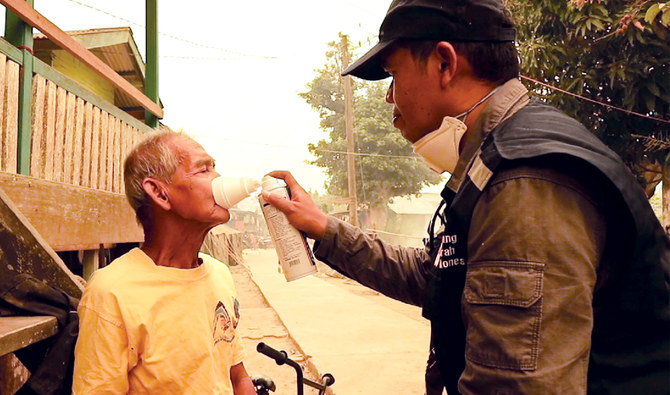
A villager gets oxygen help from a Red Cross volunteer in Jambi on Tuesday. Blazes have been spewing toxic haze across Southeast Asia. (AFP)
Updated 24 September 2019
Follow

Greenpeace blames Malaysia oil firm for Indonesia’s haze

  • Ecological group says companies responsible for burned lands go unpunished

KUALA LUMPUR: International environmental group Greenpeace on Tuesday blamed a Malaysian-owned palm oil company as among the 10 palm oil companies whose concessions had the largest burned area, significantly contributing to the Indonesian haze. 

According to the data provided by Greenpeace, Genting Plantation’s subsidiary PT Globalindo Agung Lestari at Central Kalimantan was responsible for 5,000 hectares of burned land between 2015 and 2018. All ten companies listed have never received any serious civil or administrative sanctions from the government.

Genting Plantation is the plantation arm of the billion-dollar Malaysian company Genting Group. On its website, Genting Plantation states that it owns more than a dozen estates in west, central and south Kalimantan. The company is certified under the Roundtable on Sustainable Palm Oil and claimed that it has adopted a variety of sustainability measures including a zero burning policy.

 “The Indonesian government has not revoked a single palm oil license due to these forest fires, nor has it given any other serious sanctions to these 10 companies,” said Greenpeace. 

Greenpeace also revealed the list of other palm oil and pulp companies, the majority of which have gone unpunished despite being responsible for the burned lands in Sumatra and Kalimantan between 2015 and 2018. Through the official government’s “burn scar” data, Greenpeace Indonesia analyzed that more than 3.4 million hectares of land burned between 2015 and 2018.

This year, thousands of hotspots in Kalimantan and Sumatra have affected 328,724 hectares of forest and farm land, according to data from the National Disaster Mitigation Agency. In the last three weeks, the heavy smoke fumes from Indonesia’s forest fires have affected neighboring countries Malaysia, Singapore, Brunei, Thailand and the Philippines. 

In Sumatra’s ground zero, the skies turned blood red as the air pollutants absorbed the sunlight. The Indonesian government declared on Monday a state of emergency for Sumatra as the air pollution index exceeded 500.

Since 1997, forest fires have become an annual occurrence due to the use of “slash and burn” techniques by residents and plantation companies when clearing lands. The method is cheap but causes severe damage to the environment. The prolonged dry season this year only intensified the burning.

The findings from the analysis contrast sharply with Indonesian President Jokowi Widodo’s claims that the government has led a crackdown against illegal burnings. “Stopping this recurring fire crisis should have been at the top of the government’s agenda since 2015,” said Kiki Taufik, global head of Greenpeace’s Indonesia forests campaign.

“But our findings show the reality: Empty words and weak and inconsistent law enforcement against companies. Jokowi and his ministers must immediately remove licenses from companies with fires on their land,” he added.

In Malaysia, expensive and large-scale cloud seedings only managed to relieve the situation short-term. The transboundary haze continues to be a major headache for Indonesia, Malaysia and its neighboring countries. 

“Tackling forest fires is not only Indonesia’s responsibility alone,” said Greenpeace Malaysia campaigner Heng Kiah Chun. 

Despite previous effort to enact the Association of Southeast Asian Nations (ASEAN) agreement on Transboundary Haze Pollution, ASEAN leaders have failed to address the annual crisis.

Chun urged the Malaysian and Indonesian governments to cooperate and tackle the long-standing problem of transboundary haze.

“Both the Malaysian and Indonesian governments need to look at where the fires are burning, why, and who is behind them to hold the main culprits behind the fires accountable, especially now that haze from Indonesian forest fires are spreading beyond the country’s boundaries,” he added.


Carney says Canada has no plans to pursue free trade agreement with China as Trump threatens tariffs

Updated 26 January 2026
Follow

Carney says Canada has no plans to pursue free trade agreement with China as Trump threatens tariffs

TORONTO: Canadian Prime Minister Mark Carney said Sunday his country has no intention of pursuing a free trade deal with China. He was responding to US President Donald Trump’s threat to impose a 100 percent tariff on goods imported from Canada if America’s northern neighbor went ahead with a trade deal with Beijing.
Carney said his recent agreement with China merely cuts tariffs on a few sectors that were recently hit with tariffs.
Trump claims otherwise, posting that “China is successfully and completely taking over the once Great Country of Canada. So sad to see it happen. I only hope they leave Ice Hockey alone! President DJT”
The prime minister said under the free trade agreement with the US and Mexico there are commitments not to pursue free trade agreements with nonmarket economies without prior notification.
“We have no intention of doing that with China or any other nonmarket economy,” Carney said. “What we have done with China is to rectify some issues that developed in the last couple of years.”
In 2024, Canada mirrored the United States by putting a 100 percent tariff on electric vehicles from Beijing and a 25 percent tariff on steel and aluminum. China had responded by imposing 100 percent import taxes on Canadian canola oil and meal and 25 percent on pork and seafood.
Breaking with the United States this month during a visit to China, Carney cut its 100 percent tariff on Chinese electric cars in return for lower tariffs on those Canadian products.
Carney has said there would be an initial annual cap of 49,000 vehicles on Chinese EV exports coming into Canada at a tariff rate of 6.1 percent, growing to about 70,000 over five years. He noted there was no cap before 2024. He also has said the initial cap on Chinese EV imports was about 3 percent of the 1.8 million vehicles sold in Canada annually and that, in exchange, China is expected to begin investing in the Canadian auto industry within three years.
Trump posted a video Sunday in which the chief executive of the Canadian Vehicle Manufacturers’ Association warns there will be no Canadian auto industry without US access, while noting the Canadian market alone is too small to justify large scale manufacturing from China.
“A MUST WATCH. Canada is systematically destroying itself. The China deal is a disaster for them. Will go down as one of the worst deals, of any kind, in history. All their businesses are moving to the USA. I want to see Canada SURVIVE AND THRIVE! President DJT,” Trump posted on social media.
Trump’s post on Saturday said that if Carney “thinks he is going to make Canada a ‘Drop Off Port’ for China to send goods and products into the United States, he is sorely mistaken.”
“We can’t let Canada become an opening that the Chinese pour their cheap goods into the U.S,” US Treasury Secretary Scott Bessent said on ABC’s “This Week.”
“We have a , but based off — based on that, which is going to be renegotiated this summer, and I’m not sure what Prime Minister Carney is doing here, other than trying to virtue-signal to his globalist friends at Davos.”
Trump’s threat came amid an escalating war of words with Carney as the Republican president’s push to acquire Greenland strained the NATO alliance.
Carney has emerged as a leader of a movement for countries to find ways to link up and counter the US under Trump. Speaking in Davos before Trump, Carney said, “Middle powers must act together because if you are not at the table, you are on the menu” and he warned about coercion by great powers — without mentioning Trump’s name. The prime minister received widespread praise and attention for his remarks, upstaging Trump at the World Economic Forum.
Trump’s push to acquire Greenland has come after he has repeatedly needled Canada over its sovereignty and suggested it also be absorbed into the United States as a 51st state. He posted an altered image on social media this week showing a map of the United States that included Canada, Venezuela, Greenland and Cuba as part of its territory.