Medieval masterpiece by Cimabue rediscovered in French house

1 / 3
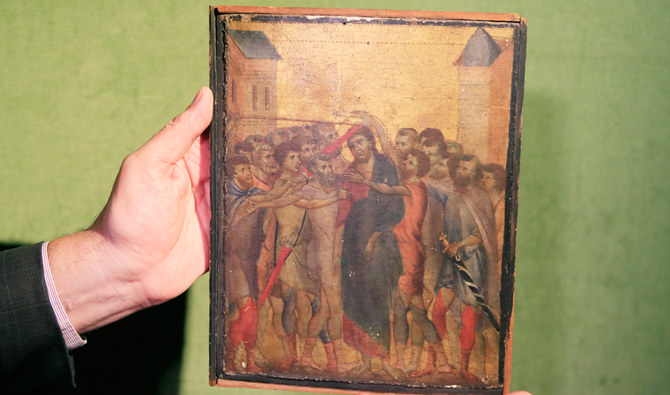
Art expert Eric Turquin inspects the painting "Christ Mocked", a long-lost masterpiece by Florentine Renaissance artist Cimabue in the late 13th century, which was found months ago hanging in an elderly woman's kitchen in the town of Compiegne, displayed in Paris, France, September 24, 2019. (REUTERS)
2 / 3
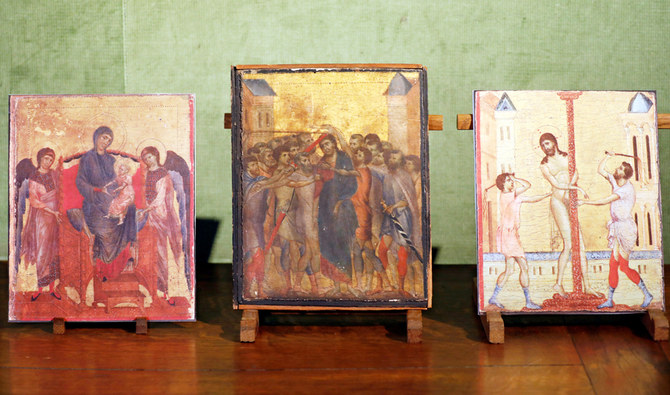
The painting "Christ Mocked" (C), a long-lost masterpiece by Florentine Renaissance artist Cimabue in the late 13th century, which was found months ago hanging in an elderly woman's kitchen in the town of Compiegne, is displayed in Paris, France, September 24, 2019. (REUTERS)
3 / 3
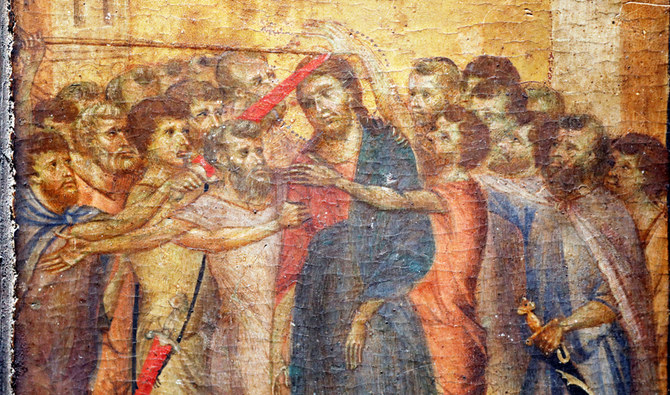
A part of the painting "Christ Mocked", a long-lost masterpiece by Florentine Renaissance artist Cimabue in the late 13th century, which was found months ago hanging in an elderly woman's kitchen in the town of Compiegne, is seen in Paris, France, September 24, 2019. (REUTERS)
Updated 24 September 2019
Follow

Medieval masterpiece by Cimabue rediscovered in French house

  • The painting will be the first Cimabue masterpiece to be auctioned when it is put up for sale at the Acteon auction house north of Paris on Oct. 27, according to Pinta

PARIS: A masterpiece attributed to 13th century Italian painter Cimabue has been discovered in a French woman’s kitchen — and it’s expected to sell for millions of euros at an upcoming auction.
Titled “Christ Mocked,” the small wood painting depicts Christ surrounded by a crowd. Experts think it to be part of a larger diptych Cimabue painted around 1280, said Stephane Pinta, an art specialist with the Turquin gallery in Paris.
“It’s a major discovery for the history of art,” Pinta said of the newly discovered work measuring about 10 inches by 8 inches (24 centimeters by 20 centimeters). Other experts agreed.
Until recently, the painting hung on a wall between the kitchen and the dining room of a home in Compiègne. The woman considered it an icon of little importance until an auctioneer spotted the painting while going through her house and suggested bringing it to art experts, Pinta said.
Cimabue, who taught Italian master Giotto, is widely considered the forefather of the Italian Renaissance. He broke from the Byzantine style popular in the Middle Ages and incorporated elements of movement and perspective that came to characterize Western painting.
After examining the French kitchen find, Turquin gallery specialists concluded with “certitude” it bore hallmarks of Cimabue’s work, Pinta said.
They noted clear similarities with the two panels of Cimabue’s diptych, one displayed at the Frick Collection in New York and the other at the National Gallery in London.
Likenesses in the facial expressions and buildings the artist painted and the techniques used to convey light and distance specifically pointed to the small piece having been created by Cimabue’s hand. Pinta said all those characteristics animate the newly discovered piece. “What’s moving in this painting is the motion that we see in Christ,” Pinta said.
Alexis Ashot, an independent art consultant for British auction house Christie’s, said the discovery in France sent ripples of excitement in other parts of the art world.
“It’s wonderful to be reminded that there are paintings of such major importance that are still out there and still to be discovered,” he said.
The painting will be the first Cimabue masterpiece to be auctioned when it is put up for sale at the Acteon auction house north of Paris on Oct. 27, according to Pinta. Turquin experts think a major art museum will buy it for a price of between 4 million and 6 million euros. Ashot said he thinks the painting could fetch even more.
“I could easily see that if word gets out there that this painting is available for sale, then the price could be much higher than they are estimating,” he said.


NASA and families of fallen astronauts mark 40th anniversary of space shuttle Challenger accident

Updated 23 January 2026
Follow

NASA and families of fallen astronauts mark 40th anniversary of space shuttle Challenger accident

CAPE CANAVERAL, Florida: Families of the astronauts lost in the space shuttle Challenger accident gathered back at the launch site Thursday to mark that tragic day 40 years ago.
All seven on board were killed when Challenger broke apart following liftoff on Jan. 28, 1986.
At the Kennedy Space Center memorial ceremony, Challenger pilot Michael Smith’s daughter, Alison Smith Balch, said through tears that her life forever changed that frigid morning, as did many other lives. “In that sense,” she told the hundreds of mourners, “we are all part of this story.”
“Every day I miss Mike,” added his widow, Jane Smith-Holcott, “every day’s the same.”
The bitter cold weakened the O-ring seals in Challenger’s right solid rocket booster, causing the shuttle to rupture 73 seconds after liftoff. A dysfunctional culture at NASA contributed to that disaster and, 17 years later, shuttle Columbia’s.
Kennedy Space Center’s deputy director Kelvin Manning said those humble and painful lessons require constant vigilance “now more than ever” with rockets soaring almost every day and the next astronaut moonshot just weeks away.
Challenger’s crew included schoolteacher Christa McAuliffe, who was selected from thousands of applicants representing every state. Two of her fellow teacher-in-space contenders — both retired now — attended the memorial.
“We were so close together,” said Bob Veilleux, a retired astronomy high school teacher from New Hampshire, McAuliffe’s home state.
Bob Foerster, a sixth grade math and science teacher from Indiana who was among the top 10 finalists, said he’s grateful that space education blossomed after the accident and that it didn’t just leave Challenger’s final crew as “martyrs.”
“It was a hard reality,” Foerster noted at the Space Mirror Memorial at Kennedy’s visitor complex.
Twenty-five names are carved into the black mirror-finished granite: the Challenger seven, the seven who perished in the Columbia disaster on Feb. 1, 2003, the three killed in the Apollo 1 fire on Jan. 27, 1967, and all those lost in plane and other on-the-job accidents.
Relatives of the fallen Columbia and Apollo crews also attended NASA’s Day of Remembrance, held each year on the fourth Thursday of January. The space agency also held ceremonies at Virginia’s Arlington National Cemetery and Houston’s Johnson Space Center.
“You always wonder what they could have accomplished” had they lived longer, Lowell Grissom, brother of Apollo 1 commander Gus Grissom, said at Kennedy. “There was a lot of talent there.”

.