

El-Sisi calls on US to take Sudan off terror-sponsor list

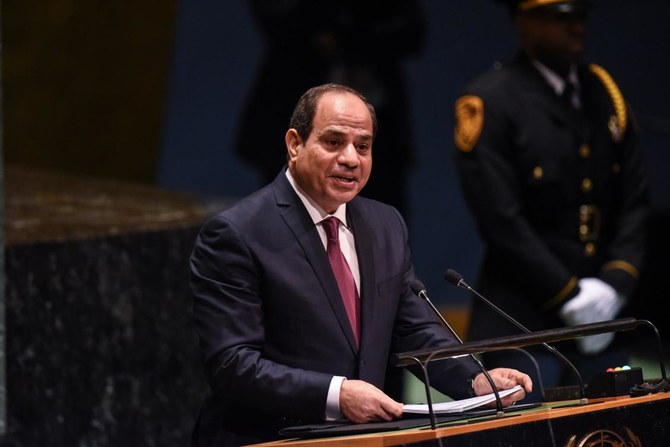
Egyptian President Abdel Fattah El-Sisi speaks at the UN General Assembly on Tuesday. (Reuters)
Updated 24 September 2019
Follow

El-Sisi calls on US to take Sudan off terror-sponsor list

  • The move would help Khartoum tackle economic problems, says Egyptian president
  • Egyptian president says concerted effort needed to stop militias taking control of Libya

NEW YORK: Egyptian President Abdel Fattah El-Sisi used his speech at the UN General Assembly to amplify a call to get neighboring Sudan off the US’ list of countries deemed sponsors of terrorism.

El-Sisi told world leaders Tuesday that taking Sudan off the list would help the country tackle economic problems and reclaim what he called “the place it deserves among the international family.”

Sudan has been on the US list since 1993. Khartoum says getting off it is crucial to rebuilding the country after years of sanctions.

The US administration began a process to take Sudan off the list. The procedure was put on hold when mass protests erupted in December against former ruler Omar Al-Bashir. The military ousted him in April. Sudan’s new Prime Minister Abdalla Hamdok recently said he’d discussed the issue with the Trump administration.

El-Sisi also said that a concerted effort was needed to stop militias taking control of Libya.

On Monday, US President Donald Trump voiced support to the Egyptian president, saying that El-Sisi “has done (in Egypt) some things that are absolutely amazing in a short period of time.”

“When he took over not so long ago, it was in turmoil. And it’s not in turmoil now,” Trump said in a press conference along with El-Sisi after their meeting. “Egypt has a great leader. He’s highly respected. He’s brought order. Before he was here, there was very little order. There was chaos. And so I’m not worried about that at all.”

El-Sisi, who has been waging a harsh crackdown on militants, blamed “political Islam” for the protests and the turmoil in the Mideast. He stopped short of naming the Muslim Brotherhood directly.

“I want you to rest assured that, especially in Egypt, the public opinion and the people themselves are rejecting this kind of political Islam in Egypt,” he said. 

“They have demonstrated their rejection before, and they reject those to have control on the country for only one year.” Egypt is fighting an insurgency led by a local affiliate of Daesh in the Sinai Peninsula as well as smaller militant groups allegedly belonging to the Brotherhood.

Meanwhile, Egyptian security forces killed six suspected members of the Muslim Brotherhood in a shootout in Cairo, the Interior Ministry said Tuesday.

The six were killed in a firefight when police raided their hideout in the Cairo suburb of Sixth of October, the ministry said in a brief statement. 

The ministry oversees police forces. The statement said the suspects were planning militant attacks. It did not say when the raids took place. Egypt branded the Muslim Brotherhood a terrorist organization in 2013 and arrested thousands of its members after the military’s ouster of President Mohammed Mursi, who hailed from the group, amid mass protests against his brief rule.


Jordan-EU Summit confirms commitment to regional security, investment

Updated 6 sec ago
Follow

Jordan-EU Summit confirms commitment to regional security, investment

  • Jordan, EU to hold investment conference in April to enhance economic partnerships
  • Ursula von der Leyen says King Abdullah is key partner for Europe in Middle East, relations between parties ‘built on stability, on security, but also on prosperity’

LONDON: King Abdullah II of Jordan hosted the first Jordan-EU Summit in Amman on Thursday, with European Council President Antonio Costa and European Commission President Ursula von der Leyen in attendance.

King Abdullah noted that the summit had built on last year’s Strategic and Comprehensive Partnership agreement with the EU, enhancing political dialogue and economic cooperation, according to the Jordan News Agency.

He spoke of his appreciation of the EU’s support for Jordan’s modernization and highlighted the country’s readiness to enhance cooperation in security, defense, education, and youth empowerment.

“Our partnership is also vital in supporting sustainable growth, job creation, and innovation, by strengthening economic resilience and expanding cooperation in trade and investment,” King Abdullah added.

Crown Prince Hussein attended the expanded meeting with EU leaders at Al-Husseiniya Palace.

Jordan and the EU are to hold an investment conference in April to enhance economic partnerships between the two parties, while the first EU-Jordan Security and Defense Dialogue is also scheduled for this year in Amman.

Costa said that bilateral relations with Jordan were strong and would continue to strengthen. He praised Jordan’s initiatives to address the humanitarian crisis in Gaza by establishing air and land corridors; its contribution to regional stability; its efforts to de-escalate tensions; and its pursuit of peace.

Von der Leyen said that King Abdullah was a key partner for Europe in the Middle East, and that relations between the EU and Jordan were “built on stability, on security, but also on prosperity.”

She added: “In times of growing geopolitical challenges, it is good to know that the European Union and Jordan stand side by side, because this is what friends do."

She noted that the EU aimed to increase investments in Jordan to 1.4 billion euros.

The summit also covered regional and international developments, including Lebanon, the Syrian Arab Republic, Ukraine, the reform of the Palestinian Authority, and Israeli settlement policy in the West Bank.

Jordan’s Prime Minister Jaafar Hassan, Deputy Prime Minister and Foreign Minister Ayman Safadi, Director of the Office of His Majesty Alaa Batayneh, Minister of Planning and International Cooperation Zeina Toukan, Jordan’s Ambassador to Belgium Yousef Bataineh, and a number of European officials also attended the summit.