

Saudi oil production surges back to 75 percent of pre-attack level

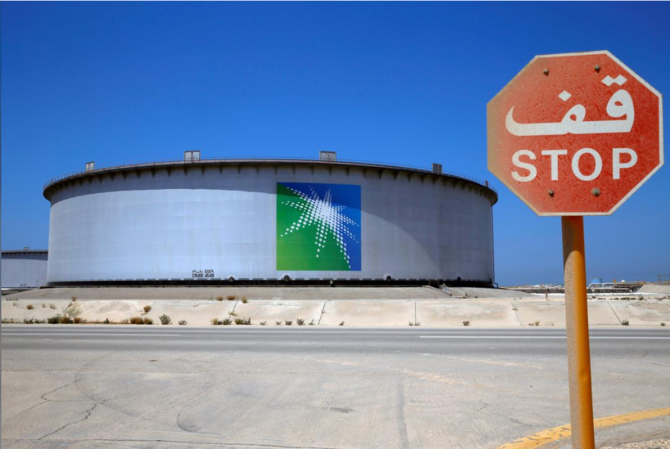
An Aramco tank is seen at Saudi Aramco's Ras Tanura oil refinery and oil terminal in Saudi Arabia May 21, 2018. Picture taken May 21, 2018. (Reuters)
Updated 24 September 2019
Follow

Saudi oil production surges back to 75 percent of pre-attack level

  • We can deal with effects of ‘cowardly sabotage,’ king says of drone and missile attacks
  • Two Aramco plants were hit in drone and missile attacks on Sept. 14 that caused fires and significant damage, halving the country’s oil output

JEDDAH: Saudi Arabia has restored more than 75 percent of the production lost after attacks on two oil processing plants and will return to full capacity next week.

The Khurais facility is now producing more than 1.3 million barrels per day and the Abqaiq plant about 3 million, industry sources said. 

Both Aramco plants were hit in drone and missile attacks on Sept. 14 that caused fires and significant damage, halving the country’s oil output. The Kingdom’s ability to quickly restore production demonstrated an important degree of resilience to potentially damaging shocks, the ratings agency Moody’s said.

King Salman said on Monday that Saudi Arabia was able to deal with the effects of what he described as “this cowardly sabotage, that targeted the Kingdom and the stability of global energy supplies.”

He spoke after talks in Jeddah with King Hamad of Bahrain, who denounced the “serious escalation targeting the security and stability of the region.”

Meanwhile, the diplomatic focus on the fallout from the missile strikes moved to New York, where world leaders are gathering for the UN General Assembly. Saudi Arabia and the US have blamed Iran for the attacks, and they were joined on Monday by Britain.

“The UK is attributing responsibility with a very high degree of probability to Iran for the Aramco attacks. We think it very likely indeed that Iran was responsible,” British Prime Minister Boris Johnson said on his way to the US.

“We will be working with our American friends and our European friends to construct a response that tries to deescalate tensions in the Gulf region,” he said.

However, the UK risks opening a diplomatic rift with other European countries trying to salvage the Joint Comprehensive Plan of Action (JCPOA), the 2015 deal to curb Iran’s nuclear program in return for an easing of economic sanctions. Their efforts have so far failed, with the US withdrawing from the deal and reimposing sanctions.

French President Emmanuel Macron has refused to blame Iran for the Aramco attacks. “One must be very careful in attributing responsibility,” he said on his way to New York.

Macron, Johnson and German Chancellor Angela Merkel held talks on Monday to coordinate their Iran strategy before meetings with US President Donald Trump and Iranian President Hassan Rouhani.

Gulf states, the US, the Europeans and others needed to engage in “collective diplomacy” to defuse tensions, a senior GCC official said.

“The conversation should no longer be about the JCPOA, but Iran’s missile program and its regional misbehavior, which are as important if not more important — they have the potential to hold the region to ransom,” he said.


US freezes visa processing for 75 countries, media reports Pakistan included

Updated 14 January 2026
Follow

US freezes visa processing for 75 countries, media reports Pakistan included

  • State Department announces indefinite pause on immigrant visas starting Jan 21
  • Move underscores Trump’s hard-line immigration push despite close Pakistan-US ties

ISLAMABAD: The United States will pause immigrant visa processing for applicants from 75 countries starting Jan. 21, the State Department said on Wednesday, with Fox News and other media outlets reporting that Pakistan is among the countries affected by the indefinite suspension.

The move comes as the Trump administration presses ahead with a broad immigration crackdown, with Pakistan included among the affected countries despite strong ongoing diplomatic engagement between Islamabad and Washington on economic cooperation, regional diplomacy and security matters.

Fox News, citing an internal State Department memo, said US embassies had been instructed to refuse immigrant visas under existing law while Washington reassesses screening and vetting procedures. The report said the pause would apply indefinitely and covers countries across Asia, Africa, the Middle East, Europe and Latin America.

“The State Department will pause immigrant visa processing from 75 countries whose migrants take welfare from the American people at unacceptable rates. The freeze will remain active until the US can ensure that new immigrants will not extract wealth from the American people,” the Department of State said in a post on X.

According to Fox News and Pakistan news outlets like Dawn, the list of affected countries includes Pakistan, Afghanistan, Bangladesh, Iran, Iraq, Egypt, Nigeria, Russia, Somalia, Brazil and Thailand, among others. 

“The suspension could delay travel, study, and work plans for thousands of Pakistanis who annually seek US visas. Pakistani consulates in the US are expected to provide guidance to affected applicants in the coming days,” Dawn reported.

A State Department spokesman declined comment when Arab News reached out via email to confirm if Pakistan was on the list. 

The Department has not publicly released the full list of countries or clarified which visa categories would be affected, nor has it provided a timeline for when processing could resume.

Trump has made immigration enforcement a central pillar of his agenda since returning to office last year, reviving and expanding the use of the “public charge” provision of US immigration law to restrict entry by migrants deemed likely to rely on public benefits.

During his previous term as president, Trump imposed sweeping travel restrictions on several Muslim-majority countries, a policy widely referred to as a “Muslim ban,” which was challenged in US courts before a revised version was upheld by the Supreme Court. That policy was later rescinded under the President Joe Biden administration.

The latest visa freeze marks a renewed hardening of US immigration policy, raising uncertainty for migrants from affected countries as Washington reassesses its screening and vetting procedures. 

The freeze on visas comes amid an intensifying crackdown on immigration enforcement by the Trump administration. In Minneapolis last week, a US Immigration and Customs Enforcement (ICE) agent shot and killed 37-year-old Renee Good, a US citizen, during a federal operation, an incident that has drawn nationwide protests and scrutiny of ICE tactics. Family members and local officials have challenged the federal account of the shooting, even as Department of Homeland Security officials defended the agent’s actions. The case has prompted resignations by federal prosecutors and heightened debate over the conduct of immigration enforcement under the current administration.