

Saudi Cabinet asks international community to end ‘aggressive and subversive Iranian policies’

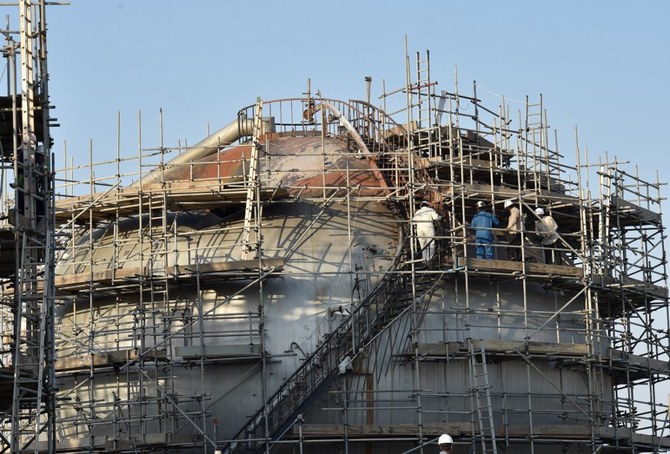
Workers start repair works on damaged facilities at Saudi Aramco’s plant in Abqaiq on September 20, 2019. (AFP)
Updated 24 September 2019
Follow

Saudi Cabinet asks international community to end ‘aggressive and subversive Iranian policies’

  • ‘The use of Iranian weapons is a threat to international peace and security’
  • The attack caused an interruption of an estimated 5.7 million barrels in crude supplies

DUBAI: Saudi Arabia’s Cabinet on Tuesday has called on the international community to put an end to what it described as “aggressive and subversive Iranian policies,” Saudi Press Agency (SPA) has reported.

In a series of tweets in Arabic, the state news agency quoted the Saudi Cabinet saying “the international community has a great responsibility to put an end to the acts of aggressive and subversive Iranian policies.”

SPA also tweeted, quoting the Saudi Cabinet, that the “sabotage attack on the Aramco facilities in Abqaiq and Khurais, and the use of Iranian weapons is a threat to international peace and security, and an unjustified aggression on energy supplies to world markets.”

The attack caused an interruption of an estimated 5.7 million barrels in crude supplies and threatened the world economy.

King Salman on Monday has described the drone and missile attacks on Aramco facilities on Sept. 14 a “cowardly act” aimed at destabilizing the Kingdom and disrupting the world’s energy supply.

Britain, France, Germany and the United States have blamed Iran for the attacks, which Tehran has vehemently denied.

Meanwhile, in the interview with MSNBC, Jordan’s King Abdullah II stressed Jordan’s support for Saudi Arabia following the recent attacks on Aramco’s oil facilities.
The king reaffirmed the distinguished Jordanian-Saudi relations, highlighting that the security of Saudi Arabia is of the utmost importance to Jordan.
“We have an outstanding relationship with the Saudis. We are committed to their defense. Having said that, I think many of us over the past six months, if not more, have been trying to caution escalation and calm things down. And relatively that’s happened across the summer.
“Obviously the attack on Aramco has upped the ante. And this is a very important week in New York, where I think all of us are trying to figure out how to step away from the brink of war,” the king said. 


The founding economy: A blueprint for stability in the First Saudi State

Updated 23 February 2026
Follow

The founding economy: A blueprint for stability in the First Saudi State

  • The establishment of the First Saudi State created a secure environment that facilitated the arrival of caravans, secured vast trade routes, and revived commerce across the Arabian Peninsula

RIYADH: The economy during the founding stage of the First Saudi State served as a fundamental pillar in building the nation, consolidating its influence, and ensuring its stability. This early economic growth was inextricably linked to achieving security, unifying regions, and organizing society—factors that directly stimulated trade, stabilized markets, and enhanced the foundations of daily life in Diriyah and its surrounding areas.
According to Dr. Abdullah Al-Saleh Al-Othaimeen's "Diriyah: Origins and Development during the First Saudi State," published by the King Abdulaziz Foundation for Research and Archives (Darah), the founding economy stands as a historical model reflecting the reciprocal relationship between political stability and early economic prosperity.

Beyond its political and intellectual prominence, Diriyah emerged as a vibrant economic hub. (SPA)

The establishment of the First Saudi State created a secure environment that facilitated the arrival of caravans, secured vast trade routes, and revived commerce across the Arabian Peninsula.
Beyond its political and intellectual prominence, Diriyah emerged as a vibrant economic hub. Its active markets attracted merchants and students from across the region, all of whom benefited from the state-provided stability. The local society relied on diverse activities for its livelihood, including trade, agriculture, and livestock breeding, with horses and camels playing crucial roles in transportation, commerce, and securing roads.
The social and administrative organization upon which the state was founded ensured the continuous availability of goods and sustained market stability. Ultimately, the close relationship between public security and economic growth during this founding phase solidified Diriyah's position as a premier political and commercial center in the Arabian Peninsula.