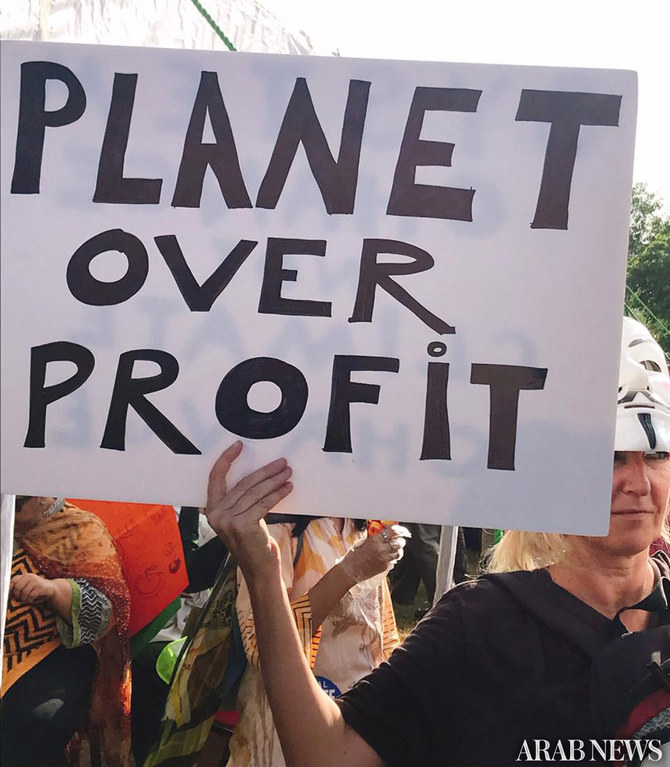
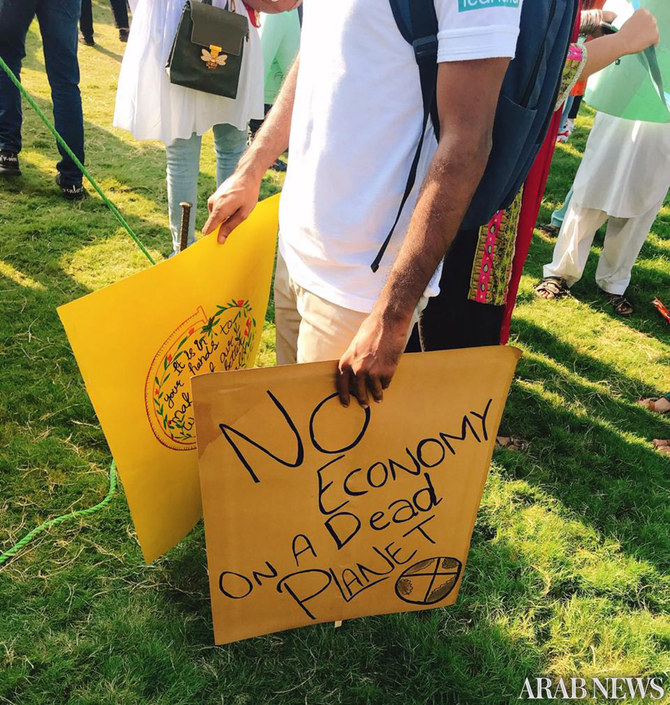
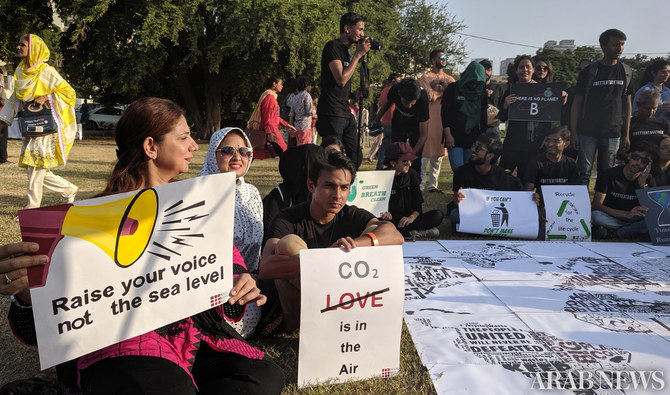
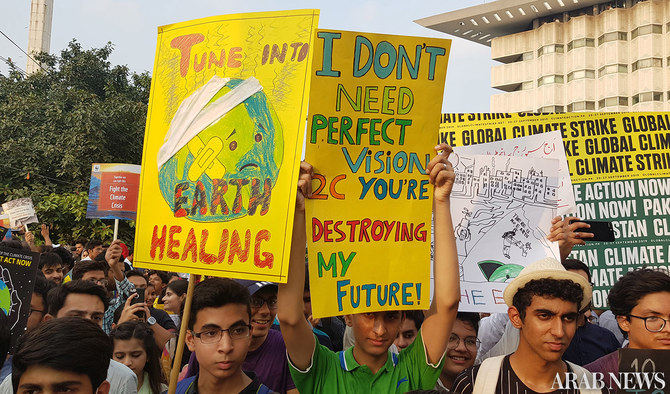
ISLAMABAD: Thousands of Pakistanis gathered across the country on Friday to join the worldwide protest demanding action against climate change ahead of a United Nations summit on the subject next week.
Students, civil society activists, officials and people belonging to other walks of life enthusiastically participated in the event.
“Unlike the protesters abroad, we are calling our intervention a march, not a strike, since we are victims of climate change despite our negligible emissions,” Saleem Sheikh, deputy media director at the climate change ministry, told Arab News while referring to the internationally used phrase, global climate strike, for the day of protest.
Tens of thousands of people in other parts of the world poured into the streets of their countries to express concern about the global climate change challenge.
Sheikh said that more than 2,500 events had been planned in 117 countries, including Pakistan, on September 20.
According to officials, Pakistan emits less than one percent of the total annual global greenhouse gases, though it still remains in the top ten countries most vulnerable to climate change.
“Global warming is already causing more droughts, floods, severe storms, wildfires and melting ice across the planet,” Sheikh said, adding that the Earth’s average temperature had gone up by one degree and could continue to go beyond that point unless carbon emissions were drastically reduced.
Pakistan’s Minister of State for Climate Change Zartaj Gul said in a video message that the country was facing the adverse impact of climate change.
Humayun Khan, who works with the Climate Change Center of the University of Agriculture Peshawar, participated in the march in his city. He told Arab News it was imperative to plant saplings on an emergency basis throughout Pakistan to protect the environment and avoid negative impact of changing weather patterns.
“Various species of saplings need to be planted in order to minimize the worst effects of climate change,” he noted.

Thousands join global climate strike in Pakistan
- The South Asian nation is among the top ten countries most vulnerable to climate change
- Pakistan only emits one percent of global greenhouse gases every year
At Gulfood expo, minister urges Pakistani firms to boost exports to end reliance on foreign debt
- The Dubai expo brought together more than 8,500 exhibitors from 195 countries, showcasing over 1.5 million food and beverage products
- Planning Minister Ahsan Iqbal says Islamabad is committed to promoting productivity, quality and innovation within the private sector
ISLAMABAD: Planning Minister Ahsan Iqbal on Thursday urged Pakistani companies participating in the Gulfood food and beverage exhibition in Dubai to expand exports and focus on value-added products, saying it was the only way for Pakistan to end reliance on foreign debt.
Gulfood’s 31st edition, being held in Dubai from Jan. 26 till Jan. 30, has brought together more than 8,500 exhibitors from 195 countries, showcasing over 1.5 million food and beverage products across 12 sectors, making it one of the most influential platforms for global agri-food trade.
Pakistan has made its largest-ever showing at the world’s leading food and beverage trade exhibition, with a total of 142 Pakistani companies participating in the 2026 edition, according to a statement from the Ministry of Information released this week.
On Thursday, Iqbal visited toured various stalls and interacted with exhibitors at Pakistan Pavilion at the exhibition and encouraging them to focus on enhancing exports and value-addition, Pakistan’s Press Information Department (PID) said.
“If we are to permanently free ourselves from reliance on the IMF (International Monetary Fund) and foreign debt, there is only one way forward, promoting and expanding our exports,” he was quoted as saying. “I am particularly encouraged to see that Pakistani exporters are now focusing on value added products.”
Pakistan has struggled with boom-bust cycles for decades and secured 22 IMF bailouts since 1958. The country is currently navigating a long, tricky path to economic recovery under a $7 billion IMF program secured in Sept. 2024.
Pakistan has been increasingly using global trade exhibitions to promote value-added food exports, particularly to Gulf and Middle Eastern markets, which remain among the country’s largest destinations for rice, meat and processed food products.
Of the 142 Pakistani firms, 67 companies are participating under the Trade Development Authority of Pakistan (TDAP), while 75 companies are taking part independently, across four specialized pavilions covering rice, pulses and grains, world food, beverages, and meat and poultry. Notably, 30 rice exporters are participating under TDAP, underlining Pakistan’s position as one of the world’s leading rice suppliers.
Iqbal visited the Biryani Festival stall at Pakistan Pavilion and appreciated the initiative to showcase and promote Pakistani Basmati rice.
“We are committed to promoting productivity, quality, and innovation within the private sector so that ‘Made in Pakistan’ becomes a global symbol of quality, and Pakistani products are visible on every stall, in every shop, and on every shelf across international markets,” he said.