Fallen Tunisian autocrat Zine El-Abidine Ben Ali dies

1 / 10
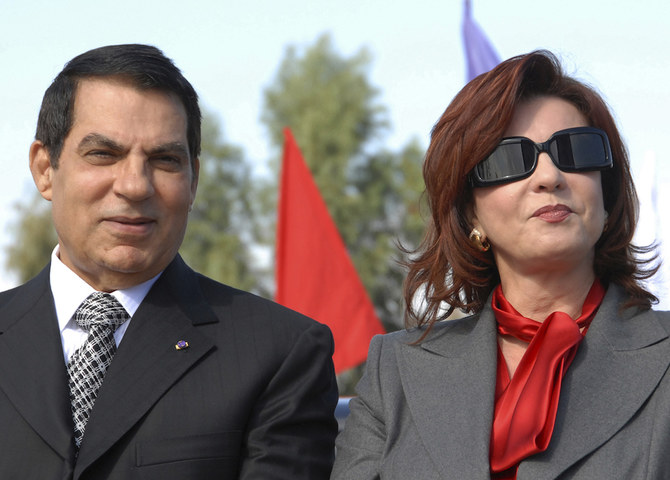
Ben Ali and his wife Leila mark the 20th anniversary of Ben Ali's presidency, in Rades, outside Tunis in 2007. (AP)
2 / 10
Tunisia's President Zine al-Abidine Ben Ali waves to supporters after he took the oath at the national assembly in Tunis November 12, 2009. (Reuters)
3 / 10
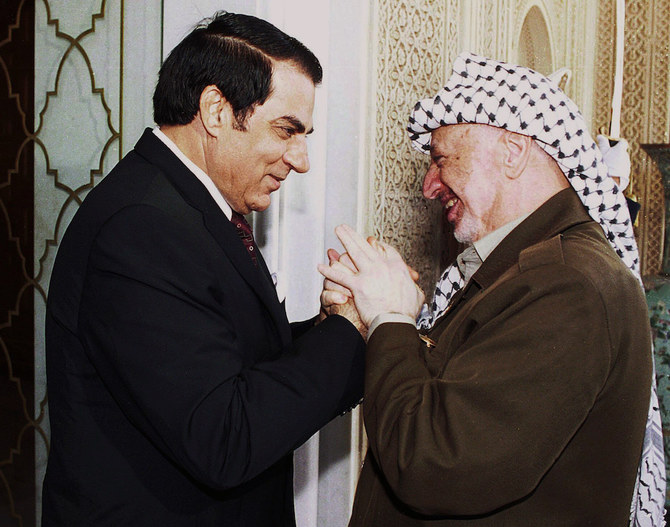
Ben Ali welcomes Palestinian leader Yasser Arafat prior to their talks in Tunis in 2001. (AP)
4 / 10
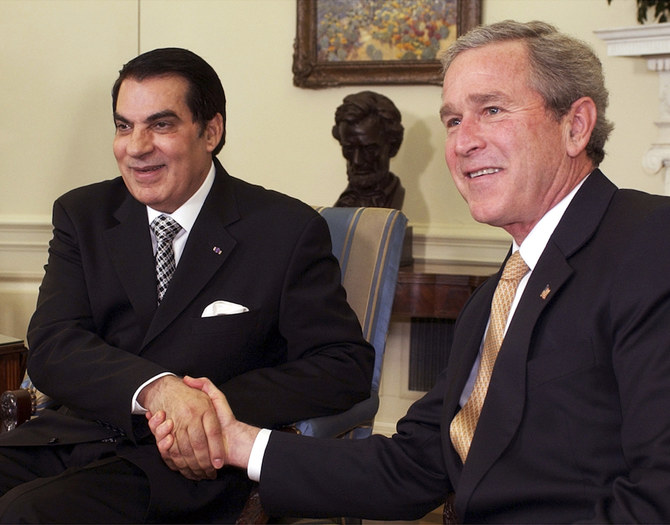
President Bush shakes hands with Ben Ali in the Oval Office of the White House in Washington in 2004. (AP)
5 / 10
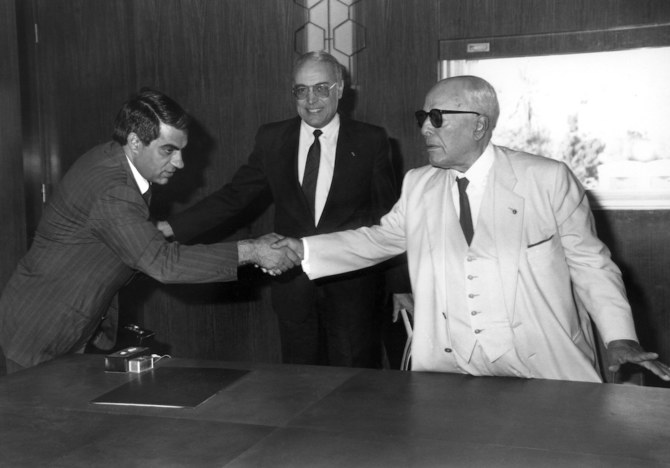
Former Tunisian President Habib Ben Ali Bourguiba (R) shakes hands with his then prime minister Ben Ali (L) in 1986. (AFP)
6 / 10
Ben Ali waves to the crowd upon arrival in Rades stadium where he delivered his speech on the 50th anniversary of independence of Tunisia from France in 2006. (AFP)
7 / 10
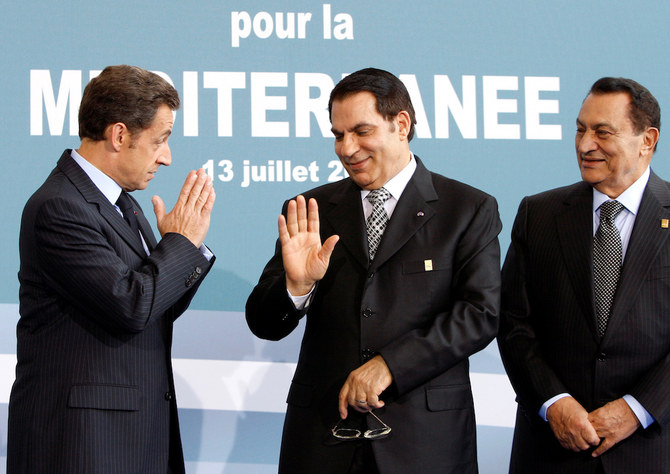
Ben Ali (C) is greeted by France's President Nicolas Sarkozy (L) and Egypt's President Hosni Mubarak as he arrives at the EU-Mediterranean summit in Paris, July 13, 2008. (Reuters)
8 / 10
Ben Ali poses for an official picture in front of the Tunisian flag in 1988. (AFP)
9 / 10
Ben Ali meets Libya's leader Muammar Qaddafi as they pose for a family photo during the third European Union-Africa summit in Tripoli in 2010. (Reuters)
10 / 10
Children welcome Tunisian President Ben Ali in 2008 as he arrives to a meeting marking the 21st anniversary of his accent to power in Tunis. (AP)
Updated 20 September 2019
Follow

Fallen Tunisian autocrat Zine El-Abidine Ben Ali dies

  • Ben Ali was the first of several Arab leaders to be driven from power during regional uprisings
  • Ben Ali ruled the North African country from 1987 until 2011

TUNIS: Former Tunisian president Zine El-Abidine Ben Ali, the first leader to be toppled by the Arab Spring revolts, died on Thursday in Saudi Arabia.
"We had confirmation of his death 30 minutes ago," Tunisia's foreign ministry said, without giving further details.
The 83-year-old's lawyer, Mounir Ben Salha, confirmed the news, citing family members and Ben Ali's doctor.
Ben Ali, who ruled his North African country from 1987 until 2011, was viewed by some as a bulwark against extremism, but faced criticism for muzzling the opposition and his reluctance to embrace democracy.
Eventually, growing frustration over unemployment and high prices snapped.
In late 2010, after a young trader died when he set himself on fire, protests erupted across the country and sparked a deadly clampdown.
Ben Ali fled Tunisia on Jan. 14, 2011 and sought exile in Saudi Arabia.
His rapid departure sparked a string of similar uprisings across the region, toppling Egyptian and Libyan strongmen Hosni Mubarak and Moamer Qaddafi.
The turmoil triggered what was to become Syria's devastating eight-year war.
In mid-2012, Ben Ali was sentenced in absentia to life in jail for his role in the deaths of protesters during the uprising that ousted him.
Ben Ali is survived by six children; three daughters by a first marriage and two daughters and a son by Leila Trabelsi.


Russian forces begin pulling out of bases in northeast Syria

Updated 28 January 2026
Follow

Russian forces begin pulling out of bases in northeast Syria

  • Despite having been on opposite sides of the battle lines during the civil war, the new rulers in Damascus have taken a pragmatic approach to relations with Moscow

QAMISHLI, Syria: Russian forces have begun pulling out of positions in northeast Syria in an area still controlled by the Kurdish-led Syrian Democratic Forces after the group lost most of its territory in an offensive by government forces.
Associated Press journalists visited one base next to the Qamishli airport Tuesday and found it guarded by SDF fighters who said the Russians had begun moving their equipment out in recent days.
Inside what had been living quarters for the soldiers was largely empty, with scattered items left behind, including workout equipment, protein powder and some clothing.
Ahmed Ali, an SDF fighter deployed at the facility, said the Russian forces began evacuating their positions around the airport five or six days ago, withdrawing their equipment via a cargo plane.
“We don’t know if its destination was Russia or the Hmeimim air base,” he said, referring to the main Russian base on Syria’s coast. “They still have a presence in Qamishli and have been evacuating bit by bit.”
A UN humanitarian convoy from Damascus reached Qamishli on Tuesday, UN spokesman Stéphane Dujarric said.
“It delivered food, warm clothes and blankets, among other supplies,” he told UN reporters. “More convoys are planned in the coming days.”
Dujarric said the UN is also continuing to distribute food, bread and cash elsewhere including displacement sites.
There has been no official statement from Russia about the withdrawal of its forces from Qamishli.
Russia has built relations with the new central Syrian government in Damascus since former President Bashar Assad was ousted in December 2024 in a rebel offensive led by now-interim President Ahmad Al-Sharaa — despite the fact that Moscow was a close ally of Assad.
Moscow’s scorched-earth intervention in support of Assad a decade ago turned the tide of Syria’s civil war at the time, keeping Assad in his seat. Russia didn’t try to counter the rebel offensive in late 2024 but gave asylum to Assad after he fled the country.
Despite having been on opposite sides of the battle lines during the civil war, the new rulers in Damascus have taken a pragmatic approach to relations with Moscow. Russia has retained a presence at its air and naval bases on the Syrian coast.
Al-Sharaa is expected to visit Moscow on Wednesday and meet with Putin.
Fighting broke out early this month between the SDF and government forces after negotiations over a deal to merge their forces together broke down. A ceasefire is now in place and has been largely holding.
After the expiration of a four-day truce Saturday, the two sides announced the ceasefire had been extended by another 15 days.
Syria’s defense ministry said in a statement that the extension was in support of an operation by US forces to transfer accused Daesh militants who had been held in prisons in northeastern Syria to detention centers in Iraq.