Israel’s Gantz says he should be PM in Israel unity government

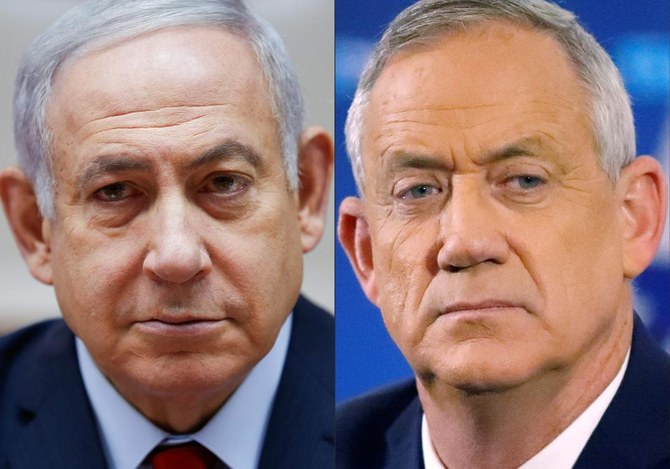
Netanyahu (L) is seeking to create a unity government with his main opponent Gantz (R) (AFP/Oded Balilty and Jack Guez)
Updated 19 September 2019
Follow

Israel’s Gantz says he should be PM in Israel unity government

  • Netanyahu earlier called for them to join together in a unity government as results from Tuesday’s vote
  • The change of strategy reflected Netanyahu’s weakened position

TEL AVIV: Benny Gantz, Israeli Prime Minister Benjamin Netanyahu’s main opponent in the country’s general election, said Thursday he should be prime minister in a broad unity government.
Gantz spoke to journalists after Netanyahu called for them to join together in a unity government as results from Tuesday’s vote showed neither with an obvious path to form a majority coalition.
A senior Blue and White leader Moshe Yaalon also told reporters at an event attended by Gantz: “We will not enter a coalition led by Netanyahu.”

Making the surprise offer, Netanyahu, head of the right-wing Likud party and Israel’s longest-serving leader, said in a video clip that in the run-up to Tuesday’s election, he had pledged to form a right-wing government.
“But to my regret, the election results show that this is impossible,” Netanyahu said. “Benny, we must set up a broad unity government, as soon as today. The nation expects us, both of us, to demonstrate responsibility and that we pursue cooperation.”
In subsequent comments, at a ceremony — which Gantz also attended — marking the third anniversary of the death of Israeli statesman Shimon Peres, Netanyahu said his offer came with no preconditions. A smiling Netanyahu and Gantz warmly shook hands at the event.
Netanyahu hinted at a possible rotating premiership deal with Gantz, noting that Peres, a left-wing leader, had forged a coalition with conservative Yitzhak Shamir in which they rotated top office between 1984 and 1988.
Netanyahu’s comments reflected his heightened political vulnerability after again failing to security a parliamentary majority, following an inconclusive election in April.
President Reuven Rivlin, who commands wide respect in Israel in his largely ceremonial position, said he welcomed Netanyahu’s unity call. Under Israeli law, Rivlin taps a party leader to try to form a government after the final vote tally is in.
The campaigns run by Netanyahu, 69, and Gantz, 60, pointed to only narrow differences on many important issues, and an end to the Netanyahu era would be unlikely to bring about significant changes in policy on relations with the United States, the regional struggle against Iran or the Palestinian conflict.
With Israeli media reporting more than 95 percent of votes counted in Tuesday’s election, a Likud-led right-wing, religious bloc looked poised to control 55 of parliament’s 120 seats, with 56 going to a center-left alliance.
On Wednesday, Gantz said he hoped for a “good, desirable unity government.” But he has also ruled out forming one with a Netanyahu-led Likud, citing looming corruption charges against the prime minister. Netanyahu denies any wrongdoing.

“Mr Clean“
Gantz is a newcomer to politics. Many voters saw him as a “Mr Clean,” an alternative to Netanyahu and the cloud of alleged criminal misdeeds hanging over him.
Netanyahu’s call for a broad government preceded a scheduled visit later on Thursday by Jason Greenblatt, an architect of US President Donald Trump’s as-yet unveiled plan for Israeli-Palestinian peace.
Israeli cabinet minister Tzachi Hanegbi, a senior Likud member, said he believed Greenblatt was coming to discuss the peace blueprint.
Palestinians, who seek a state in the West Bank and Gaza Strip, with East Jerusalem as its capital, have rejected the Trump plan out of hand, accusing the president of pro-Israeli bias.
“As to whether he (Greenblatt) will be presenting the plan, I have no idea,” Hanegbi said on Army Radio.
With Israeli politics in flux, Netanyahu canceled his annual speech at the UN General Assembly next week, a spokesman said on Wednesday about a visit that might have provided an opportunity to meet with Trump.
Netanyahu highlighted his close ties with Trump in his election campaign. But in Los Angeles on Wednesday, Trump appeared to distance himself from Netanyahu, amid political stalemate in Israel.
He told reporters he had not spoken to Netanyahu since Tuesday’s ballot and said: “Our relationship is with Israel.”


As Iran conflict spills over, Iraq’s Kurds say ‘this war is not mine’

Updated 5 sec ago
Follow

As Iran conflict spills over, Iraq’s Kurds say ‘this war is not mine’

  • The Kurds, an ethnic minority with a distinct culture and language, are rooted in the mountainous region spread across Turkiye, Syria, Iraq and Iran
  • American bases there have come under fire, as have positions held by Iranian Kurdish parties — the same ones US President Donald Trump said it would be “wonderful” to see storm Iran

SORAN, Iraq: On a deserted road not too far from the border between Iran and Iraqi Kurdistan, Satar Barsirini looked up at the sky, now streaked with jets and drones.
Iraq’s Kurdish region has found itself caught in the crossfire of a regional war triggered by US and Israeli attacks on the Islamic republic.
Dressed like the Kurdish fighters he once served alongside, Barsirini still wears the khaki shalwar, fitted jacket and scarf wrapped around his waist.
Though recently retired, he refuses to give up his peshmerga uniform as he tills his small plot of land.
The rumble of jets and hum of drones “come from everywhere. Especially at night,” he told AFP in the hamlet of Barsirini, dozens of kilometers from the border.
He described the “shiver in our flesh” as the drones hit the ground outside.
“I feel bad for the people, because we have paid a lot in blood to liberate Kurdistan... We just want to live.”
Irbil, the autonomous region’s capital, and the valleys leading to the border have been targeted by Tehran and the Iraqi armed groups it supports.
American bases there have come under fire, as have positions held by Iranian Kurdish parties — the same ones US President Donald Trump said it would be “wonderful” to see storm Iran.
But Iran warned on Friday it would target facilities in Iraqi Kurdistan if fighters crossed into its territory.
“This isn’t my war,” said 58-year-old Barsirini.
He recalled the brutal repression and flight into the snowy mountains after the 1991 Kurdish uprising that followed the first Gulf War.

- ‘Dangerous people’ -

The uprising was repressed, leading to an exodus of two million Kurds to Iran and Turkiye.
“When we fled the cities for our lives, we went to Iran. They helped us, they gave us shelter and food,” he said.
The Kurds would not forget that, Barsirini stressed, adding that they could not just “turn against them” now to support the US and Israel.
“I don’t trust (Americans). They are dangerous people,” he said.
The Kurds, an ethnic minority with a distinct culture and language, are rooted in the mountainous region spread across Turkiye, Syria, Iraq and Iran.
They have long fought for their own homeland, but for decades suffered defeats on the battlefield and massacres in their hometowns.
They make up one of Iran’s most important non-Persian ethnic minority groups.
A week of war has gripped daily life in Iraqi Kurdistan, residents told AFP.
“People are afraid,” said Nasr Al-Din, a 42-year-old policeman who, as a child, lived through the 1991 exodus — “thrown on a donkey’s back with my sister.”
“This generation is different from the older ones” that have seen “seen fighting.”
Now, he said, you could be “sitting down in your home... and all of a sudden a drone hits your house.”
“We may have to go into town or somewhere safer,” said Issa Diayri, 31, a truck driver waiting in a roadside garage, his lorry idle for lack of deliveries from Iran.

- ‘Shouldn’t get involved’ -

Soran, a small town of 3,000 people about 65 kilometers (40 miles) from the border, was hit Thursday by a drone that fell in the middle of a street.
There, baker Yussef Ramazan, 42, and his three apprentices, hurriedly made bread before breaking their fast.
But, living so close to the Iranian border, he said “people are afraid to come and buy it.”
He told AFP he did not think it was a good idea “for the Kurdish region to get involved in this war.”
“We are not even an independent country yet. We would like to become one, but we are nothing for now, so we shouldn’t get involved in these situations.”
Across the street, Hajji watched from his empty dry cleaning shop as the road cleared.
Before the war, the town was crowded as evening fell, he said, declining to give his full name.
“But after the drone explosion, no one was here. In five minutes, everyone left the street and no one was out.”